

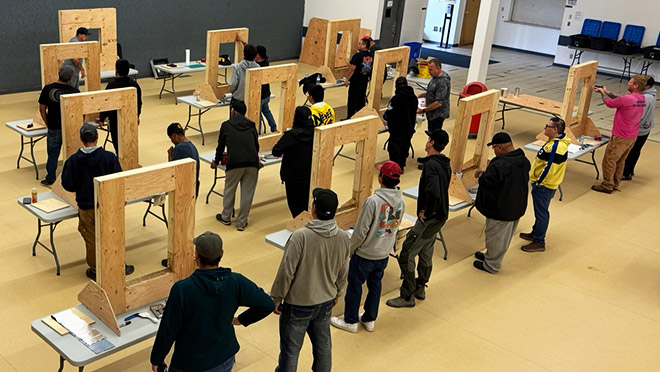
 Trainees in the First Nations community of Gitanmaax in northwestern B.C. get hands-on training in window installations as part of a BCIT-led high-performance building workshop.
BCIT brings high-performance building skills training to B.C.'s northwest
BC Hydro is helping the Gitanmaax Band deliver a suite of capacity-building initiatives in northwest B.C., including a three-day, in-person high-performance building envelope course delivered directly in the First Nations community this past summer.
The course gave the Band's housing staff and contractors the knowledge and practical skills to construct the envelope of wood-frame buildings to the performance requirements of the upper steps of the BC Energy Step Code. Delivered by the British Columbia Institute of Technology (BCIT), with coordination and funding support from BC Hydro, the Fraser Basin Council and Community Energy Association, the workshop brought hands-on learning to a community that's about a five-hour drive northwest of Prince George.
Gitanmaax sits near the meeting of the Skeena and Bulkley Rivers, adjacent to the village of Hazelton and 5 km west of New Hazelton. Like other First Nations in the northwest and northeast of the province, Gitanmaax had been underserved for high-performance building training, and travel to urban centres is a real barrier for community staff.
Energy advisor emerges as a local champion
Richard Joseph is BC Hydro's liaison at Gitanmaax, funded by the federally-supported Codes Acceleration Fund to act as the informal energy manager for the Band.
An energy advisor from the neighbouring Wet'suwet'en Nation community of Hagwilget, Joseph knows the Gitanmaax community well. He has been conducting housing energy audits in Gitanmaax with a target of evaluating 300 homes as part of a localized community energy plan. The audits align with the Gitanmaax Band's 2026 Housing Strategy, which centres on elevating local housing stock to stricter energy efficiency metrics. Recent work includes 10 newly-completed duplexes built to comply with the rigorous BC Energy Step Code.
Joseph said that when working with the Band to recruit registrants for July's high-performance building envelope workshop, BCIT's reputation was pivotal.
"BCIT's name carries a lot of clout, so once I put that out there, people opened up," said Joseph.
Capping enrollment to 24 participants was deliberate. Joseph said he learned from a comparable session in Terrace that drew more than 50 students, which proved challenging. With two BCIT instructors and Joseph, the smaller cohort benefitted with a lot more direct input.
Participants at Gitanmaax were mostly band maintenance crews and handypeople, along with a few Red Seal builders. Joseph said they all arrived with solid skills but learned a new approach to airtightness. The workshop centred on windows and the creation of a continuous air barrier.
"The old-school way is just to get a can of spray foam, spray the window gap, trim it down and call it done," said Joseph. "The new process with BCIT is a little more involved than that."
The workshop's hands-on training taught participants how to make a continuous air barrier around window and plumbing penetrations and how to test the air barrier and resolve deficiencies.
Joseph educated the workshop's students on the consequences of an incomplete approach to buildings, including moisture and mould risk if airtightness isn't matched with ventilation.
The workshop shows BC Hydro's partners pooling existing resources to advance workforce and community development in the North. Joseph's advice to other First Nations communities is to consider investigating funding options from multiple sources, citing funding from the CEA and Fraser Basin Council as good places to start.
 Tugce Conger, who started her role of climate lead with the City of Abbotsford this past January, on a family trip to Costa Rica.
Partner Q & A: Tugce Conger, City of Abbotsford
As Abbotsford grows faster than almost any other city in B.C., it's also grappling with extreme heat, aging buildings in need of energy-efficiency upgrades, and the challenge of reducing GHG emissions from vehicles. We sat down with the City of Abbotsford's new senior energy and climate action manager Tugce Conger, a native of Türkiye who earned her Ph.D in Resource Management and Environmental Studies at UBC, and worked with the City of Vancouver and the Fraser Health Authority before joining the City of Abbotsford this past January.
The following has been edited for brevity and clarity.
Powering Communities: What first drew you to B.C., and into climate resilience work?
Tugce Conger: While I was doing my Master's degree in Denver, Vancouver kept coming up as a leader in sustainability and climate action. I still remember a talk about the Olympic Village development—all the green infrastructure and rainwater reuse—and being really influenced by it. I also love the outdoors, so the idea of Vancouver always stuck with me. The actual move came when my partner was accepted into a PhD program at UBC.
PC: You spent more than five years in policy analyst and senior planner roles at the City of Vancouver. What did you learn there that you've brought to Abbotsford?
TC: I didn't have much local government experience before Vancouver, so it was a crash course in how cities actually work. Just as important was learning how to work across departments: parks, planning, different engineering teams. In climate work, you simply can't make meaningful progress in silos.
PC: Has B.C. lived up to your expectations around climate action, energy efficiency, and sustainability?
TC: In my experience, yes, we're ahead of many places. But there's a lot of work ahead. Sometimes I worry that we forget to celebrate the achievements along the way. Simple things like composting are good examples. For us, it's a day‑to‑day reality, and we take it for granted, but in many places, it's not even an option. The same is true for energy efficiency. We've seen significant growth in technologies such as heat pumps, higher building performance standards, and energy-efficient construction practices. These may not always make headlines, but they represent meaningful progress and are helping to reduce emissions, lower energy costs, and improve climate resilience.
PC: In Abbotsford, how big a role do buildings and residential retrofits play in your climate work?
TC: Buildings play a critical role in our climate work. Like most fast‑growing communities, they're the second largest source of community greenhouse gas emissions—around 41% of our total. They also represent one of our biggest opportunities to reduce emissions by improving energy efficiency and building performance. Measures such as better insulation, higher-performance building standards, the growing adoption of heat pumps, and the potential use of renewable energy can significantly reduce energy consumption while improving comfort, affordability, and climate resilience. Our Climate Resilience Strategy, unanimously approved by our Council in July, gives residential retrofits renewed prominence through dedicated actions under Big Move 5: Enable Low-Carbon, High-Performance Buildings. We also have a strong corporate focus, where we're continuously looking for opportunities to improve the energy efficiency of our buildings and operations, and explore renewable energy solutions. This is driven by our desire to lead by example. We can't ask residents and businesses to invest in retrofits, improve energy efficiency, reduce GHGs, or prepare for extreme heat if we're not taking those same steps within our own facilities.
PC: Extreme heat is now a major concern in B.C. How is that changing how you think about buildings?
TC: Our building stock—both single‑family and multi‑unit—is aging. Cooling has become a much bigger part of the conversation, especially as we experience more frequent and intense heat events. We're looking at everything, from actions within City's control to areas where the City can influence change. This includes supporting the community in improving existing buildings and helping residents transition to more resilient, energy-efficient homes. For example, we encourage heat pump retrofits, which can provide efficient heating and cooling while reducing emissions.
PC: Transportation is another big lever, with 52% of Abbotsford's GHG emissions coming from vehicles as of 2022. What role do EVs and zero‑emission mobility play in Abbotsford, where EV adoption has increased but where only about 1 in 20 registered vehicles are electric?
TC: While approximately 5% of vehicles registered in Abbotsford were electric vehicles (EVs) in 2025, the share of EVs in new vehicle sales increased from 11.6% to 17.2% over the five-year period from 2020 to 2024. This number is highly sensitive to federal and provincial EV regulations and financial incentives. As a result, we view achieving our zero-emission mobility goals as a shared responsibility among all levels of governments, BC Hydro, and the industry. Our role as the local government is to help create the conditions needed for this transition by supporting the expansion of charging infrastructure and applying an equity lens to ensure residents without access to at-home charging have convenient options at work and in the community, including through expanded EV-ready requirements in commercial and industrial areas.
PC: You live in Port Moody and commute to Abbotsford. How is that working out?
TC: I enjoy the drive and the views of the mountains and rolling hills of the Fraser Valley. I've also finished off many audiobooks and podcasts I'd been putting off for years. We have two cars—one full EV and one plug‑in hybrid. Between my three days a week commuting to Abbotsford and my husband's two days commuting to Vancouver, our total charging cost is about $75 a month. My round‑trip to Abbotsford costs about $1.75 in electricity. Compared to gas vehicles, the difference is incredible. Of course, that's only possible because we can charge at home, and that's not true for everyone. So again, it reinforces how important at‑home charging, workplace charging, and public infrastructure are if we want more people to make the switch.
PC: The Abbotsford Recreation Centre heat recovery and optimization project has won provincial awards and delivered big savings. What stands out to you about that project?
TC: The project originated from a BC Hydro-funded energy study conducted four or five years ago that identified an opportunity to connect three heating systems that were operating independently. The solution was to integrate them using heat recovery chillers, allowing waste heat generated in one area of the facility to be captured and reused to heat other parts of the recreation centre. What impresses me most is not only the technical solution, but also the process behind it. There was strong project management involvement from the early design stages, along with a high level of collaboration among the project team. The project was delivered around $2 million under budget, and our utility monitoring consultant has already observed measurable improvements in the facility's energy performance just months after completion.
PC: What have you learned from that project that you can apply elsewhere in Abbotsford?
TC: The scale of energy and emissions reductions you can achieve when system optimization, energy efficiency, and greenhouse gas reduction are considered together from the start.
PC: You'll be at BC Hydro’s Powering Communities Fall Ideation workshop this year. What are you hoping to get out of it and bring back to Abbotsford?
TC: I'm really looking forward to it. I inherited a couple of projects that came out of earlier ideation rounds—community solar work and the BCIT air‑tightness micro‑credential—so I've seen firsthand how those workshops can turn ideas into real programs.
PC: Tell us more about the air-tightness micro-credential.
TC: We're partnering with Richmond, New West, and Surrey along with BCIT and BC lHydro to offer eligible sub trades what's basically a free course that's subsidized, including taking time off for this course. We're removing barriers for participation and learning, helping participants develop the skills needed to deliver or build more energy-efficient buildings while building local capacity to support the transition to high-performance construction.
 A trade show is part of the Home Performance Contractor Network Forum, and the 2026 event in Kamloops featured more vendors than ever before.
A big turnout for first interior stop for HPCN Forum
It was billed as a chance for more B.C. contractors from beyond southwestern B.C. to get in on what has become a popular event. And the first regional Home Performance Contractor Network Forum, held in June in Kamloops, did exactly that.
Buoyed by a more central location and some $10,000 in travel subsidies, the forum attracted more than 220 registrants: 62% from central and southeast B.C., 26% from the Lower Mainland, and 6% each from northern B.C. and Vancouver Island.
"A lot of contractors from the northern and central part of B.C. aren't able to come down to Vancouver for a forum," said Tony Ceh, a BC Hydro program specialist who works with residential contractors to deliver energy efficiency and solar rebate programs to homeowners. "And they don't have as many resources in the smaller towns where they operate. One of the forum's top accomplishments was simply being able to connect with contractors we don't normally get to meet with because they're spread around the province."
The Home Performance Stakeholder Council is a not-for-profit society that supports the growth of the home performance industry in British Columbia. Membership in the contractor network, known as the HPCN, is a mandatory eligibility requirement for select rebates from BC lHydro, CleanBC, FortisBC, and Pacific Northern Gas. Funded in part by BC Hydro, the forum is co-hosted by the HPCN and the Community Energy Association (CEA).
The large turnout for the 2026 event, which included the event's biggest ever trade show, has underlined the need for more regional events in the future. Enthusiastic contractor feedback—95% of survey respondents rated their likelihood of attending another Interior event as 4 or higher on a 5-point scale—also demonstrated an appetite for sector-specific events down the road.
The HPCN network represents retrofit professionals in B.C. who offer services in windows and doors, heating, cooling and ventilation, insulation, general retrofit, energy advisors, along with solar and battery expertise.
What happened at the 2026 forum
The forum is designed to increase awareness of retrofit best practices, available resources, industry trends, and program opportunities. Contractor-led presentations, panel discussions, and interactive sessions were particularly effective in supporting professional learning and knowledge exchange.
The event also strengthened relationships among contractors, industry organizations, training institutions, utilities, and program administrators, contributing to broader sector capacity-building objectives and fostering greater collaboration across the retrofit industry.
"The topics of best-practice installation and energy efficiency aren't discussed much elsewhere in the industry," says Ceh. "The forum is unique in that way: it's an opportunity to focus on the best-practice and efficiency aspects of heat-pump installation. I think that's one of the big draws for contractors because that focus isn't really available elsewhere."
The forum is not, however, all about heat pumps. There's a growing interest in solar and battery technologies as BC Hydro now offers rebates for homeowners who want to add renewable energy and storage systems to their homes.
"The solar and battery offering was still so new, and the HPCN membership category was only months old, yet about 10% of the attendance was from solar-and-battery firms," said Ceh. "That's a really good indicator of future interest and the building momentum the event will have for solar and battery."
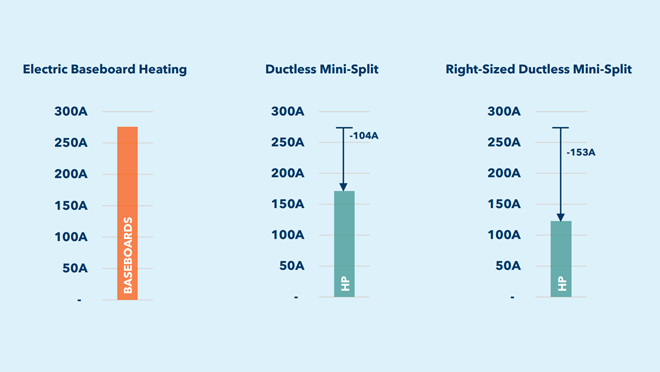 Excerpt from a new guide shows an analysis of how a 30-suite residential building could use right-sized heat pumps to decrease heating loads at the building’s main service.
Power efficient design guide for MURB retrofits offers insights, strategies
With heat pumps, electric hot water heating, electric cooking, and EV charging on the rise, multi-unit residential buildings (MURBs) are facing increasing power demands. A new guide provides the context for these changes and details how power efficient design (PED) can defer or avoid costly upgrades to existing infrastructure.
Prepared by Dunsky Energy + Climate advisors for the BC Retrofit Accelerator, the Retrofit Planning & Design Guide for Multi-Unit Residential Buildings [PDF, 1.83 MB] is the result of a partnership between the Zero Emissions Innovations Centre (ZEIC), BC Hydro and Metro Vancouver. The guide dives into PED strategies for existing MURBs and is intended to provide actionable insights to engineers, contractors, energy advisors, property managers, and other stakeholders involved in electrification projects.
The guide outlines how MURB costs to upgrade utility services and shared electrical infrastructure can range from between $1,000 to $5,000 per suite. It lays out how proactive planning using PED strategies allows buildings to maximize existing capacity to save significant capital and time.
Part 1 of the guide looks at what's driving electrification, an overview of building systems, and how MURBs can plan for electrification and power efficiency.
Part 2 looks at PED strategies including optimizing load calculations, efficiency and right-sizing, energy management systems, and onsite energy storage systems.
Retrofit Planning & Design Guide for Multi-Unit Residential Buildings [PDF, 1.83 MB]
News from BC Hydro and our communities
- Power Smart 2.0, BC Hydro's energy efficiency plan
- Step-by-Step Guide: Implementing Building Energy & Carbon Reporting Requirements [PDF, 4,6 MB] (Community Energy Association)
- Momentum 2026: The Future of Buildings is Electric (B2E)
- All-electric Surrey school is a hit with students, staff
- North Coast Transmission Line breaks ground to power economic growth