
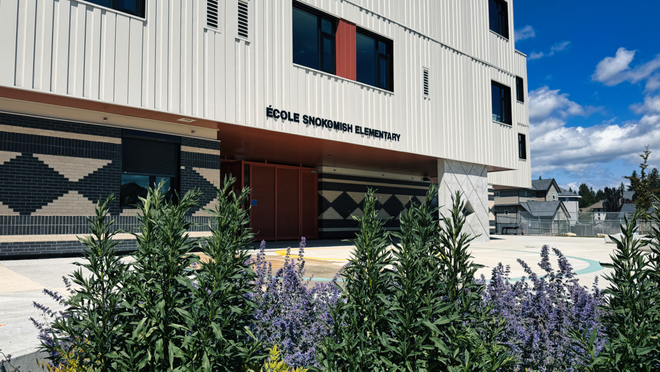
 Surrey’s all-electric École Snokomish Elementary is a three-storey building that maximizes outdoor space, including an interior courtyard that serves as a space for both play and instruction.
École Snokomish Elementary big on design, views, outdoor space
Part of our series on Power Smart Champions: businesses, homes, and institutions—large and small—recognized for their efficient use of electricity and reduction in their reliance on fossil fuels.
One day you're a kid worrying about changing schools, even though your current school is crowded and your classroom is a portable. The next day, you get a sneak peek at your new home—three storeys high and unlike any school that you, or your parents, have ever seen. This is next level.
École Snokomish Elementary in Surrey has 27 classrooms for 655 kindergarten to Grade 7 students. Built with First Peoples Principles of Learning in mind, it's designed like an Indigenous wheel—around a multi-use inner courtyard. Instead of being spread out, it's stacked to shrink its footprint and allow for more outdoor space for play and perks, including garden plots where kids learn to grow vegetables.
The school is also all-electric, with heat pumps and electric boilers instead of natural gas-fuelled systems. And it just looks and feels different.
"We pulled kids from each of four schools because they were over capacity," says Laura Grills, principal of Surrey's newest school, which opened in January 2026. "When they came and saw the site, they were blown away. They felt like, 'Oh my gosh, we're in this beautiful space and it feels like we're in a high school'. It's bright, it's airy. There's truly not a bad view from anywhere in the school."
The school delivers on Surrey School District's need to find more space for a growing student population while reducing GHG emissions, energy costs, and maximizing the use of increasingly expensive land. Surrey's average elementary school produces 77 tonnes of GHG emissions, while recently-built schools with heat pumps produce about 35 tonnes a year. Emissions at Snokomish are expected to produce just five tonnes per year.
That's because Snokomish is the first in the district to move away from fossil fuel-fired boilers and opt for electric.
"Heat pumps take care of a good chunk of the heating in moderate winter temperatures," says David McKee, Surrey School District's manager of energy management and sustainability. "The part that was missing was the cold weather heating, so that's where we've replaced natural gas boilers with electric boilers. Typically around 85% of the natural gas used in a school is for space heating. So being able to knock out that extra bit there really made a big difference."
Did you know? The name "Snokomish" was gifted by the Semiahmoo First Nation to honour an Indigenous community that thrived near the Serpentine and Nicomekl rivers before survivors joined the Semiahmoo and Kwantlen peoples.
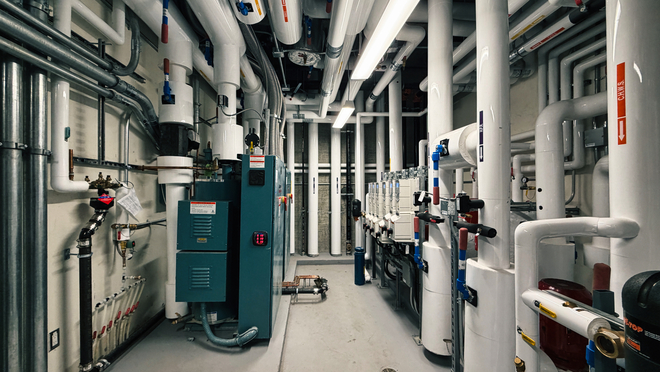 The average school in Surrey produces 77 tonnes of GHG emissions per year. Heat pumps and electric boilers in the all-electric École Snokomish Elementary will help limit emissions to an estimated 55 tonnes annually.
Energy smarts and a great place to learn
The school's design was informed in part by a CleanBC-funded energy study and, as an all-electric school, it qualified for a 10% bonus incentive. It demonstrates how climate goals—an anticipated GHG reduction of 89% compared to LEED Gold baseline building—can be achieved within public-sector budgets.
Each floor of the school features something different, from multipurpose rooms on the bottom to makerspaces on the top, as well as a music room, library, breakout spaces, a gym with floor-to-ceiling windows, and a Neighbourhood Learning Space for daycare and before and after school care. Occupancy and daylight sensors ensure that energy for lighting isn't wasted.
"I've been in the district for a long time—I'm starting my 36th year," said Principal Grills. "I have never been in a gym that has floor to ceiling windows as a corner, and it's spectacular."
Grills says teachers got to choose which space in the building they wanted to teach from. And they had some intriguing choices. One side looks out to the North Shore mountains, another east to the Fraser Valley and Mount Baker, another south to Mount Baker, and to the west, greenspace, a view to a playground and Goldstone Park.
"Our staff is big into outdoor learning, so they're outside a lot," says Grills. "Our centre courtyard is used every day, and it's an amazing space. Teachers are in there all the time and the kids love it, along with the outdoor play spaces."
So far, the courtyard has been used for a variety of student activities parents might never have imagined:
- A grade 7 sleepover camp, in tents, complete with s'mores on a barbecue.
- A Vaisakhi lunch, a vibrant Punjabi celebration of the spring harvest, featuring traditional Punjabi vegetarian dishes.
- A gravitron STEM event, where kids built race cars and rocket-type vehicles out of recyclable materials and tested them in the courtyard.
- Art and math in the courtyard: "It's just sort of an extension of the classroom," says Grills. "It's a safe enclosed space, so the little ones can also be out there. Every morning kids playing, floor hockey or soccer, and I have to say to them, as long as the ball doesn't hit the windows, you can keep playing."
Indigenous education staff in the school district served on a steering committee that recommended the "circular" design of the school that avoided "trapping" students at the end of hallways.
"By having the building as more of a circle, there's the perception of there always being a way out," says Dave Riley, executive director of the district's capital project office. "You don't feel trapped anywhere. It changes from an institutional feeling to more of an open, welcoming feeling."
In his role, Riley manages new schools planning and makes funding applications to B.C.'s education ministry. With budget challenges looming large in school districts, he likes what he sees at Skokomish Elementary.
"The final cost was roughly $60,000 per seat, and that's pretty typical for elementary schools," says Riley. "Capital cost wise, it's comparable to any other school we're building."
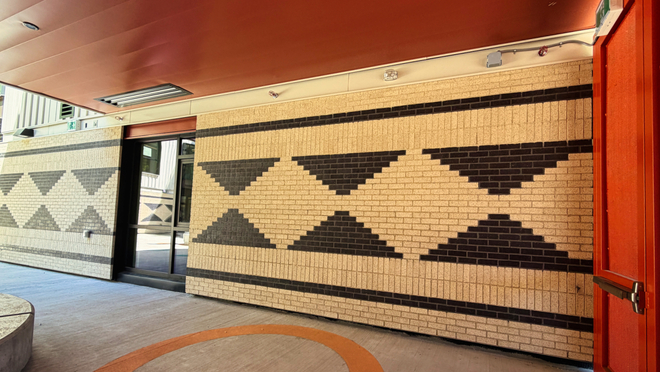 Indigenous Learning Principles informed the design, which features an interior courtyard inside a "circular" building that avoids "trapping" students at the end of hallways.
Heat pumps now the go-to at Surrey schools
Surrey School District has set GHG emission targets aligned with provincial goals, aiming for a 40% reduction by 2030 compared to a 2010 baseline. One key weapon in decarbonizing is relying on our clean, renewable electricity to electrify HVAC systems in schools. Even before Snokomish Elementary was built, the district had used heat pump installations to produce a 40% drop in GHG emissions at individual schools.
"It's a focus in my work to achieve greenhouse gas reductions across the district," says McKee. "We're growing fast, so every time we add a building, it's a challenge to meet our [emission] targets. If we're going to achieve our targets, we need to ensure that any new school that comes on board doesn't significantly add to emissions."
The effects of climate change—not just climate action—has also been taken into consideration. Where cooling classrooms wasn't a priority until very recently, heat pumps now provide that option.
"Cooling is a huge upside for us and benefits the building and occupants," says McKee.
What are the chances of more fully electric schools being built in Surrey? McKee and Riley are hopeful that will happen, but a lot will depend on the continued availability of energy efficiency and decarbonization incentives. There's no other fully electric school currently on the books in the district, but the district continues to use heat pumps wherever possible, including in the many additions it's making to existing schools.
The district's Capital Project Office currently has 11 additions in various stages of progress. Earlier this year, the Surrey Board of Education approved the district's 2026-27 five-year capital plan, requesting $5.7 billion from the Ministry of Education and Child Care for 76 major capital projects to address the ongoing need for more student spaces.