
Skip to content

Future capacity planning

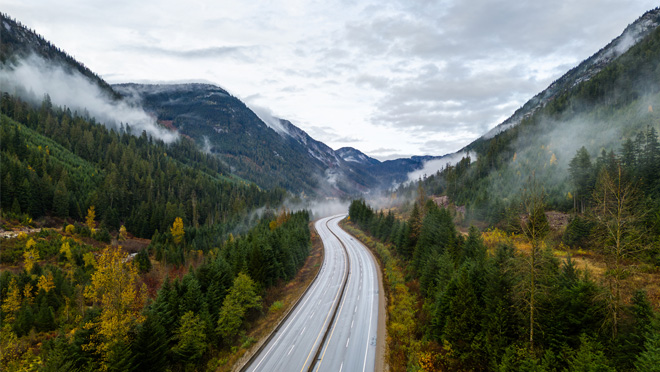
Road in the middle of the valley.

Investigating new large hydroelectric potential

For more than 60 years, hydroelectricity has been at the heart of how we power British Columbia. The large hydro projects built between the 1960s and 1980s still form the backbone of our system today, reliably powering homes, businesses and communities across the province.

To ensure we can continue to meet the long-term electricity needs of the province, we’re investigating the potential for new large hydroelectricity projects as a part of our Powering Growth Strategy, along with other options to add capacity to our system. This work doesn’t represent a decision to proceed with these projects. Instead, it’s about gathering the information needed to make well-informed decisions on how best to meet the province's future energy needs.

Projects we're investigating

Two large hydro sites are currently being considered: Site E on the Peace River and the Homathko River system on the central coast of B.C. on the Bute Inlet.

  • Site E: Located on the Peace River, approximately 60 kilometres from the recently completed John Horgan Dam and Generating Station (formerly Site C), the potential Site E project would take advantage of existing reservoir storage to expand capacity in the region. Early estimates suggest it could provide up to 750 megawatts of generating capacity and produce roughly 3,000 gigawatt hours of energy each year. 
  • Homathko River: The potential Homathko River project, near the Bute Inlet – approximately 250 kilometres northwest of Vancouver, would consist of up to four dams and three powerhouses, and depending on the configuration could provide about 500 to 900 megawatts of capacity and 3,000 to 4,500 gigawatt hours of energy annually. An adjacent river system (Southgate) is also being considered for an additional 200 megawatts of capacity. Transmission lines connecting the potential project site to the provincial grid at Williams Lake and Vancouver Island will also be investigated.

These sites were identified based on their potential to provide significant, dependable capacity and reliable, on-demand power that wind and solar alone cannot consistently deliver, particularly when demand for electricity is highest (peak demand periods).

Potential large hydro sites map

Why we’re investigating large hydro now

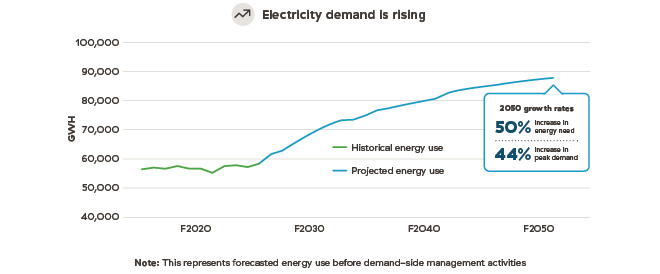
Looking ahead to 2050, B.C.’s electricity demand is expected to increase by 50%, including a 44% increase in peak demand, driven by electrification and economic growth.

Rising electricity demand graph

Along with increasing energy demand is a growing need for capacity. Think of the power system as a highway:

  • Capacity is the number of lanes available during rush hour. 
  • Energy is the total number of cars that travel the road over time. 
  • A highway might move a lot of cars overall, but without enough lanes it still gets congested during peak times. 

Electricity works the same way. Even with enough energy overall, we still need sufficient capacity to deliver power during periods of peak demand, when reliability matters the most. Large hydroelectric facilities are valuable capacity for B.C. because they are available during the electricity system's winter peak when other renewable energy is not providing as much capacity.

Large hydro development process

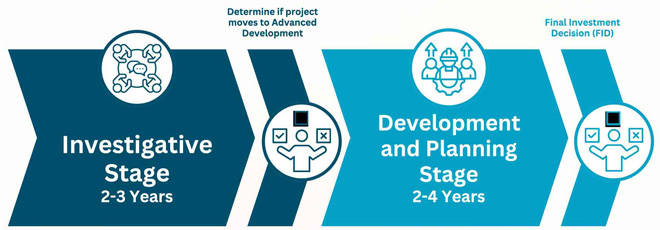
The development process is structured around two stages: the investigative stage and the development and planning stage. The process is designed to thoroughly assess the potential projects and confirm whether they meet the necessary technical, environmental, economic and social requirements to proceed to the next stage.

At the end of each stage, we, along with the Government of B.C. will review the findings and decide whether to proceed, adjust, pause or stop. The development process may also be paused, extended, or stopped at any time during a stage for a number of reasons, including if information indicates that a project is not feasible, if more information is needed, or if a decision is made to pursue another capacity resource option.

Investigative timeline

Investigative stage

During the investigative stage, we’ll:

  • Engage and consult with potentially impacted First Nations, the public and interest holders 
  • Update technical and design work from prior studies 
  • Identify and assess project risks and information gaps 
  • Update planning stage cost information 
  • Identify potential job and procurement opportunities should the project proceed to future phases 
  • Apply for the permits required to undertake site and field investigations (if enabled by Clean Energy Act changes) 
  • Conduct field investigations and environmental studies (if enabled by Clean Energy Act changes) 

Development and planning stage

If one or both projects proceed to development and planning, the following activities would be undertaken over the next two to four years:

  • Ongoing consultation with impacted First Nations 
  • Ongoing public and interest holder engagement and consultation 
  • Advancing engineering and project design 
  • Submitting an Environmental Assessment application (if enabled by Clean Energy Act changes) and completing the environmental assessment process 
  • Initiating market sounding and limited early procurement activities to support decision making 
  • Developing a permitting approach for construction permitting 
  • Developing a project plan and supporting plans for project implementation 
  • Updating cost estimates and completing a full business case based on conditions of environmental certificate (if approved) 

At the conclusion of the development and planning stage, the findings will be reviewed to determine if the project(s) are ready for a final investment decision.

Working with First Nations and communities

Engagement with First Nations, local communities and interest holders is critical to understanding whether these projects are technically, environmentally, socially and economically feasible.

For the Homathko River project, we’re committed to working collaboratively with the Homalco Nation as they proposed the project during the Request for Expressions of Interest for Capacity process in 2025. We’ll also collaborate with other potentially impacted First Nations. Any involvement will be structured around a framework that respects Indigenous rights and interests while also being mindful of the long-term public interest of B.C. residents.

FAQs

  • We are embarking on the investigative stage to understand the viability of both projects and evaluate them against other capacity resource options. 
  • We do not yet know whether either project, both projects, or another capacity resource will prove to be the best option for British Columbia. 
  • Alongside investigating these projects, BC Hydro's energy planning teams will continue to assess the province's future needs for energy and capacity to inform decisions on how much additional capacity is required and when it will be needed. 
  • No decisions have been made regarding future development.

  • It is important to begin engaging with potentially affected First Nations, local governments, communities and stakeholders early in the investigative stage, before any decisions are made. 
  • Early engagement provides an opportunity for people to hear directly from BC Hydro, ask questions, share local knowledge and better understand what the investigative process involves. 

  • BC Hydro has made available the historical feasibility report for each of the Site E and Homathko projects. These reports were prepared as part of investigations undertaken in the 1970s and 1980s and provide background on how the projects were evaluated at that time. 
  • You can access the historical feasibility reports here: 
  • These documents are being made available solely for background and informational purposes. They reflect the technical, environmental, policy, regulatory and economic context at the time they were prepared and may be incomplete, preliminary, superseded or based on assumptions that are no longer current. 
  • Accordingly, these documents should not be interpreted as representing BC Hydro's current views, assumptions, analyses, plans, risk assessments or project designs. BC Hydro is updating historical investigations to reflect current engineering standards, environmental information, regulatory requirements, Indigenous rights considerations, project costs and the needs of today's electricity system.

  • BC Hydro has taken important learnings from the John Horgan Dam and Generating Station experience, including the importance of: 
    • early, transparent First Nations and community engagement; 
    • thorough environmental assessment; and 
    • rigorous cost estimation. 
  • These learnings will be incorporated into the Investigative Stage and, if approved to proceed, the Development and Planning Stage. 
  • The staged development process is specifically designed to ensure that projects of this scale only advance when they meet the necessary requirements including technical, environmental, and economic requirements.

  • If BC Hydro and the Province determine that a project should continue, it would move into the development and planning stage. 
  • The Development and Planning Stage is expected to take approximately two to four years. 
  • Activities during this stage would include: 
    • Ongoing consultation with impacted First Nations. 
    • Ongoing public and interest holder engagement and consultation. 
    • Advanced engineering and project design. 
    • Submission of an Environmental Assessment application (if enabled by Clean Energy Act changes) and completion of the environmental assessment process. 
    • Development of a permitting approach. 
    • Development of a Project Plan and supporting implementation plans. 
    • Updating cost estimates and completing a full business case. 
  • At the conclusion of the development and planning stage, BC Hydro and the Province of B.C. will likely determine whether to proceed with a final investment decision.

Questions, comments or feedback?

If you have questions or comments about BC Hydro's investigation into potential new large hydroelectric projects, we'd like to hear from you.

If you are a local resident, property owner, community member or stakeholder and would like to share feedback on either the Site E or Homathko investigation, please complete our community feedback form. Your feedback will help inform our ongoing investigations and engagement activities.

General inquiries
capacityplanning@bchydro.com

First Nations inquiries
FirstNationsCleanEnergy@bchydro.com