

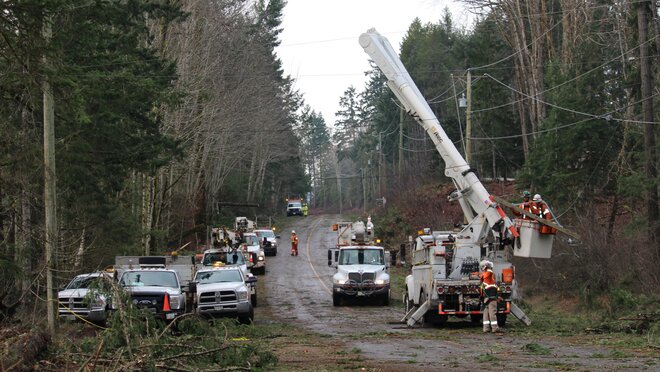
 Make sure you and your loved ones are prepared for emergencies and power outages. Take the time to put together a 72-hour emergency kit, along with portable grab-and-go bags.
A few steps now can make a big difference when severe weather strikes
Why worry? It's not going to happen to me.
No matter where you live in B.C., you should be ready for an extended power outage or a serious emergency, wildfire, flood, or earthquake, that could force you out of your home on short notice. So far this year, over 22,000 British Columbians were forced to evacuate due to wildfires, with thousands more under evacuation alerts.
As we go into winter storm season we all need to be prepared for power outages. While we restored power to 75% of affected customers in under 12 hours, and 90% of affected customers within 24 hours, during the record-breaking 2024 storm season, it remains important to always be ready for potential power outages.
The good news is that taking a few simple steps today can help you and your family be better prepared when the unexpected happens. Read on for a few things you can do to get started.
And because every household should have an emergency kit on hand, completing the form below will automatically enter you for a chance to win one. Looking for extra chances to win? Follow us on Facebook and Instagram for additional giveaway opportunities. [Contest rules]
1. Know the hazards and make an emergency plan
What's the plan if an earthquake hits and your household is spread around the community? If an emergency happens, does everyone know where to find the emergency kit? Often overlooked, an emergency preparedness plan is vital. It's recommended that you review it annually and whenever circumstances change — a move, new school, new job or new pet, for example.
Thinking ahead and creating an emergency plan will strengthen your ability to respond and recover. PreparedBC has a comprehensive guide and hazard map so you can know the hazards in your community.
Their Emergency Ready Planner also walks households through questions such as where they'll go if they need to evacuate, how family members will reconnect if they're separated, emergency contacts, medical information, insurance, utilities, pets, and local hazards. The finished plan can be saved electronically, printed and shared.
2. One kit helps you stay. One bag helps you go. You need both.
A 72-hour emergency kit is what you rely on when you have to remain at home during an extended power outage, earthquake aftermath, or other disruption to normal services. A grab-and-go kit is what you take when you need to leave quickly. PreparedBC recommends having these readily accessible at home, at work, and in vehicles as well because an evacuation may happen when you and your family members aren't home.
Both will require similar items so we recommend checking the full lists on PreparedBC. Your grab-and-go kit needs to be easy to carry so a good-sized backpack is a great option. Remember some essentials: water (at least two litres of bottled water per person per day for three days), flashlights, extra batteries, a battery-powered or hand-cranked radio, a whistle, a phone charger or power bank, first-aid kits and prescription medications, toiletries, including extra glasses or contacts and solution, cash in small denominations, extra house and vehicle keys, and copies of important documents, including your emergency plan. For the grab-and-go bag, remember to include extra seasonally-appropriate clothing, emergency blankets, a pen and paper, and additional items — such as a map with your family meeting spot identified. Don't forget items for all members of your household, including your pets.
Don't build the kits and bags and forget them. Put a calendar reminder in your phone once or twice a year to replace expired food, batteries, and medications, and to update documents.
3. Don't be caught in the dark during a power outage
Always be prepared and understand what to do before and after an outage, as well as in emergency situations involving downed power lines. If your power goes out:
- First check to see if the outage is limited to your home or business. If your neighbour's power is still on, check your circuit breaker panel or fuse box.
- Check our outage map or outage list first. If your outage isn't listed, report it online or call 1 800 BCHYDRO (1 800 224 9376) or *HYDRO (*49376) from a mobile phone. If you rent your home and don't have a BC Hydro account number, you can still report an outage over the phone. When you're prompted to share your account number, simply remain on the line and you'll soon be connected to an agent.
- Turn off appliances and electronics, especially those that generate heat. This helps protect your equipment and reduces the risk of overloading electrical circuits when power is restored.
- Keep your freezer and fridge doors closed:
- A full fridge can keep food cold for about four hours.
- A full freezer can keep food frozen for up to 48 hours; a half-full freezer will keep food frozen for about 24 hours.
- Make sure the kids know what to do as well. We have fun and interactive activities that teach kids how to be safe around electricity.
4. Know electrical safety during a flood
If flooding is expected, switch off the main electrical supply in your home before water enters the building — and only if it can be done safely. Then move portable electrical equipment out of flood-prone areas.
Water and electricity can be a lethal combination. Never enter a flooded area for any reason, including to shut off power.
Learn more about safety during and after floods
5. Be ready and safe in the case of an earthquake
Natural Resources Canada says that in B.C.'s highest-risk areas, there's at least a 30% chance over the next 50 years that there will be a strong earthquake capable of causing significant damage to some buildings, and B.C.'s Disaster and Climate Risk and Resilience Assessment estimates there's up to a 20% chance of a magnitude 9 Cascadia megathrust earthquake occurring off Vancouver Island within the next 50 years.
If a strong earthquake strikes, you won't have time to pack. As with all earthquakes, follow the "Drop, Cover, and Hold On" strategy, stay clear of windows and objects that could fall, expect aftershocks, check for injuries, and follow your emergency plan.
If you need to leave your home, take your grab-and-go bags. You have one for everyone in the household, right?
Everything you need to know about preparing for earthquakes
6. Know where to get information during emergencies
- We have comprehensive information on how to prepare your home and build a 72-hour emergency kit. You can also see maps and lists of current power outages at any time.
- EmergencyInfoBC provides current, verified emergency information, including evacuation alerts and orders. The site is updated around the clock.
- PreparedBC also offers planning, household kits, evacuation preparation, and hazard guides.