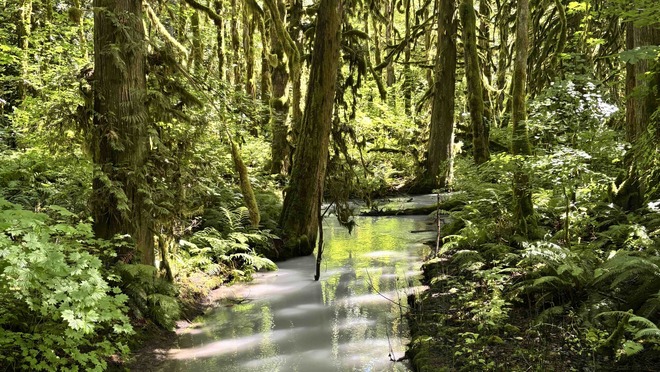
 A milky stream runs through the forest on the property of the Cheakamus Centre, which has been run by the North Vancouver School District as an outdoor learning centre and, more recently, as a place where older students can learn about energy-efficient building techniques.
A hit with kids, outdoor school has also trained youth on near net zero construction
Part of our series on Power Smart Champions: businesses, homes, and institutions — large and small — recognized for their efficient use of electricity and reduction in their reliance on fossil fuels.
For generations of North Vancouver students, a trip to Cheakamus Centre near Squamish has meant escaping the classroom to a very different kind of school.
They have slept in cabins and explored magical trails featuring 800-year-old cedars dripping with moss. They've learned about Indigenous culture and carried tiny salmon fry from a fish hatchery designed for students to spawning channels that wind through the forest like rivers of spilled milk.
For some children, a multi-night stay is their first extended trip away from home. Cathy Jenkins knows firsthand the power in that experience.
Jenkins is the fundraising and strategic partnerships manager at Cheakamus Centre. But her connection to Paradise Valley stretches back to the early 1970s, when she first arrived as a North Vancouver school kid. Her mother even kept a postcard Jenkins' sister mailed home from the outdoor school in 1971.
"A lot of these kids arrive nervous about staying here… and then don't want to go home," says Jenkins of a place that hosts about 12,000 people each year — a mixture of school kids, adult groups often on corporate retreats and recently, Indigenous youth enrolled in trades training.
While the forest, river, and salmon remain essential to the Cheakamus Centre experience, its aging cabins act as a living lab for energy-efficient construction. Through partnerships including BCIT, BC Hydro, and Indigenous training organizations, Cheakamus has emerged as a place where older teens and young adults can learn firsthand how to build better, more efficient, buildings.
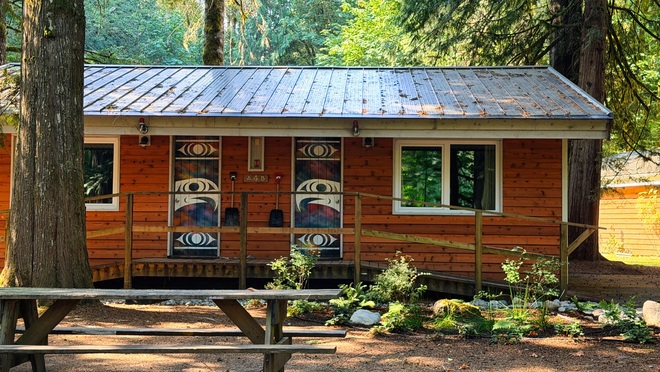 The renovated Cabin 4 at Cheakamus Centre, where Indigenous students got hands-on high-performance building training through a BCIT trades training program. The stunning art on the two doors is a design by Coast Salish artist Sinàmkin (Jody Broomfield).
A cabin becomes a classroom
There's a cabin at Cheakamus Centre that looks almost exactly like it did when it was built in the early 1970s. Just steps away sits an instructor's cabin, known as Cabin 10. And it's an entirely different thing.
The aging cabin has been transformed through a deep energy retrofit incorporating improved insulation and air sealing, upgraded ventilation, LED lighting, and a heat pump. Reclaimed wood was used inside, with BCIT students studying joinery contributing to the work. Outside, rain gardens help manage runoff from the cabin's roof.
In 2024, Cheakamus became the real-world construction site for Kílila, a skilled-trades training program for Indigenous youth. Kílila introduced participants to high-performance building science through training at BCIT's High-Performance Building Lab, followed by hands-on construction work on Cabin 10.
"Kilila is the Squamish word for "butterfly" and "transformation," said project coordinator Courtney Ellis-MacDonald in a video feature on the project. "We originally thought it was about the application of transforming a cabin, but we've been able to see the students transform before our eyes."
Kilila student Summer Hildibrand said she felt immense pride in helping rebuild the cabin and that she had never before seen an Indigenous instructor, let alone a female one. She was particularly inspired by the career path of Ellis-MacDonald, a Sayasi Dene First Nation member who is now a project coordinator with B.C.'s Aboriginal Housing Management Association.
Cabin 10 is the latest of six cabins that have been upgraded. The old cabin beside it will also be upgraded, but there's no specific timeline for it: Jenkins says there's an "endless job jar" on the 165-hectare property.
Buildings throughout the property tell the story of changing approaches to environmental design. The LEED Platinum BlueShore Environmental Learning Centre uses geothermal water heating, stormwater harvesting, natural light, and reclaimed timber. Its elevated "tree-house" design places visitors close to the forest canopy.
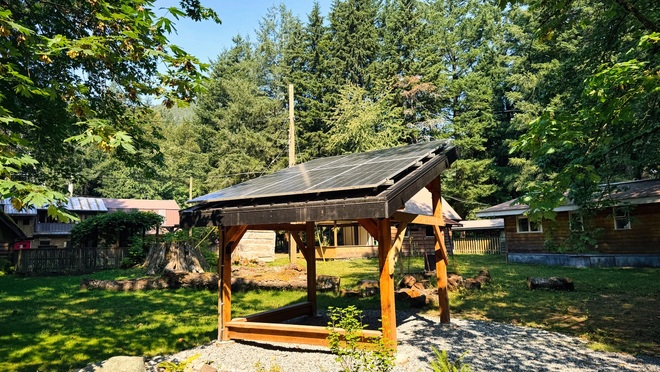 Indigenous students work alongside instructors to install six solar panels atop a gazebo next to Cheakamus Centre's Cabin 10. (Image courtesy ZEB Learning Centre at BCIT.)
Indigenous women install solar panels
At the foot of the Cabin 10 rain garden is a solar-roofed pergola that doubles as an outdoor learning space. Its three-kilowatt solar array showcases clean-energy technology for students of all ages and was built by Indigenous women learning electrical skills under the eye of experienced electricians. The trainees — through BCIT's ConnectHER Hub — came to Cheakamus for two days to work on the solar installation.
"It was pretty empowering," says Sherry Brown, a Squamish Trades and Training Centre student featured in a video on the solar project. "I've got to tell you the truth — I was so surprised to hear all these different women who owned their own businesses and who've been doing it for 5, 10, 15, 20 years."
The learning at Cheakamus Centre happens through the work itself, but also through mentorship, conversations, and relationships among Indigenous learners, instructors, and experienced tradespeople. Jenkins says the Centre offers a great opportunity to welcome others to learn, gather, and share in nature on land situated on the unceded traditional territory of the Skwxwú7mesh Nation. She notes that it's been a place of learning for the Chʼiyáḵmesh people for thousands of years.
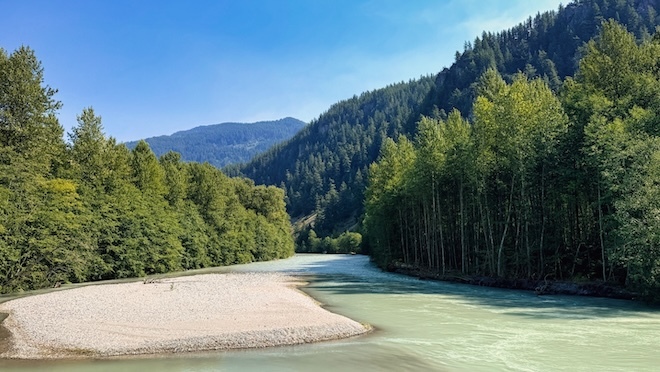 Cheakamus Centre sits alongside the lower Cheakamus River's Paradise Valley, an important salmon spawning area.
A Kiwi transplant envisioned the outdoor school
Cheakamus Centre was established as the North Vancouver Outdoor School in 1969 after education director Don Robertson, originally from New Zealand, championed the idea of getting students outside to learn.
The North Vancouver School District acquired the Paradise Valley property, partnering with the Nature Conservancy of Canada in an arrangement that helped protect its ecological values. It's a 165-hectare ecological preserve surrounded by forest and the Cheakamus River.
Spawning channels weave through the property as part of the Dave Marshall Salmon Reserve. The lower Cheakamus River's Paradise Valley is an important spawning area, particularly for chum salmon. In some years, more than 150,000 chum have spawned within four kilometres of Cheakamus Centre
Habitat restoration here dates to 1981, when Fisheries and Oceans Canada's Dave Marshall initiated the first salmon restoration project with what is now Cheakamus Centre. Over decades, Cheakamus has worked with Fisheries and Oceans Canada and partners including the BC Hydro-supported Fish & Wildlife Compensation Program, Squamish Watershed Society, and Squamish Nation to restore and enhance side-channel habitat.
Those quieter side channels of the salmon reserve provide refuge from winter flooding in the main river and habitat for chum, coho, pink, Chinook, and sockeye salmon as well as steelhead. Salmon, in turn, support the bald eagles that gather in the watershed.