

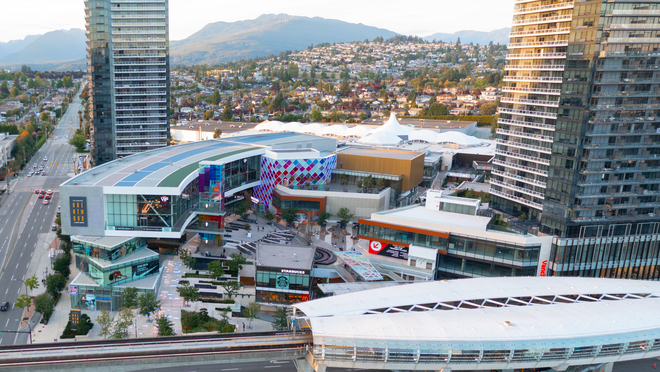
 The Amazing Brentwood mall complex is one of two Shape Properties developments in Burnaby, along with The City of Lougheed, to discover significant annual energy savings through BC Hydro's continuous optimization program.
The story of continuous optimization program at Lougheed and Brentwood
For SHAPE Properties, BC Hydro's continuous optimization (C-Op) program has become a key tool for turning : "new" malls into well‑commissioned, efficient buildings.
At The Amazing Brentwood and The City of Lougheed, SHAPE paired the experience of BC Hydro Alliance member SES Consulting with C-Op support to understand how their mechanical plants really operate once tenants are in, the food court is humming and real‑world loads are in play. What they found — and fixed — shows why both SHAPE and SES see C-Op as just as valuable for newer assets as it is for older ones.
"Honestly, I think it's one of my favourite BC Hydro programs," says Ben Wood, SHAPE's director of energy and sustainability. "For a lot of people who've been in energy management for a while, the easy low-hanging fruit is all gone. You need to look elsewhere, and I've found C-Op to be a great program that always finds a bunch of measures with a decent amount of savings."
The City of Lougheed is the new name for what is transitioning from a traditional shopping mall in northeast Burnaby to a multi-phased community with up to 23 high-rise residential towers. Energy savings from C-Op projects are an estimated 206,900 kWh of electricity and 120 GJ of fuel for $18,740 of cost savings annually. There's also a reduction of 8.4 tonnes of CO2 emissions each year.
The Amazing Brentwood, another commercial/residential development in Burnaby, is the more recent C-Op project. An SES investigation phase summary puts potential savings for initiatives that have been selected for implementation at 220,700 kW and 1,580 GJ of fuel. This would mean a total of $35,310 in annual cost savings. CO2 emissions savings are estimated to be about 81.3 tonnes per year.
Our C-Op program provides funding to have an approved service provider help customers improve the efficiency of their most energy-intensive systems. Through a retro-commissioning or recommissioning process, the focus is on identifying and implementing simple, low-cost solutions without having to undertake a major capital investment.
SES embraces the role of service provider on C-Op projects
At both Burnaby sites, SES acted as the C-Op service provider, effectively the engineering arm of the program.
"Our role as the consultant is to do the engineering piece." says Brad White, a professional engineer and president of SES Consulting. "We did the investigation to identify issues with the systems, worked with the SHAPE operations team to prioritize them and then supported them in making the recommended changes — right through to the final report to confirm everything is working as intended."
The role of SES includes:
- Detailed site investigation and data review
- Identifying and prioritizing issues with SHAPE's operations team
- Working with controls teams and contractors on programming changes
- Monitoring performance and documenting final savings
With C-Op experience dating back to pilot projects in 2008, SES sees Brentwood and Lougheed as part of a newer trend: applying C-Op not just to tired old buildings, but to recently built ones where initial commissioning leaves energy savings on the table.
"In both of these cases," White explains, "we're actually coming into newer facilities and using C-Op as an opportunity to almost finish the commissioning that didn't happen when they were built."
BC Hydro funding opens the door to savings, quick payback on investment
Both Brentwood and the redeveloped phase of Lougheed are relatively new. But the opportunities for cost savings through C-Op are many.
Large commercial projects are often rushed to meet opening dates. Systems are commissioned under partial tenant occupancy and incomplete loads. Years later, when the mall is finally at full tilt — often with a heavier mix of food and "experience" tenants that demand more cooling and outside air — there's rarely time or budget to go back and commission holistically.
C-Op fills that gap. It provides structure, funding, and a mandate to revisit controls, set points and sequences now that the buildings are operating under real‑world conditions.
"I think 10% is an achievable metric," SHAPE's Wood says when asked what typical C-Op energy savings might be. "And it's definitely lower cost than measures that involve capital equipment replacement."
C-Op funding through BC Hydro significantly trims simple payback dates on customer investment. At Lougheed, the average payback on four implemented projects was 2.4 years. At Brentwood, the average payback — if all nine recommended projects are implemented — is four years.
According to Wood, it all adds up to a pretty compelling case for the customer. He likes the combination of energy savings, short payback periods, and the relatively short project delivery time, which he estimates is 12 to 15 months.
White also sees C-Op as an easy sell that's pretty much irresistible.
"In most cases, the support from BC Hydro covers most or all of the consulting piece," says White. "And as a customer, you know you're only obligated to implement things that are two years payback or less, which again most owners are very happy to go ahead and do."
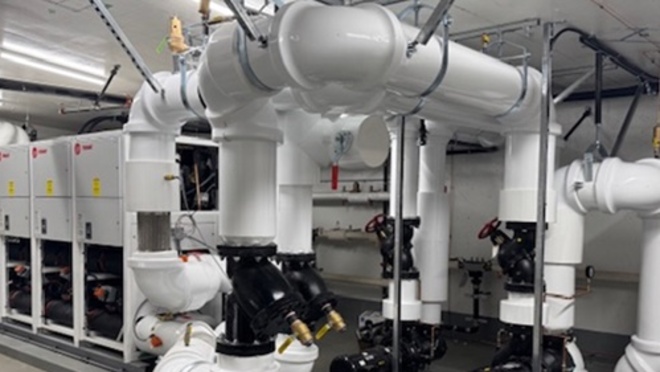 The timing for a continuous optimization study at Brentwood was perfect as it coincided with the integration of a new heat recovery chiller.
Two different projects, different measures
The two malls offered a useful contrast.
Brentwood is roughly 500,000 sq ft of retail with a larger, more complex mechanical plant. It has cooling challenges resulting from a tenant mix shifting toward energy‑intensive food and experience uses. Lougheed, much smaller at about 150,000 sq ft of retail in the newer phase, involved a smaller plant and a more straightforward control environment.
A defining feature of Brentwood's C-Op project was a recently installed heat recovery chiller. From SES's perspective, C-Op became the framework for integrating that new equipment into the broader system.
"What we've been using C-Op for is to realize that this piece of equipment doesn't just sit on its own," says White. "It affects how the rest of the mall operates and how we want to operate the rest of the mall."
For Wood, installing the new equipment while incorporating C-Op investigation was one of the project's biggest strengths.
"Piggybacking C-Op directly onto [the heat recovery chiller] really allowed us to look at how that new piece of equipment fit with the overall control strategy," says Wood. "We were able to push that piece of equipment beyond what was originally spec’d in the project proposal, and C-Op was definitely part of that."
Savings alone from optimizing the use of hot water supply (HWS) pumps at Brentwood are expected to save 138,500 kWh in electricity and 261 KW of demand annually. A whopping 1,212 KW are expected from demand management measures.
White describes C-Op at Brentwood as a chance to step back from a single capital upgrade and re-optimize the whole control philosophy of the mall.
"We're kind of leveraging a major upgrade and using C-Op to look at the bigger integration piece," says White. "The [heat recovery chiller] is a major change to how this building works."
Big wins from novel solutions at Lougheed
By contrast, the Lougheed project illustrates how C-Op can unlock substantial savings without major new hardware. A key to savings at The City of Lougheed is the parkade ventilation system.
Early on, the parkade fans were being run hard as a temporary fix for humidity and comfort issues related to the mall's grocery tenant, and that added significant heat to the shared space. Once a separate project addressed those root issues, SES used the C-Op to revisit the fan strategy, dialing down speeds and the hours of operation.
The result was a deep cut in parkade ventilation energy use. "We ended up saving two or three times more energy than what we initially expected on that venture," says White.
An engaged operations team is critical to success
The more involved your operations team is, the better things go, says Wood. He recommends including them in kickoff meetings, giving them a heads-up of what's coming, and avoiding "wholesale, overnight shifts" in favour of stepped changes.
SES Consulting's White concurs. In his experience, operations teams are so busy "putting out fires" that they can be reluctant to want to take on more work.
"There's often a lot of resistance there — they can see these sustainability initiatives as kind of a bother to them," says White. "So we start by sitting down with the ops team and ask them 'What are the challenges you face? What are the things that are a pain in the butt for you on a daily basis?'"
White says that quite often, solving the ops team's headaches leads to energy savings. Flipping the conversation from "extra work" to "how can we help" pays off in cooperation and builds trust that allows for the introduction of more sophisticated controls, additional complexity in sequencing, and broader sustainability measures that might otherwise face pushback.