

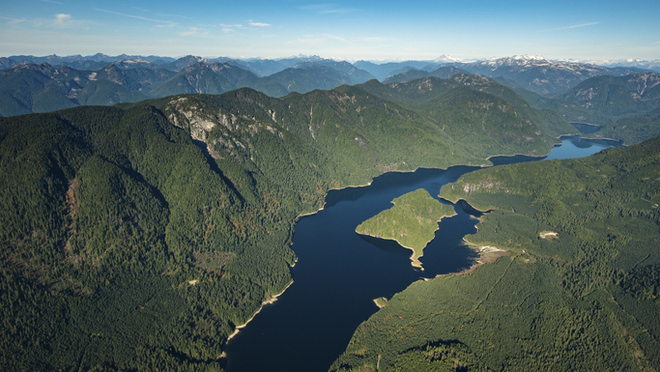
 The Coquitlam Lake reservoir is unusual among BC Hydro reservoirs, as it’s one of the few that supplies drinking water. About a third of Metro Vancouver’s drinking water comes from the reservoir.
BC Hydro is a pioneer in water use planning
There are a lot of hydroelectric utilities in the world, but no one does water use planning, a regulatory-driven activity, quite like BC Hydro. We rely on a dedicated internal team to take on the daunting challenge of finding a balance between power generation, spawning fish, recreation, drinking water and more.
Our water use planning (WUP) focuses on shared water use by a variety of First Nations and stakeholders, while recognizing there can be trade-offs.
Fish don't have a direct say in the rivers they live in, but speaking for them are strong advocates such as First Nations, fishing guides, environmental groups and us at BC Hydro. All British Columbians need electricity to power their homes and businesses, and about 91% of that electricity comes from hydroelectric power stations. Farmers lobby us for improved flood control, and a few communities, such as Campbell River and parts of Metro Vancouver, rely on our reservoirs for drinking water. Campers on our reservoirs prefer to tent near the shoreline rather than far from the water's edge when reservoir levels recede.
Our river systems actually lose some water via drinking water requirements and irrigation for agriculture. On the other hand, water for hydroelectric power flows through power station turbines, and in many cases, is used multiple times for power generation. The new Site C dam and power station near Fort St. John, for example, uses water that first goes through the W.A.C. Bennett and Peace Canyon power stations upstream on the Peace River.
The overall goal of water use planning is to find a better balance between competing uses of water in a way that’s environmentally, socially and economically acceptable to British Columbians.
"One thing I'd like to emphasize is that these were not little tweaks on our hydroelectric system," says BC Hydro water use planning manager Genevieve Martin. "They were substantive changes across the entire system to better meet interests other than power generation."
The water use planning process has resulted in more than 750 ordered constraints on our operations across B.C., equivalent to a loss of about 10 per cent of our generating capacity.
Just how well that's been working is the subject of a current major assessment of the effectiveness of water use planning to date.
"We know that in some watersheds, we really are seeing benefits to fish habitat," says Martin. "We put minimum water flows in place, and that’s been really helpful. We're trying to fine tune what we do and make sure it works. Now we're looking at questions such as 'Is that the right minimum flow?' and 'Should those flows be timed differently?'
Started in the 1990s, WUP orders are now up for review
Our water use planning process is one of the most comprehensive and well-documented examples of collaborative water management in Canada and is widely regarded as one of the leading models of its kind in the world.
Rivers and reservoirs are key to BC Hydro's generation system, but the water also has cultural significance, provides drinking water for communities, is home to fish and wildlife, and supports recreation. To find a better balance between these uses, the Government of BC developed water use planning in the late 1990s, and mandated BC Hydro to undertake the process.
Between 1999 to 2004, we undertook water use planning for 23 of our hydroelectric facilities across the province. It was the first collaborative watershed planning engagement activity of its kind, and it brought together a diverse group of stakeholders to review operations at our facilities. At the table were federal and provincial agencies, First Nations, water licence holders and other key stakeholders.
We've completed hundreds of studies to monitor our operations at our generation facilities since the Water Use Plan Orders have been in place. Directed by the Government of B.C., it's time to do a comprehensive review of our 23 water use plan orders in depth. And once again, we’ll be bringing multiple First Nations and stakeholders into the process.
What's known as the Water Use Plan Order Reviews will take years to complete, and while no new WUPs will be developed by the reviews, an advisory committee will work to identify any key issues related to water order operations.
Anatomy of a WUP order: Coquitlam-Buntzen system
The Coquitlam Lake and Buntzen reservoirs lie within watersheds in unceded, traditional territory and culturally significant to kʷikʷəƛ̓əm (Kwikwetlem First Nation) and other First Nations. They're specifically located in the Metro Vancouver Regional District watershed about 10 km north of Lougheed Highway in Coquitlam.
Water for the Coquitlam-Buntzen system originates in the headwaters of the Coquitlam River, which flows from the Coast Mountains south to the Fraser River via the Coquitlam Lake Reservoir.
A WUP order has been in place for the Coquitlam-Buntzen system since 2006 and includes specifics on:
- Minimum flows in the Coquitlam River to support fish and fish habitat.
- Downstream operations in coordination with Metro Vancouver.
- Ramping rates, which are agreed upon limits to decreases and increases in water releases from a dam or generating station, which translate into the rate of change in river flow or water level downstream.
- Minimum operating levels of Buntzen Lake Reservoir: the lowest lake elevations at which the hydroelectric facility fed by the reservoir (Buntzen Generating Station) can operate effectively and safely.
- Maximum operating elevation of Coquitlam Lake Reservoir, which uses diversion tunnels to supply drinking water to Metro Vancouver and to Buntzen Lake Reservoir, where intakes are located for Buntzen Generating Station.
- Monitoring programs on the system.
The Coquitlam Lake Reservoir supplies about a third of Metro Vancouver's drinking water. Usage for drinking water increases to nearly half during summer peak demand.
"We've allocated some of the water that would otherwise be used for power generation in the Coquitlam-Buntzen system to Metro Vancouver for drinking water," says Martin. "And it's a fine balance managing that."
The Coquitlam-Buntzen water use plan order review is now underway. The review will bring together federal and provincial agencies, First Nations, licence holders, key stakeholders, local government and the public to review BC Hydro’s operations and related studies and recommend how an operating order for BC Hydro’s facilities may be maintained or adjusted for future operations.
Related:
- Learn more about the Coquitlam-Buntzen Water Use Plan Review
- Feature: Pink salmon play outsized role on the Cheakamus River
- Get information about our water use plans, including specific WUP Orders for the Lower Mainland, Vancouver Island, Southern Interior, and Northern Interior.
- Feature: A wetland rises from former Site C dam construction site
- BC Hydro recreation areas