

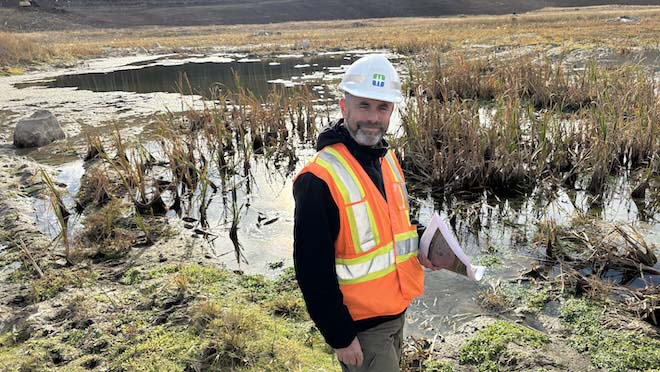
 Our environmental specialist Matt Barnette at a wetland that has emerged from an area that had been used for construction activities around Site C, the now operational third dam and generating station on the Peace River near Fort St. John.
Reclamation efforts focus on planting for wildlife habitat
Matt Barnette is in his happy place as he skips through furrowed rows of dirt and wood debris, head down, like a golfer in search of a ball after a wayward drive.
“Here’s a lodgepole pine,” says Barnette, pointing to an ankle-high sapling on a late-October day. “And over here is a spruce, and a poplar that we planted. It’s come in nicely. Maria’s team is planting 4,000 stems per hectare, and this is what you get.”
Barnette is our environmental specialist overseeing land reclamation now that the Site C dam and powerhouse are completed and operating on the Peace River near Fort St. John. Maria is Maria Cavedon, a PhD in environmental design working for Aski Reclamation, the Saulteau First Nation company hired to seed and plant for woodland, wetland, and grassland reclamation efforts around Site C.
A few minutes later, we’re on the muddy shore of a wetland featuring a riot of rushes and other plant life where only a year earlier there was only dirt, wood and a lifeless puddle. In the mud, we spot a perfect bear paw print.
“Yeah, that’s a big one — cool to see that,” says Barnette, taking a closer look at the paw print. “And there’s a smaller print over here.”
The Site C generating station is producing about 35% of the power generated by the W.A.C. Bennett dam — the first of three dams built on the Peace River — from a reservoir that covers just 5% of the area that was flooded for the creation of the Williston reservoir above Bennett dam in 1968. Site C generates enough electricity to power about 500,000 homes, boosting our total electricity supply by about 8%.
Wildlife habit restoration efforts have evolved a lot since the Bennett Dam was constructed in 1968. This time around, we’ve adopted a strategy that doesn’t just aim to replace habitat lost to the creation of the reservoir, but also relies on a detailed habitat functionality assessment to inform reclamation efforts.
Ducks Unlimited Canada has been a key partner in creating the likes of a 50-hectare wetland at Golata Canyon, which in 2022 was created as a wetland compensation project for habitats lost due to the construction of the Site C dam. Experts in wetland habitat restoration, Ducks Unlimited has also developed a functional habitat assessment tool to help us maximize the benefits of new wetlands such as the one created near the dam itself.
“Our tool assesses ecological functions related to migratory birds, amphibians, bats, and species at risk, both animal and vegetative,” says Bruce Harrison, a Fort St. John native who works as a provincial biologist for Ducks Unlimited Canada. “It also includes ecosystem components that are of particular value to Indigenous communities.”
Harrison says the new wetland near Site C shows how the blend of careful excavation followed by strategic planting and “Mother Nature’s hand” have combined to deliver a functioning wetland in less than 12 months.
“I was surprised at how little planting was required there, how much natural regrowth there was,” said Harrison. “That’s a really cool site built in a location where wetlands didn’t exist before the excavation [for dam construction] was done.”
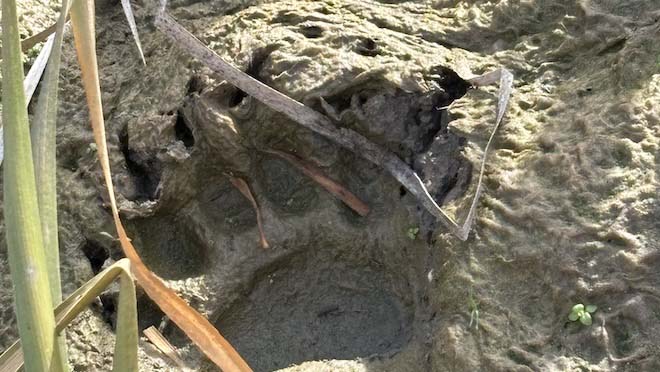 A large black bear print in the mud of a newly-grown wetland that has emerged from a former Site C project construction area.
Reclamation elements include denning andnesting structures, wide variety of trees, plants and grasses
A visit from bears is good news for an area, located within sight of the new Site C generating station, that is being sculpted, seeded and planted to revive animal habitat.
Trucks and backhoes distribute topsoil from a small mountain of soil on site and dig two-foot-deep furrows — long, narrow rows for planting seeds or directing water for irrigation. Wood debris salvaged from in and around what is now the Site C reservoir are scattered about to provide shelter for small animals, and to add nutrition to the soil.
Backhoes are also used to pile large rocks here and there to encourage dens for garter snakes and other wildlife. Wildlife habitat structures, such as nest boxes for cavity nesting birds, denning boxes for fishers, roosting boxes for bats, and nesting platforms for eagles, are also part of the design. Areas are later seeded by water spray (hydro seeding), but mostly by hand, including native trees and shrubs strategically planted in the topsoil of the furrowed ground.
“We avoid planting in the base of the furrows, as they’ll be covered in snow and then really wet and waterlogged,” says Barnette. “So we tend to plant in the upper furrow or mid-slope. White spruce are planted on the north side of the slope, and maybe a rose or a Saskatoon might be on the south side where it’s sunny and dry.”
Barnette explains that with the advance of climate change — the Peace region has experienced increasingly long droughts in recent years — efforts are being made to plant a wide variety of plant species to maximize their long-term chances of survival.
“It’s not as simple as you would think,” says Barnette. “If we want these ecosystems to be resilient in the future, we need the plants to be spaced out properly, so that if there’s a caterpillar that likes aspen, it might not eat the spruce that’s right next to it.”
Cavedon arrived from her native Italy to Canada to do her PhD in environmental design at the University of Calgary a decade ago. In Europe, she studied the ibex — a wild mountain goat with long, curved horns — and in Calgary she conducted economic analyses of caribou and worked as a bear technician. She was later hired by the Saulteau Nation’s Aski Reclamation. The Saulteau Nation has worked before on BC Hydro-funded projects, including alongside the West Moberly Nation on a remarkable caribou maternity pens initiative in territory southwest of Fort St. John.
“I was enthusiastic in getting the chance to work for an Indigenous–owned environmental consulting company,” says Cavedon, who was promoted to Aski’s restoration coordinator for the Site C project. “I think that integrating traditional knowledge with a more scientific process is the key.”
Starting next May 1 (weather permitting) Cavedon’s crews will be planting over the wider 120-hectare furrowed ground adjacent to the year-old wetland. Literally in the mix will be some strategically placed seeding of flowering plants designed to attract butterflies.
“Apparently, the butterflies will magically appear, because they like the colour of these flowers,” says Barnette. “We’re also working with Maria on planting to help create corridors of grassland between the areas to provide diversity. You get woodland, a bit of grassland, a cluster of rocks. And it supports animal movement through the area.”
Duck Unlimited’s Harrison says that while he lives in Kamloops today, as a native of Fort St. John he feels an emotional attachment to restoration efforts around Site C.
“I have a strong investment in trying to offset [the dam’s] impacts as much as possible,” he says. “But there’s always going to be some degree of trade-off in terms of what you can put back on the landscape versus what’s being impacted. There’s never going to be a 100% perfect match, but BC Hydro made it a priority to create habitats of the same type as were impacted.”
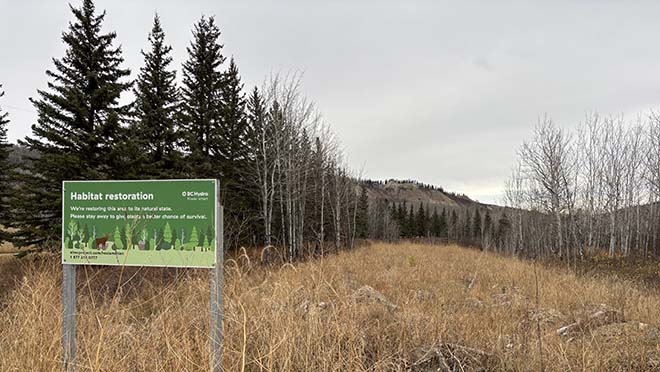 What had been a section of Highway 29, which has been replaced by a new highway alongside the Site C reservoir, has created rough and loose mounding of soil seeded and planted to provide wildlife habitat.
Broader reclamation efforts include wilding of former highway
We’ve collected seeds and plant cuttings from the Site C project area, including trembling aspen, balsam poplar, willow, and alder. Seedlings have been grown at nurseries and kept in cold storage, while seeds are cleaned, dried, and tested before also being stored.
Seeds and seedlings are then used to help populate reclaimed areas. About 30 km of the original Highway 29, for example, was relocated and rebuilt, leaving several sections of the old highway abandoned and in need of reclamation for wildlife habitat. The road’s asphalt has been removed and replaced by rough and loose mounds of dirt in which native plants and trees are seeded and/or planted to provide that habitat.
“I’d like to return to this area someday,” says Cavedon, the PhD from Italy who has fallen hard for the biodiversity of the Peace region, and Canada in general. “It would be really great to see how we’ve contributed to future generations. I think we’re doing a big part in restoring habitat — you never really know until you see it later on, but I think it will be great in 10 years.”