

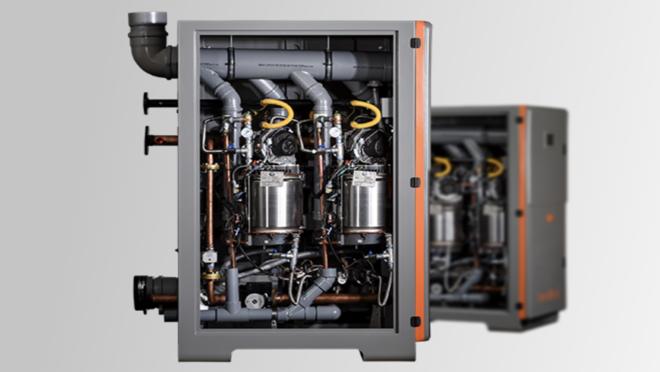
 Intellihot's tankless on-demand heat pump hot water heater is a 2024 Edison Award winner. BC Hydro's innovations team is looking for potential pilot test sites in B.C., ideally small commercial sites and multi-unit residential buildings.
Help our innovations, testing and trials teams recruiting efforts
Our innovation team regularly recruits customers to test energy-related technologies in residential, commercial, and industrial applications. The team also works with members like you in the BC Hydro Alliance to recommend new products and provide feedback on how well they perform.
Right now, we're looking specifically for customers who can implement the following with partial support from BC Hydro:
- On demand heat pump hot water heaters: A tankless technology ideally suited to small commercial sites and multi-unit residential buildings (MURBs).
- Internal solar blinds and radiative paints: Our team has one test site so far — Richmond City Hall — for solar blinds and may begin recruiting soon for phase two of the pilot. However, we've yet to find a suitable roof for radiative paint technologies from the likes of Chillskyn and SkyCool, which require a largely uncluttered surface free of pebbles or most other treatments.
- Smart panels that manage peak power consumption: With the aim of reducing grid stress and avoiding costly building upgrades, we're recruiting homes and MURBs across B.C. to test performance and capability.
Get details on these three technologies, plus others on the recruiting list, on our active innovation demonstrations page.
"We're asking Alliance members to do some research into these technologies — we have links to them from our demonstrations page — and then to contact us," says Shawn Shahrokhi, lead researcher on the innovations team.
Shahrokhi adds that for most pilot projects, BC Hydro provides a significant share of the funding — as much as 50-75%, "But we also like customers to have a little skin in the game," he says.
What the innovations team does and what else they're working on
"We spend a lot of time looking at technologies, at new products and services to see if it will work," says Tim Mosley, head of the Power Smart innovations team. "Does it do what it's supposed to do? Does it perform as the customer, vendor, or installer expects?"
Mosley's team regularly manages residential installations that demonstrate new energy management devices but securing commercial and industrial trial sites remains a challenge, even with the funding available for demonstration projects.
Learn more about our testing and year-round customer recruiting on our innovation, demonstrations, and research page. You can sign up to be alerted when we're recruiting.
We're busy searching for products and setting up testing. Here are a few other technologies currently on our list:
- Heat pump alternatives to portable room AC units.
- HVAC coil cleaning, including UV treatments and other options that improve operational efficiency and reduce energy consumption.
- Phase change cooling (PCM) in HVAC ducts. Liners or panels inside ducts can pre-cool airflow, reducing peak cooling loads on compressors.
- New formats of solar generation, including demonstration and testing of emerging solar technologies.
- Advanced window retrofit technologies, such as the TwinGlaze insert solution, that either supplement existing windows or replaces glazing to significantly improve thermal performance.
- Vertical solar generation. We've funded a vertical solar panel pilot on the roof of Vancouver's Science World and are looking to trial it in colder areas of B.C., where the European technology offers snow shedding and wind-shear benefits.
- Next-generation heat pump technologies, such as 3-in-1, on-demand hot water, and solid-state heat pump products.
- High-temperature thermal storage in new formats for multi-unit residential, commercial, and industrial sites.
- Rooftop and vertical-axis micro wind generation.
- Electrostatic air filters, which can reduce fan power consumption, improve air quality, and lower service costs.
- Solar PVT technologies — hybrid systems that generate both electricity and heat (e.g. hot water) simultaneously.
- Phase change materials (PCM) for residential space heating and hot water. PCMs store and release large amounts of thermal energy by transitioning between solid and liquid phases at specific temperatures.
Learn about energy-efficiency upgrades, including a vertical solar pilot, at Science World.