

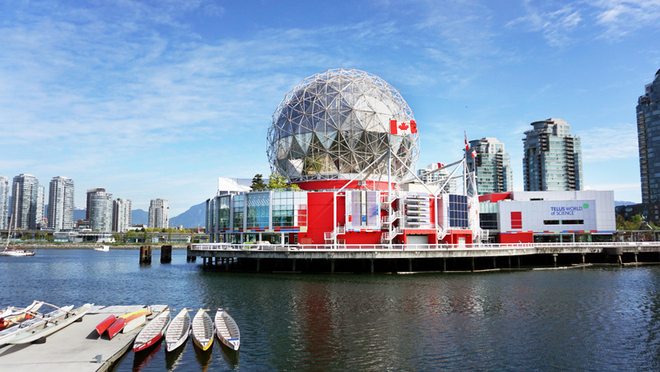
 Originally planned as a temporary building for Expo '86, Science World and its iconic dome on Vancouver's False Creek lives on, more energy efficient than ever thanks to a long list of efficiency upgrades including solar generation.
Retrofits expected to reduce energy use of iconic Vancouver dome by 42%
Part of our series on Power Smart Champions: businesses, homes, and institutions — large and small — recognized for their efficient use of electricity and reduction in their reliance on fossil fuels.
Gone from Vancouver is the Scream Machine, the exhilarating Expo '86 rollercoaster that rolls on as the Ninja at a Six Flags in St. Louis.
Gone are the Gondola Skyrides, which transported fairgoers above the Expo '86 grounds.
Also gone is the Expo '86 monorail, dismantled and shipped to Alton, Staffordshire, England, where it serves as free transportation from a car park to the gates of a theme park.
Still standing from the 1986 World's Fair are SkyTrain, Canada Place, and Science World, the iconic geodesic dome on the eastern shore of False Creek. A structure originally designed as a temporary exhibit, Science World stands today not only as a popular and engaging science museum for about 800,000 visitors each year. It's also a living laboratory of energy technologies that adds comfort and efficiency to the space inside, and big-time energy savings to the bottom line of a non-profit that operates the place as a charity.
A $39-million retrofit project that started in 2022 is expected to result in a 42% reduction in energy consumption and 66.5 fewer tonnes of GHG emissions annually. It includes upgrades to LED lighting, high-efficiency glazing (windows), air-source heat pumps, electric chillers, three different solar panel arrays on the roof, and insulation upgrades in the dome itself.
"it's been said that the greenest building is the one that already exists, because it preserves embodied carbon," says Brian Radburn, Science World's chief operating officer. "It reduces waste, lowers carbon emissions. The building is still fit for our purposes. We could tear it down and build something new. But why would we do that?"
For the retrofits, Science World is leaning on $19 million from the federal government's Green and Inclusive Community Buildings program plus $20 million from the Government of BC. Although the retrofitted building won't reach the net zero standard — creating as much energy as it uses — it's designed to be efficient enough that, through solar generation and the installation of battery storage, it may soon supply power back to BC Hydro during times of peak demand in the densely-populated False Creek neighbourhood.
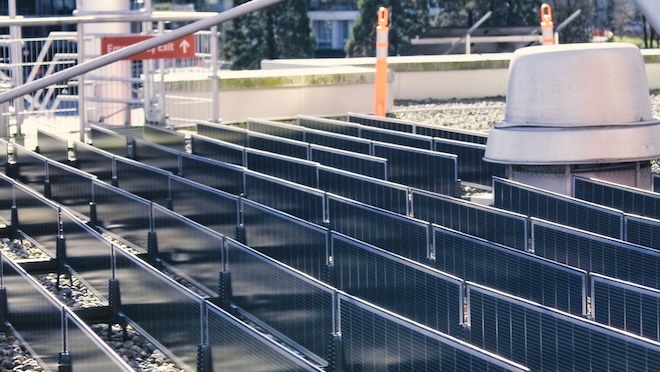 Newly-installed vertical solar panels on the roof of Science World face east and west to capture lower-angle sunlight in the mornings and afternoons. It's a pilot project for a technology that could be ideal in snowy areas of B.C.
'Climate change is here': Science World demonstrates resilience
Another Brian at Science World — director of programming Brian Anderson — carries the alternate title of 'director of performance and fun times'. He's akin to the coolest science teacher you ever had, the one who might have instructed you to put "protein pellets" into a beaker as part of a mystery mix that cooked and cooled to become peanut brittle.
Anderson is jazzed about taking the science of Science World's energy retrofits to the museum floor. Ideas being considered include a large-screen TV displaying real-time graphic details of the building's energy use, solar generation and, down the road, battery charging and discharging.
"Younger people probably know what a solar cell is, but they don't know that solar cell technology is constantly evolving," says Anderson. "The kids who visit here today are the decision makers 15 years from now. And when they get there, we want them to be thinking: 'No we're not going to tear down the building. We're going to make it a bigger, better building."
The solar panels Science World first installed are on the south wall of the main building, which extends out from the base of the dome. Those original panels generate a modest 3,000 kilowatt-hours annually. Now two new arrays coming online this spring are taking the technology, and the amount of generation, forward. A new array of 298 high-tech panels will produce closer to 140,000 kWh per year, and a novel vertical solar panel system is expected to generate another 15,000 kWh annually.
A project funded by BC Hydro, the vertical panel system will explore the system's potential — in particular in snowy and low-height sun conditions — with an initial installation on the south-facing roof of Science World. Designed to capture the lower-angle morning and afternoon sunlight, the project is planned to be extended to locations in the B.C. Interior and north where rooftop snow is more of a challenge.
"Climate change isn't coming, climate change is here," says Radburn. "How do we position ourselves, not just to be sustainable but to be climate-change ready and resilient? We have a pretty critical role to play in that we're a place to build support and awareness for sustainability. We're a trusted source of information, and we're a place where people come to build an understanding of the world around them."
'The dome really had no insulation'
It's often most practical to upgrade equipment when it nears its end of life. That's what Science World did with their heating and cooling equipment, which gave way to the new kids in town: a dozen air-source heat pumps and chillers. But it can often pay to upgrade ASAP, such as with lighting and the building envelope.
About a year ago, Science World flew a drone equipped with an infrared camera around the entire facility. Among the hot spots that showed the most heat loss through windows was the lobby/entry area, where energy-efficient windows will be installed this fall. But the most prominent upgrades are happening right now, to the dome itself.
"The dome really had no insulation," says Radburn. "I think it was around R4 and we're going to bring it up to R35. We're going to add five inches of insulation, which is significant because it's a large volumetric space that takes a lot of energy to heat and cool."
While most retrofits at Science World have been done with little or no impact to the visitor experience, the dome insulation project is a massive job that has required $1 million in specialized scaffolding and the temporary closure of the 400-seat auditorium that has long showcased Imax documentaries. The wait to get back into the theatre will be worth it, as the space will be more comfortable and will feature a new sound system, new screens, and a digital projector to replace heavy, manually-loaded 70-millimetre films.
Back in 2022, the dome's original lights were replaced as part of a $10 million project funded by the federal government's PacifiCan Tourism Relief Fund. In tripling the number of lights in the dome to 651 LEDs, Science World still managed to lower the energy costs for the dome lighting.
Along the way, BC Hydro has worked with CleanBC to contribute funding for studies and upgrades, including a study of the building's automation controls and lighting that led to incentives for both.
"BC Hydro was with us at the beginning of our sustainability journey, and they're still with us," says Radburn. "They funded a clean energy study that really led to, and helped us create, this vision we have today. Thanks to the funding provided by BC Hydro, we had consultants tell us how we could lower GHGs and energy use, and where we should invest."
Enter to win
Experience it for yourself! Enter for a chance to win a one‑year family membership to Science World. Simply fill out the form below to enter. [Contest rules]