

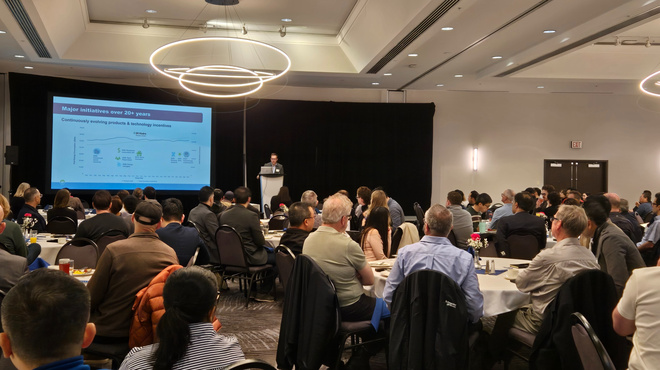
 Power Smart's new director Brandon Young kicks things off at the annual Alliance member breakfast at Hilton Vancouver Metrotown in April.
A record number of projects, and more on the way
Thanks to all who filled up the Crystal Ballroom of the Hilton at Metrotown in Burnaby for our April 16 member breakfast. Members also came through with more than 100 completed surveys at the breakfast, which will help us improve next year's event and better meet Alliance member needs. Three lucky attendees walked away with Alliance-branded thermal food jars through a random draw of those who completed the survey.
For any of you who missed it or could use a recap of key messages at the event, we're taking you back into that room, minus the fruit, croissants, eggs, and bacon.
Here are 14 things you need to know from our annual gathering, which drew more than 200 members from across B.C.
1. We delivered a record number of projects in Fiscal 2026
Alliance members helped us deliver on more than 800 projects last year across the commercial, multi-unit residential building (MURB), industrial and social housing sectors. That's a record number with a 50% increase on the commercial side, and a 40% increase on the industrial side.
Commercial energy savings added up to 90 GWh for the year, and industrial project savings were a whopping 277 GWh. Combined, that's the equivalent of powering 37,000 typical B.C. homes a year.
2. We're not slowing down
Targets for Fiscal 2027 are 270 GWh for industrial and 90 GWh for commercial projects.
3. The 30% incentive bonus will help us hit those large targets
The 30% bonus had a lot to do with our record year, so it's back for another year. Projects need to be submitted by February 11, 2027, and to be eligible, need to be completed by March 14, 2028.
We have additional funding for projects repeating continuous optimization, as long as it's been at least four years since you last completed the program. We also have program-enabled funding for energy managers and special offers for capacity-constrained areas.
4. We're standardizing incentive levels across programs
The standardization of incentive amounts will make it easier to navigate projects. We're focusing on training Alliance members to more effectively convert studies and audits into completed projects.
5. Self-driven projects really matter
We're really busy here at BC Hydro. There's a strong push for self-driven projects that reduce BC Hydro's direct project management workload and help scale results.
"Self-driven projects have really helped us," said Brandon Young, the new director of Power Smart. "These projects help take some of the workload off our team and help us scale much beyond where we we'd be at if we directly managed all projects."
6. Power Smart is our core brand, and it’s evolving
Look for the Power Smart brand to be even more prominent than it has been in the past.
"Now that energy management is in the context of electrification, the brand is being used more directly," said Young. "Power smart is energy efficiency, and it’s electrification."
7. New capacity-based programs are coming
We're moving beyond pure energy savings into capacity-based incentives and rates. Expect to hear more about demand response (DR).
"Demand response is really the idea of capacity, of shifting or reducing electricity load when there's peak periods on our grid system," said Alec Zaine, program manager for demand response. "What that means is that because we're a winter-peaking utility, we're asking customers to reduce or shift their electricity use to times outside of those peak periods, usually between 4 p.m. and 9 p.m. November through March."
There are three main demand response levers: efficiency/shape reduction, peak shaving via batteries, and shifting load outside peak hours.
8. Demand response requires a sustained commitment
Our behavioural DR program, which pays $50 per average kW reduced over the DR season, includes up to 20 "events" per season. To earn rewards, customers must take part in at least 50% of those events.
Battery-based energy storage incentives (ESI) fund behind-the-metre batteries for load shaving, with incentives up to the lesser of 80% of capital costs or a formula based on nominated KWh. That program requires a 10-year contract with BC Hydro, with batteries dispatched for four-hour events and controlled by BC Hydro's distributed energy resources management systems (DERMS).
9. We're making digital tools a priority
Expect to see more online tools, portals, and automated processes as we move to replace analog, manual workflows.
"We have a pretty aggressive investment plan with our technology group to modernize some of our systems and customer facing applications," said Young. "The aim is to make things easier."
Young added that we're trying to use the data we collect to make things easier for customers, including detailed examination of how well program processes are delivering for customers.
10. Expect more training, more online help
"Last year was a big year of change, so this year we're focused on ensuring that everyone in the Alliance is up to speed on our program offers," says Alliance program manager Tanya Perewernycky.
Stay tuned for invitations to various training sessions, and log into the Alliance member portal regularly for program updates and helpful videos.
11. Virtual power plants are on the radar
Virtual power plants aggregate decentralized energy resources — such as home solar batteries, electric vehicles, and smart thermostats — to function together as a single, flexible power plant. We haven't launched any offers yet, but in 2025, we kicked things off with a residential-based pilot project in the communities of Sun Peaks near Kamloops, and Harrison Mills in Mission.
12. Studies and audits are all the rage
Commercial studies have grown roughly seven times in three years, and last fiscal, there were 98 industrial studies tied to $6 million in funding. We're focusing on training Alliance members to more effectively convert studies and audits into completed projects.
13. Our social housing bonus incentive has been extended
Our Social Housing Energy Savings Program is designed to help non-profit, co-operative, and Indigenous housing providers, as well as provincial and local government housing authorities, improve the energy performance of their buildings.
The program includes funding for opportunity assessments, feasibility studies and equipment upgrades. We're extending our 20% bonus incentive on selected equipment upgrades — lighting measures for common areas and variable speed drive (mechanical measures) — until February 11, 2027, as part of our equipment upgrades funding offer. This bonus is in addition to other rebate amounts currently available, and to be eligible, projects must be implemented by March 14, 2028.
14. Capacity-constrained area funding can be close to 100%
Specific geographic areas in our service area are experiencing high growth and an increasing demand for electricity. In addition to offering incentives to residents for reducing or shifting their energy use at home, we're offering stacked incentives for commercial sites.
"For customers in capacity-constrained areas who are on qualifying feeders, there's a 50% bonus," says program manager Tanya Perewernycky. "As well, there's a non-lighting, mechanical system bonus that's in the business energy savings (BESI) program only, and that’s a 100% top-up. These don’t cover 100% of project costs, but as bonuses are stacked, a customer could potentially receive close to 100% funding for a project."
Capacity-constrained communities that may be eligible include Campbell Heights in Surrey, Mount Lehman, select communities between Kelowna and Vernon, Port Coquitlam (Burke Mountain), White Rock, Maple Ridge,Mission to Agassiz, select neighbourhoods in Victoria, Sun Peaks near Kamloops.