

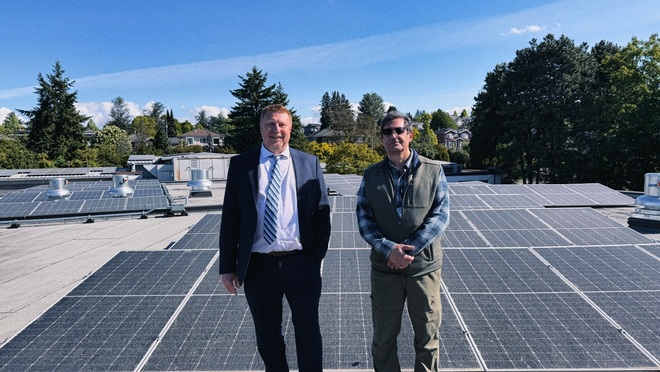
 Tony Munster (left) and Mehrdad Gharibnavaz of Providence Health Care stand on the roof of Vancouver's Holy Family Hospital, where a second phase of solar panels is expected to boost annual solar generation at the hospital to 273 GWh.
Holy Family Hospital's rooftop solar just the latest in a series of clean energy moves
Part of our series on Power Smart Champions: businesses, homes, and institutions — large and small — recognized for their efficient use of electricity and reduction in their reliance on fossil fuels.
If at first you do succeed, don't slow down.
While Providence Health Care hasn't officially adopted that as a mantra, they've put the mandates and the people inplace to drive energy efficiency and decarbonization at a rapid pace.
Back in 2019, Tony Munster — new to the role as Providence's executive director of projects, planning, and facilities management — made the mistake of wearing a suit and tie for a summer visit to a pair of long-term care facilities. Two years later, both of those Vancouver buildings St. Vincent's: Brock Fahrni and St. Vincent's: Langara) were equipped with electric heat pumps for mechanical cooling.
"We finished both places just before the heat dome arrived," recalls Munster, referring to the record 2021 B.C. heat wave that caused 619 heat-related deaths across the province. "Langara's cooling system came on about a week before it hit. We didn't know there was going to be a heatdome, but thank God, just by pure, dumb luck, we had cooling in place.
"Now, anytime we're doing upgrades, we increase cooling capacity because the summers are getting insane."
Next up was Holy Family Hospital. The site has been around since 1947, initially as a converted farmhouse and then as a purpose-built hospital starting in 1954. Between 2021 and 2023, Providence tackled the hospital's aging HVAC and other systems to cut carbon emissions by 75%, earning "Best in World" recognition from the International Federation of Healthcare Engineering.
A Holy Family Hospital lighting upgrade boosted by BC Hydro incentives completed in spring 2024 added another 50,000 kWh of energy savings annually.
Since then, CO2 emissions savings at Holy Family Hospital have been pushed to 85%. But why stop there? When it came time to build a new roof for the building, Providence jumped at the chance to add solar panels. The renewable generation came online in the spring of 2025, and generated 205 MWh of power in its first year. Additional solar panels are expected to increasethat number by about 68 MWh.
Marc Adams, the Providence project manager leading the solar project, says the solar array is almost triple the size originally planned.
"We have a smaller solar array at Mount Saint Joseph Hospital, but we just happen to have a huge roof area at Holy Family," says Adams. " As we just replaced the roof, there was nothing holding us back. It just made sense to do it as big as we could to get the most benefit out of it. These panels are going to last 25 years."
Projected to produce about 273 megawatt-hours (MWh) annually, the Holy Family Hospital array's output is equivalent to powering 27 typical B.C. homes a year. The solar power also peaks in the summer, helps offset higher summer cooling loads.
We offer solar and battery storage rebates of up to $1 million for large commercial and industrial projects , along with rebates of up to $20,000 for solar panel and battery storage systems for smaller commercial businesses, and rebates of up to $10,000 for residential solar and battery installations.
'We're on the front lines of witnessing theimpacts of climate change on human health'
Providence Health Care is one of Canada's largest faith-based, non-profit health care organizations. It operates 18 different facilities in the Lower Mainland, including hospitals, long-term care homes, hospices, and community clinics. Since 2010, Providence has reduced its carbon emissions by almost 20%, but their mission is to do a lot more.
"We've made progress, but the imperative to accelerate this progress is increasingly obvious," wrote president and CEO Fiona Dalton in Providence's 2024-2029 Planetary Health Strategy. "In health care in B.C., we're on the front lines of witnessing the impacts of climate change and environmental degradation on human health. We care for patients who've been displaced by wildfires and floods, and we directly see the impact of declining air quality and increasing temperatures on the health of the patients we serve."
St. Vincent's: Brock Fahrni, a long-term care home to 130 residents, became Providence Health Care's first net-zero carbon emission facility and earned a Best in Canada for Carbon Reduction award in 2022. Mount Saint Joseph became Providence's first facility with a solar roof in 2022.
The new St. Paul's Hospital — under construction east of Main Street near the VIA Rail Station — will be a LEED Gold certified building that exceeds City of Vancouver requirements for access to nature, zero waste planning, and low-carbon energy use.
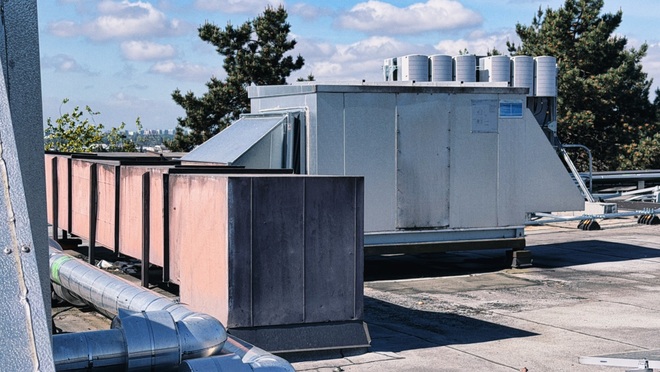 Rather than replace aging HVAC systems with like-for-like systems, Providence Healthcare leaned on highly-efficient new technologies to helps dramatically lower energy use and carbon emissions.
Assisted by BC Hydro incentives, most systems will be paid off in about 7 years
Munster estimates that the payback period on most of Providence Health Care's energy-efficient projects is around seven years. Adams expects the payback period on the Holy Family rooftop solar project will be about 15 years.
"In an industry like healthcare, where you have restricted funding from governments, efficiencies save you money in the long run," says Munster. "And solar panels pay for themselves."
A proposed solar project at Brock Fahrni is also under review by BC Hydro. A microgrid feasibility study is underway at the assisted living facility St. Vincent's: Honoria Conway, where Providence is exploring rooftop solar, wind turbines, battery energy storage, and converting electric baseboard heating to in-suite heat pumps.
Upgrades done at old hospitals with minimal disruptions
Originally built in 1954, Holy Family Hospital relied heavily on natural gas boilers for heating and domestic hot water. About 70% of the hospital's energy use was natural gas, which accounted for 95% of its carbon emissions. Single-pane windows and other outdated features proved costly to maintain, wasted energy, and led to patient and staff discomfort.
Rather than "replace" HVAC systems with similar systems, Providence adopted newer technologies, including thermal gradient header (TGH) technology for a dramatic upgrade in energy efficiency at Holy Family Hospital. That same TGH technology is also being used at Brock Fahrni and Langara.
Mount Saint Joseph Hospital is now the major focus. The hospital doesn't have cooling in all of its rooms and is Providence Health Care's biggest CO2 emitter aside from the old St. Paul's hospital downtown, which is being replaced. Earlier upgrades at Mount Saint Joseph included solar panels installed the same time they replaced the roof in 2022.
"At Mount St Joseph Hospital, we're switching our boilers out to electric, and we've done a load of other upgrades," says Munster. "We're already at about 50% emission reductions, and we'll be at over 90% when we're done, because we're going to electrify the whole thing. Eventually, we had squeezed all the heat recovery we could out of the [gas-powered] systems."
Providence was one of the first in B.C. to apply for our energy storage system incentive in 2024. Two 125 kW batteries will be installed at the hospital. A new Providence long-term care home being built in Vancouver, St. Vincent's: Heather, is one of the first health care facilities in B.C. to go through our commercial new construction whole building design program.