

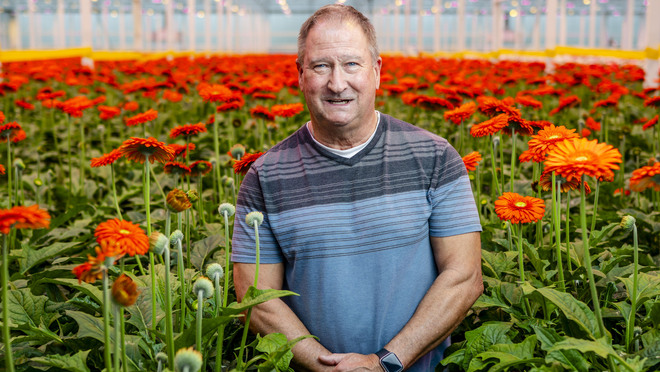
 Terry Pastorek, Hollandia's grower and operations manager, in a Hollandia greenhouse in Pitt Meadows.
If you've bought daisies for a bouquet, they're likely from Hollandia
Part of our series on Power Smart Champions: businesses, homes, and institutions — large and small — recognized for their efficient use of electricity and reduction in their reliance on fossil fuels.
It's not hard to find daisies, known as gerbera, among the cut flower options at your local florist or grocery stores. And when you see them in B.C., they're almost certainly from a Hollandia greenhouse in Pitt Meadows.
What may surprise you is that if you're on a road trip to Washington, Oregon, or California, the daisies you buy at the likes of Trader Joe's or Albertsons are also likely to be from Pitt Meadows. Hollandia's state of the art greenhouses, combined with access to clean, affordable BC Hydro electricity and abundant water, make them one of the continent's largest producers of gerbera cut flowers. They produce about 30 million daisies a year, and they're maximizing yields, flower quality and cutting energy use by leaning on BC Hydro product incentives and other programs.
Hollandia Greenhouses Ltd. operates as a modern, year-round facility spanning 22 acres of greenhouse space. Terry Pastorek, Hollandia's grower and operations manager, started in 1982 and says his main goal today is to provide Hollandia's customers with a quality flower.
"When our customers take them home, they'll get a good 10 to 12 days vase life," says Pastorek.
Over three generations of family ownership that started in 1952, Hollandia has evolved from a 2-acre tomato farm in Maple Ridge to a specialty gerbera grower, — one of North America's largest — in Pitt Meadows. An estimated 30 million blooms a year are grown at the site.
BC Hydro incentives, programs help trim energy use
Hollandia's use of state-of-the-art technologies gives them a huge advantage. Tech includes LED lights and controls, along with automated temperature, ventilation and CO2 levels. Biological pest management and digitally controlled humidity are other pluses.
Hollandia has worked closely with BC Hydro to boost energy efficiency and create optimal growing conditions.
Since 2015, Hollandia has successfully implemented six BC Hydro custom Incentive projects, including installation of LED lights and advanced lighting controls. The projects delivered nearly 7 GWh in energy savings.
In 2020, Hollandia joined a two‑year Industrial cohort program, where an energy expert led a group of BC Hydro customers through training on key topics in energy management. After completing the initial program in 2022, they continued their participation in alumni version of the program and have achieved an additional 4 GWh of savings to date.
Hollandia has looked at the potential of solar generation and battery storage, and the study results are under consideration.
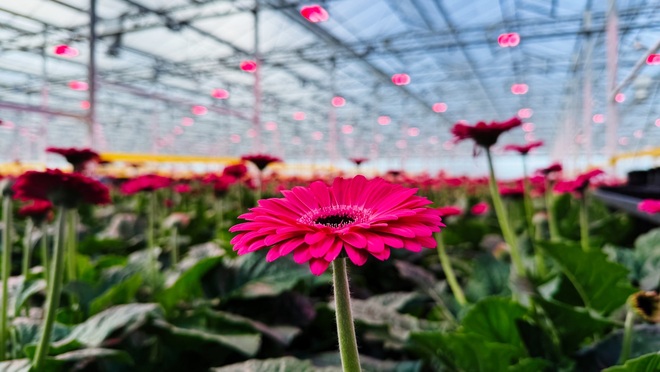 Hollandia's daisies (gerbera) dominate the B.C. cut flower market and can be found at stores in Washington, Oregon, and California.
LEDs deliver energy savings, full-spectrum colours
Pastorek stresses the important role BC Hydro’s incentives have been in enabling adoption of state-of-the-art LED lighting, which can be expensive.
"In terms of energy conservation, we will get 70% more efficiency out of our LEDs compared to the [high-pressure sodium] lighting," says Pastorek. "That’s a lot of energy savings. We just replaced 1,000-watt HPS with 1,000-watt LEDs. They still have the same energy consumption, but the LEDs give you a 70% gain in efficiency."
The LEDs deliver more "micromoles" — the amount of photons (light particles) plants receive in a given period — per energy unit going in. Pastorek adds that the full-spectrum colour advantages of LEDs also make them more effective.
LEDs are generally superior for modern indoor gardening due to better efficiency, longevity, and spectral control, providing higher quality and often better yield for less operational cost. HPS remains relevant only for specific scenarios where low initial investment is paramount, or for growers who rely on HPS heat in cold climates.
"We might pick 5% more flowers with a combination of HPS and the LED lights, compared to straight HPs," says Pastorek. "The big benefit is in shoulder season, like mid-February to mid-March, where I can just use LEDs because we don’t need heat. I don’t want to overheat my greenhouse."
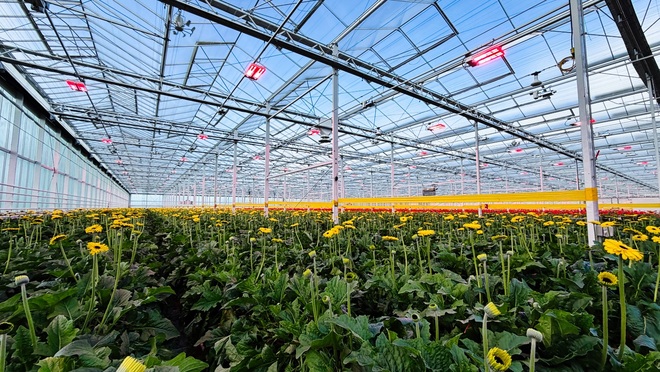 The full-spectrum colour of advantages of LEDs, along with their superior energy efficiency, lead to larger more cost-effective yields.
Big savings on a sunny February day
Hollandia is also finding ways to work with BC Hydro's demand response programs to limit energy use at times of high demand on the electricity grid. When he gets a demand response event notification from BC Hydro, Pastorek first shuts off his less efficient HPS (High-pressure sodium) lighting during called events
On February 5, 2026, Pastorek was able to shut all his lights off for several hours during the day.
"I went on the computer and at 11 a.m., shut off all the HPS lights," Pastorek said on that February day. "Then I was able to shut off the LEDs too. Right now we're having zero consumption for about three hours — and that saves us approximately 900 bucks an hour in electricity costs."
Most cut flowers in Canada are imported, but B.C. growers make headway
An estimated 80% to 90% of cut flowers sold in Canada are imported, most from Colombia and Ecuador. Led by Hollandia, B.C. growers are muscling in on some of that market, but Hollandia is the only one producing gerbera. According to Pastorek, B.C. cut flower growers tend to grow chrysanthemums, lilies and snap dragons.
Flying gerbera in from Colombia, by comparison, is CO2 intensive and the flowers can suffer. "They fly them in boxes, and they're dry so they need to rehydrate them. It's a lot of work, and they won't last nearly as long as ours do," says Pastorek.
When we talked to Pastorek in the runup to Valentine's Day, pink and red gerbera were in high demand. At Christmas, white flowers are in vogue, then it's pink in the spring, and orange or yellow in the fall.
Other recent Power Smart Champions
Inside and out, Science World gets a makeover
Cold storage and transport company Lineage is a Power Smart Champion