
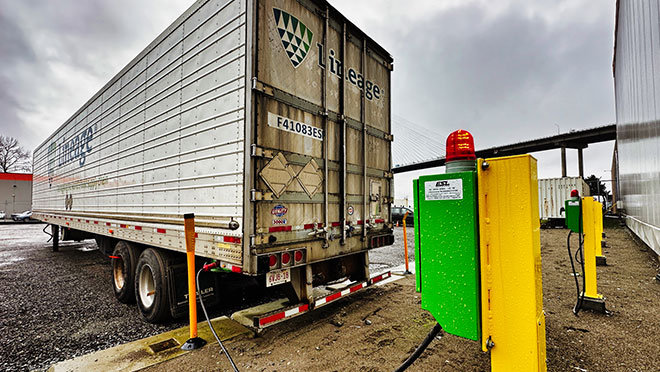
 Refrigerated Lineage trailers full of food and other perishable products are plugged into clean BC Hydro power outside a Delta warehouse rather than running off diesel while awaiting unloading or transport.
Working with BC Hydro, Lineage emerges as a Power Smart Champion
Part of our series on Power Smart Champions: businesses, homes, and institutions – large and small – recognized for their efficient use of electricity and reduction in their reliance on fossil fuels.
You probably don't know flywheeling from drayage, or have any idea what the acronym LTL stands for. But this much you can understand: The last thing anyone wants from a company that ships and stores perishable food is sweaty blueberries and frost-covered ice cream.
"We really have to be careful with blueberries," says Perry Arseneault, regional maintenance manager for Lineage Logistics. "They need to be kept close to ice cream temperature. And ice cream… boy, people love their ice cream, and they don't like ice crystals in their ice cream. That's why it has a room of its own."
Few of us think much about what it takes to get food from the farm or processing plant to our tables, or about how much energy is used for all the refrigeration and freezing that's required. In addition to operating a fleet of refrigerated trucks across Canada, Lineage operates four massive warehouses in the Lower Mainland, and one is 182,880 square feet.
If you're having trouble envisioning the size of that warehouse, picture three rows of four hockey rinks.
"We're one of the biggest companies that you've never heard of, the ones who handle your food on its journey to your plate," says Christina Wiese, who manages public relations for Lineage. "We play this hidden role in the food supply chain, and it's folks like Perry and his teams who are making those buildings as energy efficient as they can be, so that your food stays safe. We're also trying to control our own operational costs so we don't have to pass on costs to our customers or ultimately, to consumers."
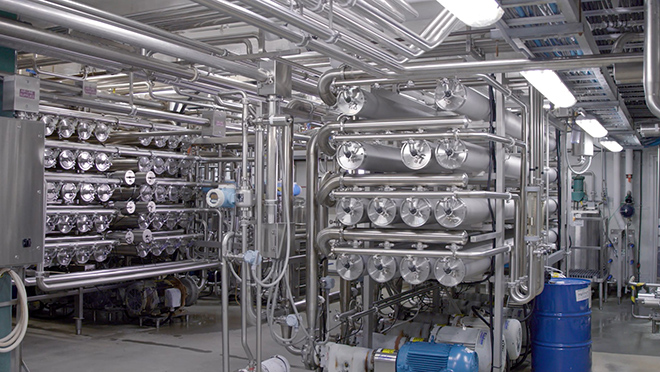
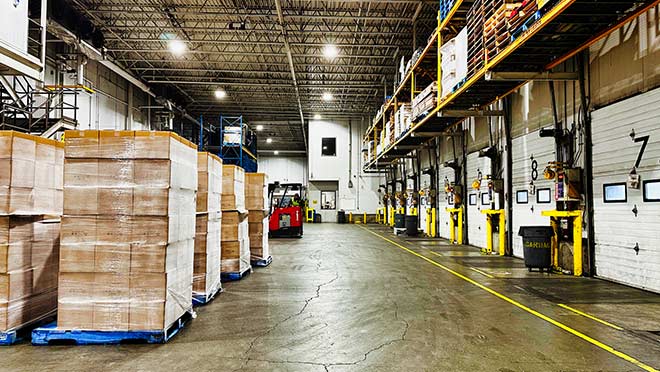 Lineage Logistics operates four massive warehouses in the Lower Mainland where energy use has been decreased through LED upgrades, continuous energy-use monitoring, variable-speed drives in fan motors, and other measures.
Lineage upgrades efficiencies, reduces peak time energy usage
As the guy who oversees Lineage operations from B.C. to Winnipeg, Arseneault is a trained electrician with a diverse background that includes 10 years in Canada's navy and another 10 years building yachts, where he became a proponent of energy efficient systems including variable frequency drives (VFD).
Arseneault's passion for electricity conservation runs from his efforts at home — he was an early adopter of LED lighting — to the workplace, where the payoffs in energy savings runs to the tune of 473,000 kW hours per year in LED upgrades alone. Those lighting upgrades never cease: backed by BC Hydro incentives, the warehouses have done upgrades from T8 lamps to smaller T5s, then to LED and then later to more efficient LEDs.
One of the Lineage sustainability team’s first moves was to ensure that each warehouse added a system to continually monitor energy use. Sustainability leads also do regular facility walks with staff to check that all systems are working as they should. Warehouses are filled with energy-intensive refrigeration systems, fans and compressors, increasingly run by motors that rely on variable speed drives (VFDs) to help reduce power consumption.
Lineage has worked closely with us not just on how much electricity they use, but also on when they use it. As part of a demand response refrigeration trial, Lineage earned incentives of over $120,000 for reducing their demand to help take pressure off our electricity grid during peak periods of usage, such as during cold winter evenings or very hot summer evenings.
While the refrigeration trial has ended, Lineage is now part of our demand response for business program. When we provide Lineage with the heads-up about a scheduled demand response event, they use demand response controls to prescribe when they dial back power use, by how much, and for what length of time.
"The easiest time for us for demand response is in winter, while summers are more difficult," says Arseneault. "At one of our facilities, for example, we usually can’t join these events during blueberry season. But we've gone to our customers and asked if they can work with our demand response schedule, and believe it or not, they're happy with that. We’ve found some solutions to handle our blast freezing of blueberries during demand response events."
In the summer of 2024, Lineage reduced their peak demand an average of 39% per site, and last winter, peak demand was trimmed an average of 54%.
'Eliminating waste and saving energy is in our DNA'
Lineage pushes Arseneault and his team to look at each building as an ecosystem, with a focus on thermal efficiencies, lighting and the little things that add up, such as putting monitors on refrigeration doors to ensure they're never left open too long.
"Eliminating waste and saving energy is in our DNA," says Arseneault.
The logistics industry is continually finding ways to make each transport and storage process more efficient. It's vital that drayage, the short-distance transport of shipping containers from a port or railyard to a cold storage warehouse, is done in a way that prevents spoilage, delays, and extra fees. Less-than-truckload (LTL) consolidation is another process that combines multiple smaller shipments into a single, larger, refrigerated truckload to reduce costs and increase efficiency.
At Lineage's transport hub, a warehouse on Derwent Way in Delta, we've helped set up access to clean electricity for parked, refrigerated trailers either waiting to be unloaded or awaiting pickup by a truck for transport. Instead of keeping things cold by running a diesel engine, refrigeration is powered by clean electricity.
"Energy management is big for us because we know that it takes a lot of energy to grow food, keep it cold and safe on its journey to people's plates," says Wiese. "It takes fuel to power the trucks that are taking it to grocery centres and into retailers. So we look at the whole system and ask ourselves: "How can we make it better? How can we make it more efficient?"