

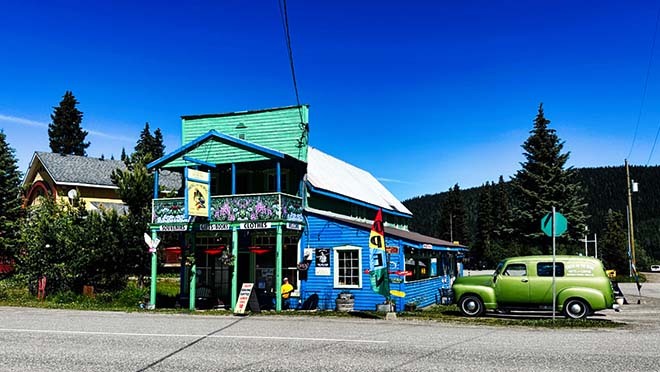
 The Frog on the Bog gift store and Willow River Guest House in Wells, B.C. – a short drive from both Bowron Lake Park and Barkerville – is now better equipped for the region’s cold winters with a heat pump plus battery backup that allows winter guests to stay comfortable in the event of a power outage.
Former mining town of Wells embraces clean power, conservation… and battery backup
Part of a series on BC Hydro Power Smart Champions: businesses, homes, and institutions – large and small – recognized for reducing their reliance on fossil fuels.
Like so many small communities in B.C., the town of Wells is somewhat frozen in time. And while that may work perfectly for the likes of neighbouring Barkerville – a major tourism draw as a restored 1860’s gold rush town – Wells' survival is a little more complicated.
Wells was also a mining town that, at its peak in the 1930s, had a population of about 4,500 people and was bigger than Quesnel or Prince George. But by the late 1960s gold and other mineral mines had closed, and the town shrunk to a few hundred. Today, Wells exists mostly as the gateway to Barkerville and as a charming stop for outdoors adventurers, including the thousands who paddle the world-famous Bowron Lake Park chain.
It’s now up to the town’s thriving arts community and enterprising folks like Dave Jorgenson, to help fuel the future of a town with just 220 full-time residents.
“People get enamoured by the experience of living here, and then start contributing to the town,” says Jorgenson, who arrived in Wells with his wife Cheryl McCarthy 27 years ago as an outdoors guide, then added a guest house, café, and Frog on the Bog gift shop to his tiny empire. “Some stay in Wells. With others, life pulls them in a new direction and they leave. Every time a house is bought and sold, it changes our economy. We want the town to grow, but we can be somewhat stifled by distance.”
That “distance” – Wells is an hour-long drive from the City of Quesnel – along with a small population and long, cold, and snowy winters, creates some dandy challenges for the second-smallest municipality in B.C. One of those challenges is ensuring a dependable supply of electricity in a place – served by a long, single-phase power line from a Quesnel substation – that gets more than its fair share of power outages.
And that’s where Wells punches above its weight. Working with BC Hydro, the town embraced a community energy conservation initiative, heat pumps, backup battery power and also a BC Hydro EV charging station hosted by Jorgenson's neighbour at the Jack O Clubs pub.
“Our community has a lot of informed people in it who are interested in sustainability,” says Jorgenson. “There’s always been an interest in how to make the world a better place.”
Battery backup is slowly catching on in B.C., especially in more communities prone to big winter weather and/or power outages. That includes over 160 homeowners at Sun Peaks near Kamloops and at Mission who have responded to a targeted BC Hydro offer to install battery storage.
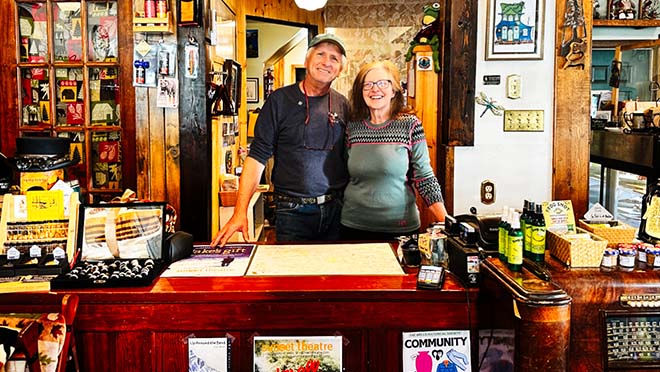 Owners Dave Jorgenson and Cheryl McCarthy have featured items in their gift shop that are made in B.C. or made in Canada.
'We've avoided investing in noisy, carbon-fueled generators we drag through the snow'
In the summer of 2022, BC Hydro started working on power capacity issues in Wells by working with residents to reseal doors and windows, replace old fridges, upgrade insulation, install LEDs and wrap hot water pipes.
Jorgenson went a step further by installing a mini-split heat pump in the Willow River Inn guest house. And then he worked with BC Hydro to help test the first small-scale commercial battery bank installation in B.C., which provides backup power to his guest house and the Frog on the Bog gift shop. Early results are promising in a town that gets big winters at an altitude of 1,200 metres.
“The backup power performed well last winter,” says Jorgenson. “We didn’t suffer from many community power failures, but the impact of the two that were significant – lasting longer than six hours – was alleviated by having battery power available. Besides the convenience, this system means that we have avoided investing in noisy, carbon-fueled generators that we drag through the snow to provide what can often be inadequate amounts of power.”
Jorgenson is also sold on the heat pump, which he says has convinced many others in the community to install a mini-split system. He has used his to heat a historic building that’s not all that well insulated and which includes the store on the main floor and two storeys of guest rooms above it.
“There’s a huge heating load in winter,” he says. “I guess I feel like we were on the cutting edge of mini splits, but now it seems like everybody has put one in. That’s a big change from when people had questioned my decision, saying it wouldn’t work in a place where temperatures dipped below -20ºC.”
Not all heat pumps are suited to B.C. Interior climates, so BC Hydro strongly recommends working with a Home Performance Contractor Network (HPCN) member to determine which heat pump is best for your home in the region you live in. Cold climate-rated heat pumps, for example, are designed to operate in temperatures as low as -30ºC, and a contractor may also recommend a backup heating source to help on the coldest days of the year.
Wells is a magnet for tourists, paddlers, and artists
All-season outdoor adventure is what drew Jorgenson and wife Cheryl to Wells, which is only a 32-km drive from Bowron Lake Park and its 116-km loop of lakes and portages that canoeists cover over a 6-to-10-day epic adventure. Through WhiteGold Adventures, the couple guided ski, hiking, and canoe tours for nearly three decades. They still offer winter ski tours but their energies in the summer now concentrate on minding the busy Frog on the Bog store and three guest houses they’ve restored.
The Frog is an “elbows-up” retail operation that features work by local and B.C. artists, musicians and writers, including many who live right in Wells. Where else can you find “Frog Snot” that’s not a joke gift, but a Wells-made afterbite ointment made of beeswax, coconut extract, and essential oil? And if you’re wondering where the name Frog on the Bog came from, it’s in honour of the frog’s role as environmental monitor due to the amphibian’s sensitivity to changes in their surroundings.
In Wells, survival is all about embracing the outdoors and in showing a good time to the more than 100,000 tourists and adventurers who pass through the town each May through September. While grabbing a soft ice cream or a sandwich at the Frog on the Bog, you can gas up or plug your electric car into a 100 kW charger outside Jack O Clubs, and perhaps ponder becoming an artist-in-residence at Wells’ Island Mountain Arts.
The new year brings a big change for Dave and Cheryl as new owners will take over guest house and gift shop. Cheryl is staying on for awhile to help with the transition.
“Wells has developed an incredible arts community, with a 49-year-running arts school that even includes an internationally known harp course,” says Jorgenson, always the Wells ambassador. “Wells is now a cool destination with a giant annual arts festival. Some think the town looks like a Newfoundland harbour with its colourful buildings and murals on the walls.”
And if you happen to venture out on a hike or the Bowron Lake canoe circuit, don’t forget the Frog Snot.
What you should know about our battery storage rebates
Starting April 1, 2026 our residential solar and battery storage rebates offer is changing in an effort to best manage demand through our Peak Saver program. Under Peak Saver, residents enroll smart home devices, including batteries, to allow us to adjust them remotely during times of high electricity demand.
As of April 1, battery rebate amounts will include:
- Up to $5,000 for battery installations, with or without solar panels, enrolled in Peak Saver.
- Up to $1,500 for eligible batteries not enrolled in Peak Saver and paired with solar panels.
- Battery-only installations that are not enrolled in our Peak Saver program will not be eligible for rebates.
Under Peak Saver, you are also rewarded for registering each of your smart home devices: one reward per device type, ranging from $50 to $250. Eligible devices include thermostats, EV chargers, batteries, and load controllers. We can adjust the devices remotely during “peak events”, but most participants don’t even notice during these short and occasional peak load events.
For businesses, we offer battery storage rebates of up to $10,000 calculated as a rebate of $500 for each kWh of installed storage capacity.