

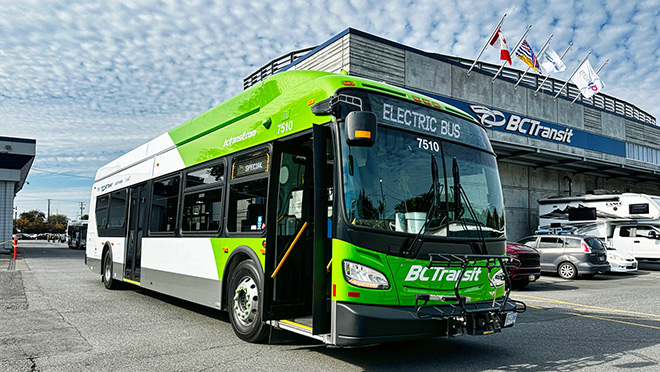
 Electric buses arrived on the streets of Victoria with the initial arrival of 10 buses in 2025. BC Transit is working to lower carbon emissions in its fleet of 1,150 buses across B.C., in line with CleanBC mandates.
BC Transit plans rollout of 80 buses in B.C. cities by the end of 2026
BC Transit is riding a made-in-Canada solution that has put battery-electric buses on the road in Victoria.
The first 10 buses are now in use in the Victoria Regional Transit System. And by the end of 2026, BC Transit hopes to have 80 electric buses – powered by overnight plug-in chargers – in service in B.C. communities including Kelowna, Kamloops, Nanaimo, Nelson, Powell River, the Sunshine Coast, Victoria and Whistler.
BC Transit is working to lower carbon emissions – they have a fleet of 1,150 buses across the province – in line with CleanBC mandates. Built by Quebec's Nova Bus and Winnipeg's New Flyer, each bus will save an estimated 77 tonnes of CO2 emissions annually when compared to a diesel equivalent.
What does that add up to? The combined 10 electric buses in Victoria are estimated to reduce carbon emissions by nearly 95%, or the equivalent of 12,000 tonnes of CO2 over their lifetime.
Each electric bus will save about a tanker truck of diesel fuel per year, or about 550 fill-ups for a mid-size car.
The buses in Victoria are a modified version of New Flyer's Xcelsior CHARGE NG™ model. And so far, they seem to be a hit with what BC Transit drivers, also known as operators.
"Our operators tell us they really enjoy driving them," says BC Transit Electrification Program director Chad Berndt. "One of the advantages of an electric bus is that it's similar to driving an electric car. With a diesel-powered bus there's a lot of switching from gas to brake to gas to brake, but with electric buses there's regenerative braking that's controlled by the gas pedal. Operators don't have to move their leg as much and that's good."
Passengers may also find they prefer an electric bus. "They're really smooth, with smooth acceleration and no gears," says Berndt. "Speed is easy to control, and there's less noise and vibration. You can have a nice conversation even while the bus is pulling away from a stop, whether you're on the bus or on the sidewalk"
All of the new buses in Victoria are powered by overnight plug-in chargers installed at the Victoria Transit Centre, taking four to six hours to fully charge. That gives the vehicles a daily range of about 500 kilometres, which is plenty of power to meet service needs. The average daily use of buses in the Victoria area is around 200 km, and most buses so far have returned to the depot with plenty of energy left in their battery packs.
A high-speed overhead charger – known as a pantograph – has also been installed, allowing for rapid midday top-ups if needed.
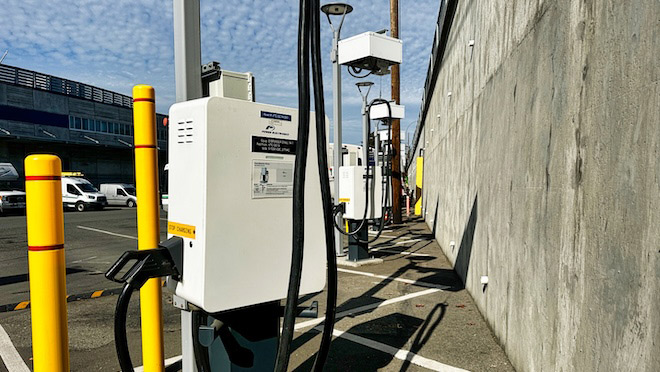 By relying on clean BC Hydro electricity at dedicated bus charging stations like this one in Victoria, BC Transit expect that each bus will save about a tanker truck of diesel fuel per year, or about 550 fill-ups for a mid-size car.
New Flyer and Nova buses already proven reliable in Canada
BC Transit's plans to roll out battery-electric buses were announced in 2022, when BC Transit announced that it was buying 10 electric buses.
One advantage of placing orders with established Canadian-made companies, Nova Bus and New Flyer, is that the buses have proven abilities in Canadian climates.
"New Flyer and Nova buses are largely based on existing platforms and chassis," says Berndt. "I think what we've seen is that New Flyer and Nova made a lot of progress in the last few years in advancing those platforms, which is great to see."
BC Transit expected a range of between 240 and 400 km with the new electrics, ranges that have been surpassed since they were introduced in Victoria in late summer. Berndt expects range will fall a bit in cooler weather, but when cold snaps arrive, the buses can be heated by auxiliary fuel heaters that will take some of the demand off the buses’ battery packs. Berndt says every extra kilometre that they can drive the electric buses will reduce emissions and save on fuel.
Berndt is also confident the buses will perform well when the snow arrives. Winter operation of electric buses in places like Toronto, Montreal, Winnipeg and Ottawa has established that electric buses are extremely capable.
The cost? Berndt commented that it’s still early in this technology transition and that’s when costs are highest. Today electric buses plus the chargers add up to a capital cost roughly twice that of a diesel bus. The savings (other than carbon emissions) are estimated to be about 80% on fuel costs compared to diesel.
That helps a lot, but the up-front costs will need to come down and cost efficiencies will be required to support continued growth.
"This is how technology advances,” says Berndt “There’s a learning rate. Someone starts making it for the first time, then they get better at it, then more people buy it, then they get better at making it again, that brings the costs down, and the cycle repeats. This has been true of everything from computers and flat screen TVs to lithium batteries and solar panels."
BC Transit has leaned on $28.6 million in joint funding for the rollout of the Victoria buses, delivered through the Public Transit Infrastructure Stream of the Investing in Canada Infrastructure Program, with contributions from the Government of Canada, the Province of British Columbia, and the Victoria Regional Transit Commission. BC Hydro contributed funding through our EV Fleet ready program for implementation of the first phase of charging.
Further funding of $395.5 million for BC Transit electric buses and infrastructure was announced in July 2023, supported in part by the Zero Emission Transit Fund and the Investing in Canada Infrastructure Program.
Getting to zero emissions will take time
BC Transit is actively working to transition to zero emissions. Adding electric buses to the fleet is just one part of the plan that includes:
- Using renewable fuels to lower emissions for diesel buses;
- Purchasing hybrid electric-buses; and
- Continuing to plan for future electric bus expansion, both for infrastructure and fleet.
"Electrification is more than just buses – there’s an ecosystem behind it, with charging infrastructure, operational changes, and IT systems required," says Berndt. "All of this takes time, expertise, and funding."
BC Transit worked with BC Hydro for capacity planning.
"BC Hydro has been a great partner for us on these projects," says Berdt.
For now, BC Transit is preparing to receive the rest of the 125 electric buses on order, expected between now and 2027. The organization is looking forward to getting electric buses into more communities, where more customers can benefit.