

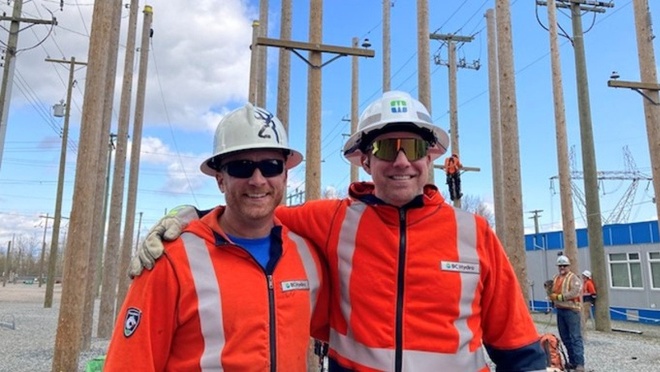
 Our power line technicians Wes Nustad (left) and Curt Minard take a break from evaluating Power Line Technician (PLT) boot campers. Aspiring PLT's are assessed in part on their self-awareness and team mentality, including whether they'll have the courage to intervene when they think work has become unsafe.
Speaking up about danger, harassment helps keep us all safe
Curt Minard knows all too well when hazards prevail and disaster strikes as a power line technician. Minard survived a near-death electrical shock incident — burned severely by 14,400 volts in 2008 – when he followed an order that ran against his instincts and cost him his left hand.
"My intention is never to scare candidates with my story," says Minard, now a foreperson PLT and instructor at our Trades Training Centre. "My intention is to inform people that this is one of the top 10 most dangerous jobs that you could pick. It isn't for everybody. This job comes with high risk and ever-evolving hazardous situations."
From 1971 to 2010, BC Hydro lost 29 employees to workplace fatalities. After the death of Brandon Beday in 2010 the Safety Taskforce was formed to bring together a team of dedicated, safety-minded employees from different operational backgrounds and business groups to determine why serious safety incidents had been occurring and to develop recommendations to significantly improve BC Hydro's safety performance. The results included the formation of the 9 Life Saving Rules, and its overarching value to have the "courage to intervene," a product of Minard's harrowing incident. This sets the key expectation that all employees and contractors can initiate a safety stop if they observe an unsafe act, condition, or someone who is unfit for duty.
Taking action in the face of unsafe conditions, behaviour, or decisions is a cornerstone of our work culture and something we should all embrace.
"I think courage to intervene is a universal concept that can be applied very broadly," says Brian Robins, our longtime employee who has worked as an electrician, trades training instructor and now as a safety advocate. "If you see something unsafe, report it. It could be a worker safety issue, a wildfire that’s started — get on the phone and report it. Or it could be someone in distress who needs help."
Robins says bystander syndrome, where a person freezes instead of reporting or helping in some other way, is fairly common. "It's like ‘someone needs my help, but I don't know what to do'. It takes courage to act."
On the job, it can be tough to speak up when you're not confident, are inexperienced, or you fear that a "safety stop" could lead to costly delays. In his job as a safety advocate, Robins sometimes field calls from workers concerned about possible risks who are not quite convinced stopping work is in the company's best interests.
Robins says it's better to have the courage to speak up, even when you may not be 100% correct, than to stay quiet and have something go wrong. At BC Hydro, a Safety Stop is the tool that provides a common language for our employees to put our courage to intervene into practice, and stop a potentially unsafe situation.
Public programs urge us to help, stand up and “report it’
B.C.’s ERASE program provides training for educators and features an anonymous online reporting tool designed to foster safe, caring school communities by preventing bullying, harassment, and violence. HereToHelpBC encourages students to speak up, refuse to join in, support the victim, and report to adults.
Both B.C. programs, and to a certain extent our "courage to intervene" policy, are in keeping with the widely-promoted "“5Ds of bystander intervention":
- Direct (speak up)
- Distract (interrupt)
- Delegate (get help)
- Delay (check in later)
- Document (record)
Robins stresses that empathy plays a big role in the courage to intervene. A resident of the Sun Peaks community near Kamloops, Robins says he recently encouraged his young son, whose close friend had recently lost their father, to be alert to when that friend might need some support in navigating a difficult time.
"My wife and I are adamant that we want our children to be empathetic and mindful," he says. "We ask them to put themselves in another person’s shoes and to stand up when that person needs you."
Help get the word out on student summer jobs and electrical safety
Three out of five overhead or underground power line incidents that cause serious injuries or fatalities in B.C. involve seasonal workers. Many workers start summer jobs such as house painting or gutter cleaning without knowing the basics, including "look up and look down to analyze a work site for electrical hazards before starting work."
New data from WorkSafeBC shows that electrical incidents overwhelmingly affect workers outside the electrical trades who may still be exposed to power lines as part of their jobs such as construction workers, window washers, painters, surveyors and crane and heavy equipment operators.
We offer a free self-guided online 45-minute Electrical Safety for Trades and Workers course that’s offered in English, Cantonese, Mandarin and Punjabi, along with information about how to stay safe while working near power lines.
Knowing how to help is a key to electrical safety
Our survey a year ago found that while most B.C. parents worry about electrical hazards inside and outside of the home, only a third discuss electrical safety with their children occasionally or regularly.
The survey also highlighted a significant gap in electrical safety awareness among B.C. parents. Only a third correctly stated that the proper response to a downed or damaged power line is to stay back at least 10 metres and call 911. And some parents mistakenly believed that posting about the incident on social media was the best course of action.
Through Power Smart for Schools, we offer free, curriculum-aligned electrical safety resources for K-12 students in B.C, with a focus on identifying hazards and preventing accidents. The program teaches crucial skills, including bystander basics including:
- Staying 10 metres away from downed power lines
- Ensuring that others also stay 10 metres back
- Calling 911
- Resisting the urge to rescue someone near a downed power line or in a vehicle that has struck a power pole or is in contact with a power line.
Last spring, our staff discovered teenagers dangerously scaling a transmission tower in Coquitlam, where they had also ignited a fire close to power lines. A few weeks earlier, emergency responders rushed to a similar scene in Vancouver, where two teenagers were spotted climbing more than 30 metres (100 feet) above the ground.
Thankfully, no injuries were reported in either case, but these incidents serve as a powerful reminder of the importance of education in preventing such hazardous situations.
Did you know? Each year on July 10 is National Lineworker Appreciation Day in Canada. It’s a time to appreciate those who work across the nation to keep electricity flowing into our homes, schools, hospitals, and businesses. The date of July 10 was chosen to mark the anniversary of the death of Henry Miller, the founder and first president of the International Brotherhood of Electrical Workers, in 1896.
Other safety and mental health programs
Be more than a bystander (BC Lions)
Courage to act: gender-based violence
Moose Hide campaign (Indigenous-led program combatting violence against women and children)