

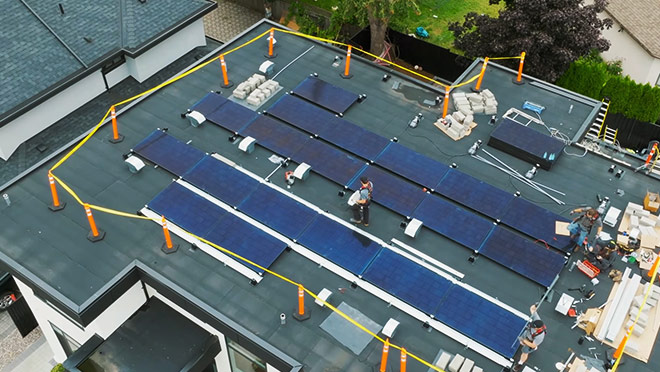
 BC Hydro solar and battery rebates have helped grow solar installations in B.C., and a new guide will help local governments develop more effective permitting for solar and energy storage.
Solar and battery permitting guide released
In the two decades leading up to 2024, the number of BC Hydro customers with solar power installations rose from a few hundred to nearly 9,000 across the province. That's not exactly a solar boom, but there's growing interest in using the sun to help power homes, especially since BC Hydro introduced solar and battery rebates in 2024.
"You don't see as many solar panels on people's roofs in B.C. as you might in other provinces or in some areas in the U.S., but that's changing, and it's becoming a priority now,” says Rebecca Cuttler of the Community Energy Association (CEA).
As interest in solar grows, installers are facing a patchwork of regulations across municipal jurisdictions. While electrical permits required for all solar and energy storage installations are consistent—and usually issued by Technical Safety BC—that's not the case with structural building permits. It's up to each local government whether to require building permits for solar projects.
Among the complicating factors around permitting are variations in roof and building type, seismic and snow load considerations.
BC Hydro and the CEA have partnered to study the permitting challenge and develop recommendations for local governments. Those findings and recommendations are detailed in the Solar and Battery Permitting Guide for Local Governments, available for download on the CEA website.
"Local governments are trying to figure out how to design permitting systems that work well," says Cuttler. "We want to help local governments handle permitting quickly and effectively to support climate goals and to meet the growing demands of homeowners."
The guide includes a detailed overview of codes and standards pertaining to both residential and commercial rooftop solar and battery systems in B.C. It also details key findings from the research via consultation with local government staff, solar installers, utilities, and regulators, plus a lengthy list of recommendations for local governments that include:
- Developing clear online materials on solar permitting and creating an online permit application portal
- Familiarizing staff with industry best practices for solar photovoltaic and battery energy storage installation.
- Providing training for staff, and holding information sessions for residents and installers
- Fast tracking retrofit solar PV applications in your building permit queue
- Working with neighbouring municipalities and regional districts to develop a consistent regional approach to permitting
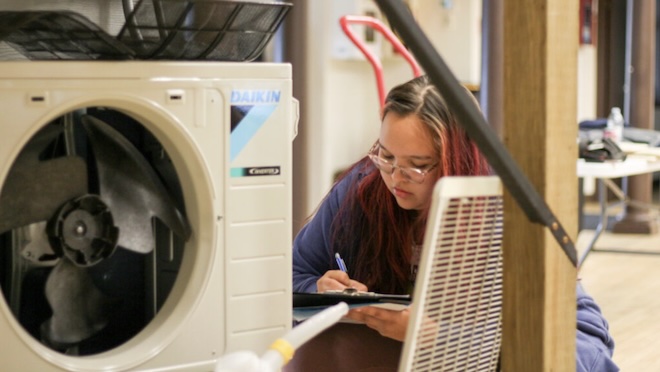 Trainee Lilliann Robinson from Kitasoo Xai'xais Nation takes notes during heat pump maintenance training at Skidegate's community hall last fall.
Heat pump maintenance training builds skills in First Nations communities
Starting with the Skidegate Band on Haida Gwaii in 2015, heat pumps have steadily become a go-to, affordable, and efficient home-heating solution for First Nations communities in remote coastal areas of central and northern B.C.
But while there are now more than 1,000 heat pumps installed in these communities—including many that get the bulk of their electricity from diesel generation—maintenance of these systems has proven costly.
Now, a new heat pump maintenance training program is shifting that story. Blending online lessons with hands-on workshops at Skidegate's community hall, the pilot is equipping community members from six Nations (Skidegate, Old Masset, Heiltsuk, Kwikwasut’inuxw Haxwa’mis, Metlakatla, and Kitasoo Xai’xais) with the skills to handle basic maintenance themselves. The initiative reduces the reliance on distant contractors and builds local capacity where it's needed most.
"The contractors who installed these heat pumps were mostly from urban centres on Vancouver Island and the Prince Rupert area," says Shakya Sur, who works as climate action facilitator for Coastal First Nations. "But until recently, there's been very limited capacity in these communities to maintain them, and they've incurred tremendous costs in transporting contractors from far away to do the maintenance."
Although most regular maintenance doesn't require HVAC-certified tradespersons, communities have been forced to spend between $50,000 and $80,000 annually to fly contractors in.
The new heat pump maintenance training program is a collaboration between Coastal First Nations' Indigenous Climate Action Network (ICAN), the British Columbia Institute of Technology (BCIT), and Coastal Heat Pumps, with on-the-ground support from Garrett Russ, the Skidegate Band Council's climate action coordinator, and funding from BC Hydro.
Fifteen trainees from six communities took part in the online training, and the majority participated in three days of hands-on training in Skidegate. The training centred on two heat pump demonstration units—one ductless version, the other ducted.
Trainees included staff from housing, public works, operations, and maintenance departments, as well as local contractors and tradespeople.
Virtual coaching over three months has been set up as a follow-up for the students who are expected to be capable of providing basic maintenance. Certified licensed technicians are only called in from elsewhere for major fixes.
Given the success of the pilot program, there are plans in the works to extend heat pump maintenance training to other First Nations communities around B.C.
"I think the real work starts now in terms of setting up the right support systems so that those who took the training can do the work in these communities," says Sur, adding that he's looking for help from British Columbia Institute of Technology (BCIT) in ensuring trainees have the necessary tools to carry out maintenance.
The good news, according to BCIT's Mary McWilliam, is that few specialized tools are needed and are relatively affordable.
"Most of our students had the required tools in their workshops, because they're in remote communities and are resilient and resourceful," said McWilliam, project lead with BCIT's Zero Energy/Emissions Building Learning Centre. "It's a minimal cost to get any missing items, which are part of a shared tool kit that can be used by a maintenance team across a community."
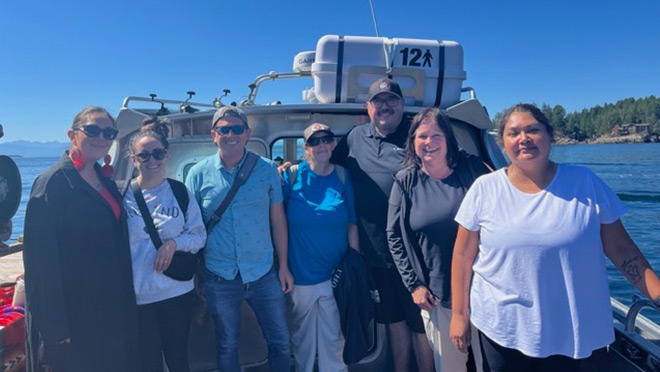 Sharon McKay (second from right) with her fellow Tla'Amin Nation Housing Department team members on a boat trip off the B.C. coast.
Partner Q&A: Sharon McKay, Tla'amin Nation housing manager
Sharon McKay is bent on making better, energy efficient housing more of a priority in BC First Nations communities. Growing up in Clearwater, she didn't learn until she was 29 and a mother of four that she was a member of Simpcw First Nation, one of 17 bands that make up the Secwe̓pemc, or Shuswap Nation. She has since worked on First Nations housing, starting as housing manager for the Simpcw band in 2019, and began working as housing manager for the Tla'amin Nation north of Powell River in August of 2025. BC Hydro's Indigenous Energy Management program is providing funding for an energy manager staff position in Tla'amin Nation, who Sharon will be overseeing. Six months into her new job, and a few months after attending her first BC Hydro Ideation workshop, we talked to McKay about her background and her role with the Tla'amin Nation.
Powering Communities: You ran a market garden at Ashcroft, B.C.'s Desert Hills Ranch, spent some time in the forestry industry and then earned an arts degree at Thompson Rivers University in Kamloops. How did you decide to make First Nations housing your career?
Sharon McKay: I thought I wanted to go into teaching or social work, but neither was really a good fit. So I went to Vancouver Island University and took the First Nations Housing Management certificate program there. I started working with the First Nations Housing and Infrastructure Council, working across B.C. on asset management. But I wanted to go back to working directly with a Nation, and found the position with the Tla'amin Nation, which I've found to be very progressive.
Powering Communities: What excites you about your new position?
Sharon McKay: For me, it's looking at our whole housing portfolio instead of one or two homes. We want to make sure a bigger scope of our needs, challenges, and resources are met. I'm big on networking and making sure we have things in place, including the right contractors. I think we now have a more effective plan around housing inspections, and we're working on creating a better asset management strategy—seeing what our 25-year plan is, and not just our immediate needs.
Powering Communities: At BC Hydro, we make it a priority to support partners on energy efficiency initiatives. What are some of the things you're working on now as Tla'amin Nation housing manager?
Sharon McKay: Our housing team has really grown, so my first work was working with my peers and what needs to be done within the Nation. I've already worked with BC Hydro on building inspection program permits, and we're now trying to implement them with the Tla'amin Nation. Another huge thing we're doing is transferring ownership of about 80 homes from the Nation-to-Nation members ownership. We're also handling rentals and repairs and following up on building permits, which wasn’t a process that was always followed in the past.
Powering Communities: You've said that you're dealing with about 240 homes on the reserve and have a plan to upgrade about 20 per year. What are some of the challenges you're facing?
Sharon McKay: Lots of our houses don't have the housing envelope that you should expect, that is up to standard. When we're doing home inspections and looking at the energy component, we consider upgrading to heat pumps. But a lot of these houses don't have adequate insulation or windows, and you need a quality housing envelope to make heat pumps successful. One exciting development is that we're hiring an energy manager through BC Hydro to oversee this.
Powering Communities: Do you think housing sits at or near the top of the priority list for most First Nations in B.C.?
Sharon MacKay: Unfortunately, I think it's near the bottom end of the priority list for most Nations. Sometimes, our goals are more about source revenue and not what our housing stock looks like. I'm very proud of the Nation I'm from [Simpcw], because 90% of the homes there are owned by band members, and when you own your own home, it becomes a higher priority. We're also facing funding challenges, staffing capacity, and a lot of times we're hiring someone who doesn't have skills around housing and needs a few years to develop. I am also very proud of the Nation I am currently working for. Housing is a priority for the stock they have now and the new homes they intend to build. Departments work together to make sure we are working for the betterment of everyone in the community.
Powering Communities: In your first BC Hydro Ideation Workshop this past fall you pitched—successfully—a project to create support networks around energy and housing across B.C. First Nations. Were you surprised your project idea was voted as one that would move forward, complete with BC Hydro funding?
Sharon MacKay: I actually didn’t think my idea would get picked. But it's exciting. This ideation approach is a way to ensure that the unheard are heard, and it's great to see funds are going into something that really supports Nations, including those outside the Lower Mainland and the Island. You can pitch us the idea of heat pumps, but if we put them in our community, they're not effective if we're not trained in how to use them and maintain them properly.
Powering Communities: What are other ways you've collaborated with Indigenous communities and local governments on the Sunshine Coast and beyond?
Sharon MacKay: I used to work for 32 nations in the B.C. Interior, helping get them educated and getting support around housing. We got funding for health and safety, for the development of building policies and procedures. Within those 32 Nations, we created pods, smaller groups that could network to fill some of their education gaps and support each other. If one Nation is bringing in a heat pump expert, or someone who is building fourplexes, they can share what is learned.
Powering Communities: What do you like about the Sunshine Coast, and what advice can you offer to visitors?
Sharon MacKay: I love the ocean, I have a boat, and my kids have grown up going on ocean trips. I still own my home in Clearwater and live in both places—both are beautiful parts of B.C. I'd say that visitors should explore the walking trails on the Sunshine Coast and get to know the people who are in the coffee shops, the grocery stores. Everyone is so friendly, and it's a humbling place to live. And if you get the chance, go to Savary Island—put it on your bucket list.
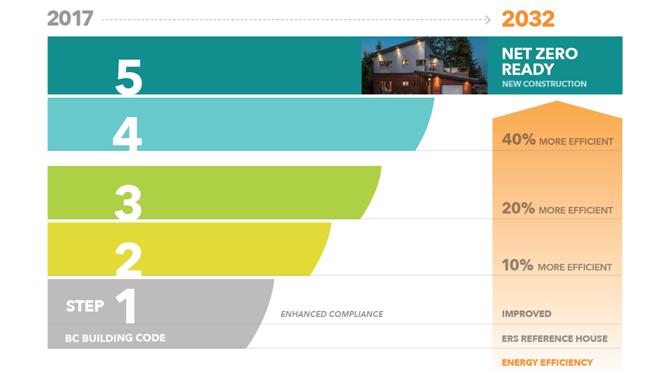 The BC Energy Step Code moves into very high-performance territory at Step 4, and then to Net Zero Ready in Step 5.
Two steps beyond: Part 9 building guide gets an update
An updated, highly visual guide to the BC Energy Step Code is on the way—and it's designed to help builders better understand what Steps 4 and 5 actually require.
Developed by a working group that includes BC Housing, BC Hydro, and the Community Energy Association, the guide responds to a growing need in the industry. While most builders are already comfortable with the first three steps for Part 9 residential buildings—houses and low‑rise multi‑family up to three storeys—the higher steps move into very high‑performance territory that approaches net‑zero‑ready construction, an area where many still want clearer direction.
"It's a challenge to meet these steps, so we're working on an illustrated guide designed to better demonstrate the key concepts around steps 4 and 5," says Ryan Gregory, BC Hydro's program manager of building policy. "It's designed to be useful for builders, both for their own education and in their conversations with the likes of owners, consultants, and building officials."
The Part 9 guide was last updated in 2020, and is due to become available for purchase in its updated form online this spring on the BC Housing site.
Gregory says the visual aspects of the new guide should make it suitable for reference on laptops and tablets in particular. He emphasizes that it's the result of a lot of feedback gathered from a variety of stakeholders including the Canadian Home Builders Association BC (CHBABC).
"We frequently interact with the leading edge of builders that tend to be very familiar with the step codes and with experience operating in that world," says Gregory. "I was much more interested in whether or not this guide is useful to the everyday builder. So we reached out through the CHBABC to access their network of builder members to solicit feedback on the previous guide. We got really good feedback from more than a dozen builders, and we've incorporated it into the updated guide."
Steps 4 and 5 of the BC Building Code increasingly emphasize reducing carbon emissions, and work in tandem with the Zero Carbon Step Code. Steps 4 and 5 focus on airtightness and the building envelope, along with efficient mechanical systems, increasingly paired with zero-carbon, all-electric requirements.