

 Many local governments were early adopters of EV Ready bylaws. A new report lays out recommendations for building on the successes of these bylaws, and strategies to support their implementation to better serve the needs of EV drivers in multi-unit residential buildings.
Charged and Ready: insights for delivery of EV Ready bylaws
More than 35 local governments in B.C. now require new buildings to include electrical infrastructure for future EV charging.
A new report – Charged and Ready: EV-Ready Residential Building Experiences in BC – shines a spotlight on the important role these bylaws have played in supporting EV adoption and offers recommendations to strengthen them.
EVs now make up almost a quarter of new vehicle sales in B.C. By introducing EV-ready bylaws, many new residential buildings—especially multi unit residential buildings (MURBs)—are designed with infrastructure to support home charging. Local governments have been instrumental in making charging more accessible and equitable, while preparing for rapidly evolving technologies and growing demand.
The study, led by Metro Vancouver and the City of New Westminster and supported by multiple partners, was developed by Watt Consulting Group and Introba to shed insight into the evolving needs of EV-ready bylaws.
One of the report's key findings is that while most residents in EV-ready single-family and multiplex homes are satisfied with their home charging experience, about half of EV drivers living in MURBs face challenges.
Those survey results echo what the project team had heard before the study was launched.
"We've been heared reports of issues with implementing existing EV-ready bylaws," says Johann Zerbe, a senior policy and planning analyst with Metro Vancouver. "The goal was to get a sense of how well they're working and what can be improved, since a number of them have been in place for six or seven years."
Victor Ngo, project lead at WATT Consulting Group, says it's rare that public policy and bylaws get such an in-depth evaluation.
"This project is unique," says Ngo. "We tried to get a comprehensive view from across B.C., from EV drivers, electrical engineers, electricians, building officials, property management, strata associations, and the development industry."
One thing that stood out for Metro Vancouver's Zerbe was that residents and strata councils face a knowledge barrier around EV charging. "The technology is changing so fast," says Zerbe. "It's all still so new, with challenges and issues arising."
One way EV-ready bylaws and associated tools can help residents, building owners, and strata councils navigate changing technology and improve energy efficiency is by encouraging the use of certified energy-efficient chargers, such as ENERGY STAR models. A CSA energy efficiency standard for Level 2 chargers is in development. Integrating smart chargers and EV energy management systems can also help manage electrical service size and enable participation in demand response programs.
The report highlights seven recommendations:
- Strengthen EV-ready requirements and design standards, including a one-stall per unit charging requirement.
- Explore a province-wide EV-ready requirement for new residential buildings.
- Enhance EV-ready permitting and construction processes, including BC Government clarification around municipal authorities' and Technical Safety BC's role in permitting, and local government development of checklists, model drawings, and on-site field reviews.
- Establish an EV charging operational plan that requires developers to submit operational plans authored by electrical engineers for EV ready buildings.
- Expand education and training for residents, strata councils, and contractors.
- Work with service providers to improve agreements, communications, flexibility of contracts, and shift to brand-agnostic software.
- Conduct cost-benefit analyses on rebates for EV energy management systems in new EV-ready single-family homes.
The report will be presented to the Community Energy Association;s Electric Mobility Peer Network, enabling local governments to explore and implement these recommendations. With EV ownership growing and EV-ready bylaws accelerating market transformation, many building owners are now preparing for home charging.
Here are a few additional resources for those looking into charging options in both MURBs and single-family homes:
Electric Vehicle Charging in Multi-Unit Residential Buildings (CEA)
Implementing Electric Vehicle Charging Infrastructure in Multi-Unit Residential Buildings (Plug In BC, Fraser Basin Council)
Keeping it Current: Primer on EV Charging Infrastructure (Metro Vancouver)
EV Ready New Construction Requirements: A Best Practice Guide for Local Governments (BC Local Government EV Peer Network)
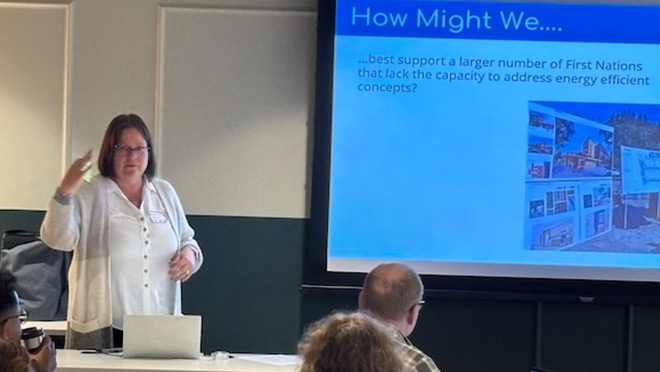 As a new Indigenous Energy Manager, Sharon McKay for the Tla'amin Nation– made her debut at this year’s Ideation workshop, with a successful project pitch aimed to help more First Nations build capacity for energy efficiency.
Energy meets innovation: BC Hydro's Ideation Workshop turns 10
A decade ago, community energy managers across B.C. began gathering annually to pitch projects that could help advance climate action solutions and energy efficiency.
The idea was to generate game-changing projects that solve common problems for communities across B.C., build relationships and connections between local government and First Nations.
"We gamified it, using the Dragon’s Den-style format, helping partners move from problems, to concrete, impactful projects," says Robyn Wark, who leads BC Hydro’s market transformation team.
How has that worked out?
According to Erik Blair, Metro Vancouver senior planner, who has been there from the beginning, it has thrived and has built a strong community along the way. “There was some discomfort at first,” says Blair .
“There’s strong alignment across this group. We workshop the ideas. Any discomfort quickly turned into excitement with the understanding that these projects were directly helping us meet climate and energy goals.”
Sharon McKay, housing manager for the Tla'amin Nation and a workshop rookie in 2025 – is an instant convert. Not just because her pitch was one of only five that earned enough votes in the October workshop to move forward.
“I like the one-minute pitch because it gets to the point – you either sell it or you don’t,” said McKay, “I'd like to take this workshop format with our own departments in the Tla’amin Nation. It’s a great way to support each other.”
Here’s a quick look at the five projects that got the nod at the October 2025 workshop:
Outreach Algorithm: Better understanding data to promote energy efficiency. Identify available datasets and tools that can help local governments advance energy efficiency in Part 9 and Part 3 residential buildings.
Got Sol? Building a guide to community solar. Develop a Community Solar for Local Governments guide with case studies and governance models.
Cool Condos: Equipping MURB residents and strata councils with information and solutions on overheating. Develop educational resources and sessions to address overheating in MURBs.
Collaboration Nation: Enable more energy efficiency solutions in First Nations buildings and housing. Develop a practical and culturally relevant framework to strengthen peer-to-peer relationships with First Nations energy and housing staff, with the goal of enabling energy efficiency solutions in First Nations communities.
Hybrid 2 Hundred: Understanding the pathways and performance of retrofitted hybrid heating systems in detached homes. Develop transition pathways for homes to meet 100% efficiency as they shift from legacy heating systems to integrated heating and cooling.
How it works: two days of collaboration
Each two-day Ideation workshop starts with one-minute project pitches and blind voting to select top projects. Participants also share feedback for the project ‘ideas’, merge similar ideas, and refine project scope. Through a day and a half of creative insights and collaboration, each ‘winning’ project is refined and teams are formed with representatives from local governments, First Nations communities, and industry.
The challenge isn’t to fund a pre-baked project idea. It’s to lean into the group’s insights, collaborate, and develop projects that advance common goals and deliver resources and tools to support energy efficiency in communities across B.C.
We co-fund 19 community energy managers and four Indigenous energy managers across B.C. We also provide funding to each Ideation project team. All guides, toolkits, and lessons produced are shared through hlocal government peer networks, industry channels, and at the annual Empowering Communities Forum.
Here are a few examples of projects delivered in past years:
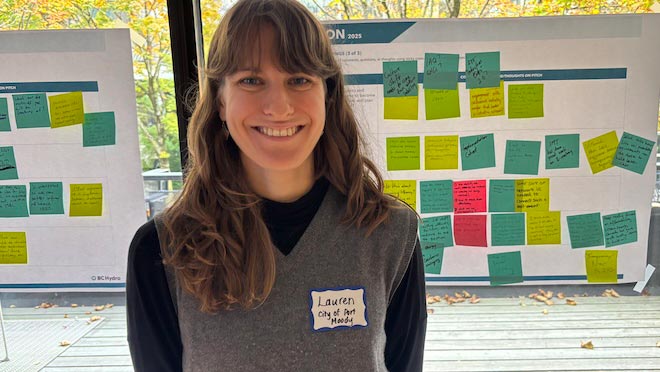 Lauren Vincent made her BC Hydro Ideation workshop debut in October as the City of Port Moody's new Senior Sustainability and Energy Team Lead.
Partner Q & A: Lauren Vincent, City of Port Moody
Port Moody is celebrated across Canada as a craft beer capital with its iconic Brewer’s Row, it’s also a leader in bold climate action and zero emission initiatives. Earlier this year, Lauren Vincent joined the City as a Senior Sustainability and Energy Team Lead, a role co-funded by BC Hydro’s Community Energy Manager program. We sat down with her to discuss her background, her first weeks on the job, and her experience at her first Ideation workshop.
The following has been edited for clarity and brevity.
Powering Communities (PC): As we speak, you’ve been on the job at Port Moody for about six weeks. How did you get here?
Lauren Vincent: I started out as a consulting engineer working on projects that were impacted by climate change, but where it wasn't always being explicitly considered. During my Master of Science at UBC, I realized I didn’t want to do climate work off the side of my desk anymore. I pivoted into doing climate work full time, first consulting at Ostrom Climate, then as associate director of Simon Fraser University’s (SFU) Action on Climate Team and now here at Port Moody. I like that working in a municipality allows you to think more holistically about climate action and all the various ways that it impacts how we live, work and play.
PC: Why did you want to work for the City of Port Moody?
LV: I worked with the Action on Climate (ACT) team at SFU. ACT worked closely with the City over the past five-plus years to integrate a low carbon resilience lens into the climate action work. I’d seen the kind of leaps and bounds Port Moody had made, so it was part familiarity and part an appreciation for the work they're doing here.
PC: What was Port Moody looking for from you?
LV: We’re developing a coastal flood management strategy. This plan will determine how Port Moody will adapt and reduce vulnerabilities by strategically addressing flooding risks now and into the future. We’re also refreshing our Climate Action Plan, reviewing what has been implemented since 2020, and reprioritizing actions for the next five years.
PC: You’re getting immersed in a number of initiatives, including energy efficiency. What’s happening there?
LV: Port Moody has a voluntary energy benchmarking initiative for Part 3 buildings. We report on all our civic buildings, but now we're talking about making benchmarking disclosure a requirement for Part 3 buildings. We see energy benchmarking and disclosure as a foundational action to accelerate retrofits for decarbonization and improve energy efficiency within the built environment. We’re looking to other municipalities to see how they rolled it out.
PC: How are you gathering that information from other municipalities?
LV: Through BC Hydro, we hired a UBC Sustainability Scholar to write some recommendations for Port Moody, specifically based on what other municipalities have done. That was a helpful way to get a bit of the lay of the land and to understand where we might go next.
PC: Port Moody has adopted a new Zero Emission Municipal Building Policy. What are some of the highlights of that policy?
LV: The Policy, adopted by Port Moody Council in September of 2024, requires all new city buildings, major additions and renovations, be designed and operated to achieve net-zero carbon emissions. It builds on Port Moody’s early adoption of higher levels of both the Energy Step Code (ESC) and the Zero Carbon Step Code.
PC: What do you see as some of the hurdles to enforcing evolving building codes and standards in the community?
LV: There’s a perception that sustainability and climate action slow development processes and add costs. So, for us, part of our messaging is now focusing on the savings that can happen from implementing climate action steps and sustainable practices. We need to frame it both as increased resilience and as a cost savings measure.
PC: Where are you getting the cost-saving numbers from?
LV: There are good case studies out there, such as the RDCK's studies on of cost effective ESC compliant buildings, the BC Housing report on costs of high performance buildings, and ZEBx's case studies on a variety of retrofits. We're always looking to find studies that are relevant to the work we’re doing.
PC: What's one good news story out of Port Moody you'd like to share?
LV: We just presented to our Climate Action Committee on EV chargers. The new BC Hydro chargers at our Port Moody Recreation Centre ave shown high usage since installation. We saw a doubling of charging usage in Port Moody between the summer of 2024 and summer of 2025. The new chargers are clearly meeting a growing need for EV charging.
PC: Through your experience working on municipal climate action, what resources or peer networks would you recommend to others in local government focused on sustainability and energy efficiency?
LV: Even before working in a municipality, I was involved in the Retrofit Peer Network sponsored by BC Hydro and run by the CEA, and federally through the Federation of Canadian Municipalities (FCM). In-person conversation is great when you can do it, but virtual discussions can also be a great resource for ideas.
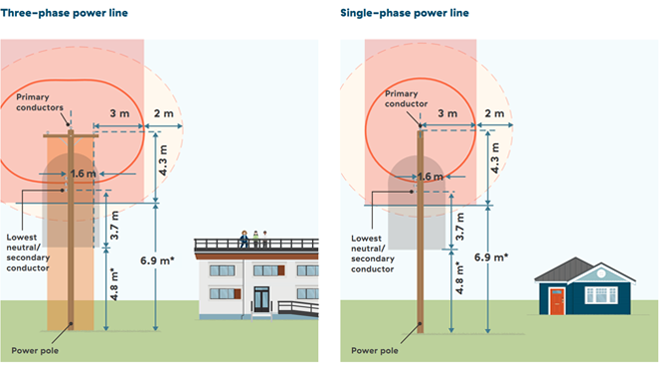 New visuals replace complex tables and calculations in our new guide to utility clearance requirements.
Updated clearance requirements to support safer, smarter design
As communities densify, taller buildings are getting closer to property lines and near BC Hydro infrastructure. In response, our safety and distribution standards team has updated its clearance requirements [PDF, 684 KB]. These changes clarify how new developments can stay compliant and avoid costly delays.
“In the previous five years, there’s been one fatality and eight serious injuries involving third party contact with overhead power lines during routine building maintenance, such as gutter cleaning, roofing, and painting,” says Anita Ansari, BC Hydro public safety advisor, noting that BC Hydro strives towards a zero-incident goal.
Clearance requirements ensure buildings are designed so maintenance can be safe for everyone. “This update helps developers and builders make informed decisions to optimize lot usage without sacrificing safety considerations,” says Ansari.
The revised clearance requirements document illustrates two distinct changes:
- New visual diagrams replace complex tables and calculations. These visuals make it easier to understand space requirements to ensure safety.
- CSA code updates and new transformer technology that allow for more favourable clearances, enabling larger building footprints without compromising safety.
Builders and developers are responding positively, though concerns remain for existing buildings or previously approved designs that violate current clearance requirements.
“Our responsibility is to share safety hazards and minimum utility clearance requirements around overhead powerlines,” says Ansari, noting that BC Hydro is working collaboratively with industry and local governments to ensure they fully understand the requirements.
The updated requirements have been shared with industry partners such as the Canadian Home Builders Association, Technical Safety BC, and designers. Upcoming presentations with the Urban Development Institute, Small Housing BC's Gentle Densification Network, municipalities, and other partners are planned in the next three months.
News from BC Hydro and our communities
- BC Hydro opens first-of-its-kind portable EV charge site in Lumby
- BC Hydro submits long-term plan to power B.C.'s economic future
- Milk, nutrition, and energy savings in Abbotsford
- Live in a B.C. strata? 8 things about power in your building
- Cadillac-Fairview tackles downtown CO2 emissions
- Rooted in reconciliation: honouring land, legacy and community in North Vancouver