

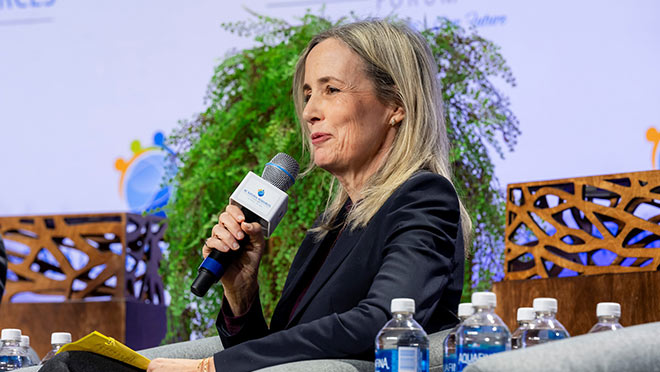
 Clean energy investment and the connection between electrification and efficiency were key themes at the 2026 BC Natural Resources Forum.
Opportunity, innovation and success
The BC Natural Resources Forum (BCNRF) has grown over the past 23 years to become Western Canada's largest multi-sector resource conference bringing First Nations, government, and the natural resource sector together to discuss opportunities, innovative solutions, and success stories.
The event hosts a large contingent of federal, provincial, and local government leaders and provides a positive, non-partisan arena to discuss and learn the latest news, trends and opportunities within the resource sector in B.C. and across Canada.
BCNRF 2026, held on January 20-22 in Prince George, came at a pivotal time for the province. With electrification accelerating across every sector and BC Hydro's recent announcements about record setting clean energy proposals and new transmission investments, the conversation was all about growth, competitiveness, and sustainability.
What we heard at BCNRF 2026
We asked Malcolm Wheeler, Senior Program Manager at BC Hydro for his key takeaways.
1. Electrification and efficiency are being integrated
"Many businesses are already busy planning electric fleets, heat pump systems, and considering electrification of their processes," says Malcolm. "But they're also very aware about the challenge this creates. Electrification can dramatically increase load which creates an opportunity to manage that load, by designing the most efficient systems possible and closely monitor them. It’s also worth noting that many organizations now view energy efficiency as a strategic lever, not just a cost saving measure."
2. Technology is transforming the workforce
"As industries make big changes to how they use energy," says Malcolm, "we're seeing AI, automation, and digital twins all becoming critical tools to help organizations reduce energy waste and optimize production."
3. Clean electricity competitiveness
The most dominant theme at BCNRF was clean competitiveness and increased investment. A lot of commentary from industry is around the need for clean electricity to support expansion and decarbonization. BC Hydro's 2025 Call for Power, which closed the day before BCNRF 2026, underscored this urgency. We received 14 clean energy proposals totaling 9,100 GWh per year. This was nearly double the target and it’s a strong signal of investor confidence and the scale of demand emerging across the province.
The 2025 Call for Power was BC's largest clean‑energy procurement in over a decade and the overwhelming display of investor interest was echoed by Adrian Dix, Minister of Energy and Climate Solutions: "Clean electricity is the backbone of B.C.'s economy. We’re not just delivering power — we're driving sustainable growth, creating thousands of jobs and building the infrastructure that will keep our province competitive for decades to come."
New transmission investments
At the same time, BC Hydro announced two major transmission investments. The first is the Woodfibre LNG Interconnection Project Stage 2, the construction of a new power line to the Woodfibre LNG facility. By using clean electricity instead of natural gas for the liquefaction process, Woodfibre LNG will be able to produce LNG with nine times lower greenhouse gas emissions than a conventional export facility.
The second is a major transmission system expansion on B.C.'s North Coast. To support economic development and meet the growing demand from ports, mining, hydrogen, and technology customers in northwest BC, planned infrastructure expansion includes new transmission lines and upgrades to existing lines, substations, and capacitor stations.
How this supports BC Hydro's energy efficiency plan
"BC Hydro's Energy Efficiency Plan is the thread that ties these developments together," says Malcolm.
Announced in June 2024, the plan outlines over $700 million of investment over the three years in tools, technology, and programs to help BC Hydro customers make energy efficient choices and shift their energy use from peak times. This investment is a 60% increase over the previous budget and adds up to 2,000 gigawatt hours of savings, which is the equivalent of powering 200,000 homes for a year.
"As electrification intensifies and more clean energy projects come online, prioritizing efficiency is the underlying factor that keeps the system reliable, affordable and sustainable," adds Malcolm.
Here's why energy efficiency matters more than ever:
- It reduces load growth, freeing up capacity for new industrial projects.
- It lowers operating costs for mines, mills, and LNG facilities.
- It helps companies meet ESG and emissions reduction commitments.
- It complements new clean energy supply by ensuring existing demand is used wisely.
What does all this mean for you?
If you're part of any of the industries already mentioned in this story, the benefits of the themes discussed from BCNRF 2026 should be clear. But what if you're an industrial or commercial customer in another sector?
BC Hydro programs supporting increased efficiency
"All of BC Hydro's programs and incentives are geared towards increasing energy efficiency province-wide," says Malcolm. "Our Strategic Energy Management (SEM) programs, integrated energy audits, studies, and up to 100% funding for custom incentive projects are all ways to help customers build a culture of efficiency across the province in preparation for the electrified future highlighted at the BC Natural Resources Forum."