

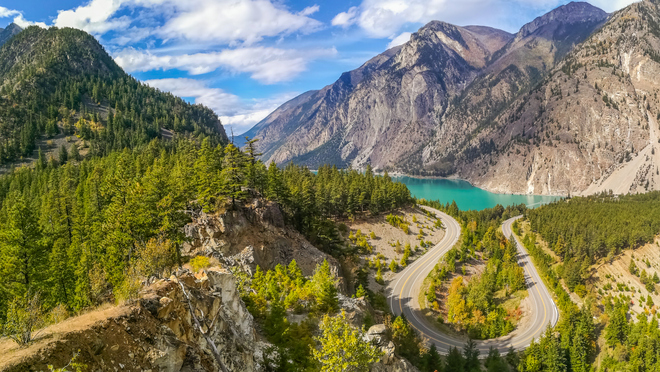
 Seton Lake's mountain backdrop and turquoise waters are a secret to many British Columbians. You can camp there for free at one of our campgrounds.
Where and when to camp, where to swim, and a few cool facts
To take full advantage of the wonders offered by our recreation areas across B.C., it helps to come with a spirit of adventure, and a little grit.
Many of our reservoirs are great for swimming, but the water is often cold. Campsites are free and first‑come, first‑served, meaning they're more rustic than you might be used to and can take some strategy to secure on a busy summer weekend. Some of the most beautiful locations also require a longer drive, sometimes on rough or unpaved roads, part of what keeps these places feeling wild and memorable.
If you're into the great outdoors, you're in for a treat. Our recreation areas include campgrounds, picnic sites, boat launches and dam visitor centres throughout the province. Because many of these sites are located at or near working dams and power stations, visitors should be aware that both natural and man‑made hazards may be present, and water levels can change quickly. Always obey posted signs and warnings to help keep yourself and others safe.
For a few lesser‑known insights about what makes our recreation areas unique — and what to expect when you visit — explore the list below.
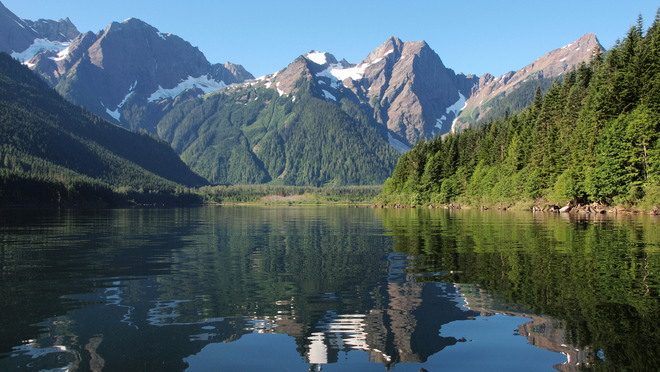 Majestic Mount Cheam is reflected in Jones Lake, where free camping spots at our recreation area 42 km east of Chilliwack are in huge demand on spring and summer weekends.
1. Camping for free in summer? Arrive mid-week
If you managed to reserve a campsite at a BC Parks campground, congratulations — for a modest nightly fee (typically between $5 and $51), it's one of the best deals around, often set in some of B.C.'s most iconic locations. If reservations were full, there's another option: camping for free at one of our six first‑come, first‑served campgrounds — Jones Lake, Seton Lake, Gun Creek, Pend D’Oreille, Upper Campbell Reservoir or Alexander MacKenzie’s Landing. At our two most popular sites — Jones Lake in the Fraser Valley and Upper Campbell Reservoir near Campbell River — arriving mid‑week greatly improves your chances of securing a spot for the weekend during peak summer months. Be sure to review site details before you go so you know what to expect. All campgrounds have outhouses, but most do not provide drinking water or firewood.
Tip: If you plan to have a campfire, bring your own firewood or collect clean shoreline debris where permitted, and always check current campfire bans before you go.
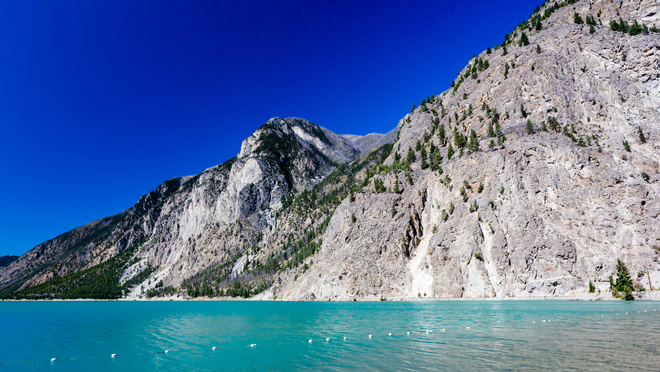 Seton Lake's striking, glacially fed turquoise waters make it a popular spot for swimming, picnicking, and camping. The lake is accessed via a scenic two‑hour drive northeast of Whistler.
2. Still waters run… turquoise
A scenic two‑hour drive northeast of Whistler — or about three hours from Abbotsford via the Fraser Canyon — brings you to Lillooet and the eye‑catching beauty of Seton Lake. Our recreation area is located at Cayoosh Creek, near the confluence of the Seton and Fraser Rivers, on lands traditionally inhabited by the Interior Salish‑speaking St'át'imc people.
This historic area offers a wide range of recreational opportunities, including boating, canoeing, hiking, and fishing. Even if you don’t have time to camp or stop for a picnic, it’s worth pausing at the viewpoint above the lake to take in the striking turquoise waters below.
Tip: If you're in Vancouver and planning a trip to the B.C. Interior north of Cache Creek, consider skipping Highway 1 and going through Whistler and Pemberton to take the Duffy Lake Road (Highway 99) through Lillooet. The drive is beautiful, there are world-class hikes, scenic lakes, and a fantastic winery (Fort Berens) along the way. At the north end of the Duffy Lake/Highway 99 drive, you'll pop out on Highway 97 just north of Cache Creek.
3. For really big fish, go north to Williston Lake
Our recreation site at Alexander McKenzie's Landing is known for its surprisingly sandy beach and beautiful views. But for many, it's the place to launch your boat and access the huge fish — the product of abundant food sources in the reservoir — in the lake.
Williston is considered a trophy trout lake, with reports of lake trout between 30 and 50 pounds and bull trout of up to 30 inches and 29 pounds. As B.C.'s largest lake, it's huge and deep (an average depth of 42 metres!), so many employ local guides for expertise in fishing.
Tip: Some preferred fishing spots on Williston near Alexander Mackenzie's Landing include Six Mile Bay, Mugaha Bay and Mugaha Creek, and the edges of the Parsnip River Channel. Some anglers make the longer trip to Finlay Reach to access major tributary inflows.
4. 'Lake Beautiful' was the first to power Vancouver
What was once known as Lake Beautiful is now Buntzen Lake, home to the most popular of all our rec sites. It's so popular that starting May 14, you'll need to reserve a half-day or full-day parking pass in advance of your arrival.
Located north of Port Moody about 30 km from Vancouver, Buntzen offers scenery, a sandy beach, excellent (and cold) swimming, paddling, and hikes around the lake and up to the surrounding peaks. And for 122 years, it has served as a source of hydroelectricity.
Named after Johannes Buntzen, the first general manager of B.C. Electric Co., Buntzen's hydroelectric project was put in service by the Vancouver Power Company in 1904 to provide the first hydroelectric power to Vancouver. Before that, the city had to depend on a 1,500-kilowatt (kW) steam plant for its power supply.
There used to be two powerhouses at Buntzen, with one — powerhouse No. 1 that was modernized in 1951 — still in operation by remote-control from a facility in Burnaby.
Tip: If you're planning to drive to Buntzen Lake, be sure to book a parking reservation in advance. Whenever possible, carpool — or consider transit instead. TransLink's 182 bus runs from Port Moody Centre Station, with seasonal weekend and holiday service from Canada Day through Labour Day.
5. If you fancy a cold plunge, take a dip in one of our reservoirs
If you prefer your lakes warm, Hayward Lake, is the warmest of our reservoirs. But if you enjoy the thrill of a cold plunge, most of our reservoirs (and the Puntledge River) fit the bill, even in summer.
While the science around the health of a cold plunge can be inconclusive, the practice has a strong following. For many years, athletes have used cold therapy for post-workout recovery. Other potential benefits include stress management and wellbeing, improved sleep and — from the initial shock to your body — a boost to the immune system via increased white blood cell counts. For those not used to swimming in very cold water, experts suggest easing into it by build a tolerance to frigid temperatures. That can even start with gradually getting used to cold (then colder) showers at home.
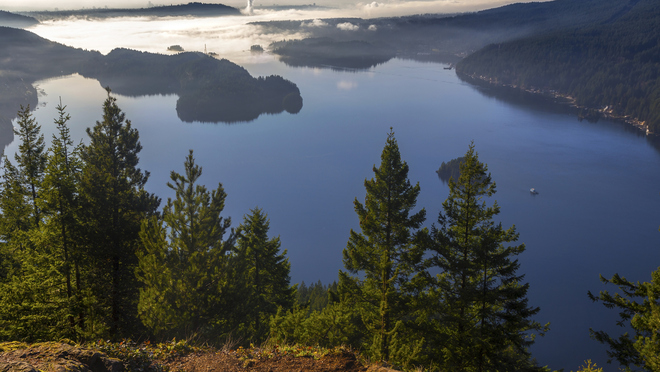 A view of Indian Arm from a viewpoint on the Diez Vistas hike you can access from our Buntzen Lake recreation site near Port Moody.
6. For the fit, Diez Vistas trail is a gem
One of southwest B.C.'s great hikes, Diez Vistas starts at the north end of the main parking lot at our Buntzen Lake recreation site. It's a challenging and rewarding hike that requires good fitness and up to 6 to 8 hours to complete the full 16-plus km.
At one time, there were 10 viewpoints (diez vistas means 10 views in Spanish), but the forest has grown enough to minimize most of those stops to peek-a-boo views. The big reward is the main viewpoint over Indian Arm. Get information on Diez Vistas and other Buntzen trails at our Buntzen trails page, and for recent trail conditions, try reviewing All Trails. If you're not taking transit and need to park, you must reserve a parking spot in advance, starting on May 14. A very popular hike, Diez Vistas in the late spring and summer is best done during weekdays before the trails (and the Buntzen parking lot) fills up.
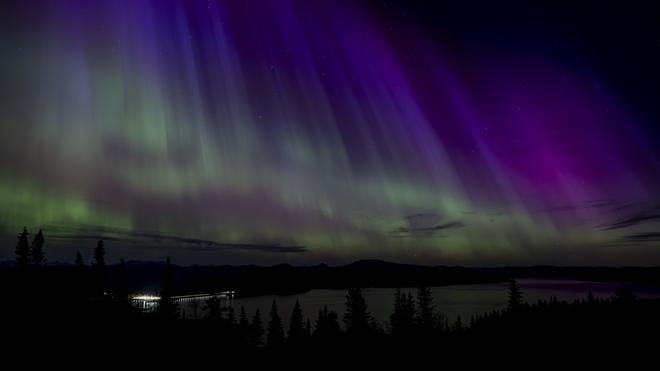 Our team member Brody Kane captured this photo from Bullhead Mountain above Williston Lake reservoir to show the W.A.C. Bennett Dam on the lower left and a spectacular aurora borealis show in the sky. (Photo courtesy Brody Kane/Instagram)
7. The stars (and northern lights) come out at our recreation sites
Get away from city lights and the sky as night darkens to unveil starry skies on clear nights. Our camping sites offer spectacular stargazing opportunities and at Alexander Mackenzie's Landing on Williston Lake, a good shot at viewing the northern lights.
Key stargazing dates over the next few months include:
- May 16, June 15, August 12, September 11. New Moon. With the moon out of view, it's a good time to observe faint objects such as galaxies and star clusters.
May 31 - Full Moon, Blue Moon. The Moon will be on the opposite side of the Earth as the Sun and its face will be fully illuminated. Since it's the second full moon in the same month, it's sometimes referred to as a blue moon – a rarity that only happens every few years (or "once in a blue moon")
June 15, August 2. Mercury at Greatest Eastern Elongation. The best time to view Mercury, as it’s at its highest point above the horizon in the evening sky. Look for the planet low in the western sky just after sunset.
August 12. Total Solar Eclipse, viewed as a partial eclipse in B.C. With clear skies, we’ll see the partial eclipse from 9:16 a.m. to 9:29 a.m.
August 12, 13. Perseids Meteor Shower peaking. One of the best meteor showers to observe, producing up to 60 meteors per hour at its peak. It is produced by comet Swift-Tuttle, which was discovered in 1862.
August 27. Partial Lunar Eclipse. The Moon will darken as it moves through the Earth's shadow and will be tough to see as it rises very low, beginning around 7:56 p.m. on August 27, reaching maximum eclipse at 9:12 p.m., and concluding at 12:01 a.m. on August 28.
Tip: If you want to maximize your chances of seeing the northern lights, go online for tips and start with this primer on best B.C. places to see the lights.
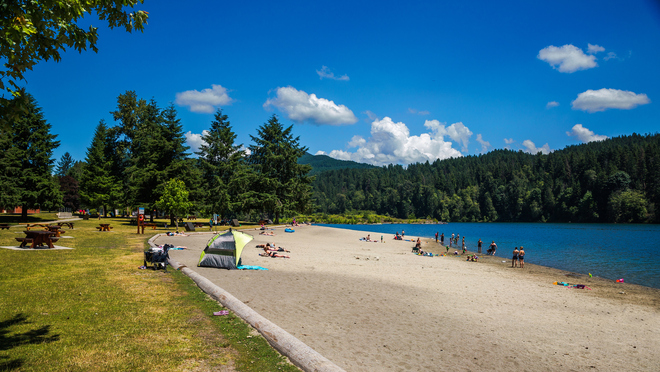 It's far from warm, but Hayward Lake near Mission is probably our warmest reservoir and a popular place to cool off in the heat of summer. Families and paddlers arrive in big numbers, so arrive early if you can.
8. Paddle or swim at Hayward Lake, and check out the visitor centre
Hayward Lake, our reservoir near Mission, is a go-to swimming spot for families in the area. It's also popular with stand-up paddleboarders (SUPs) who enjoy the views and the calm waters.
Know that this is one of our busiest recreational sites, and that parking is limited. Paddlers who want peace and calm on the lake would be wise to stick to early mornings and weekdays.
Tip: While no longer generating power, the century-old Powerhouse at Stave Falls is now a fascinating museum that features historical displays, electricity demonstrations and interactive exhibits. From March 1 to June 22, it's open seven days a week from 10 a.m. to 4 p.m., and from June 23 to September 9, its open five days a week (closed Tuesdays and Wednesdays). With school back in session, it's open again 7 days a week From September 10 to October 12.
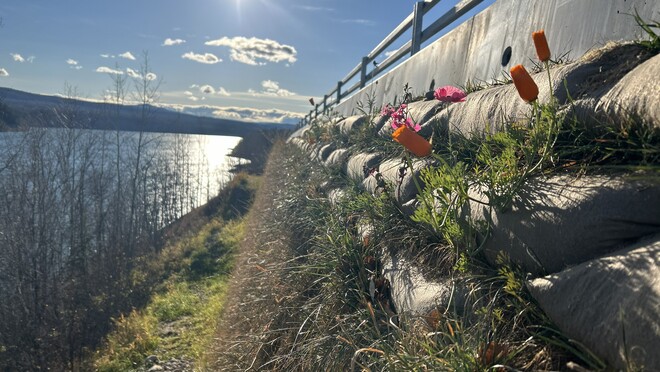 Flowers bloom out of sand/soil bags riddled with wildflower seeds alongside the entry road to BC Hydro's DA Thomas boat launch and recreation area along the Site C reservoir at Hudson's Hope.
9. Wildflowers emerge at our newest recreation area
Originally founded as a trading post in 1805, the town of Hudson's Hope is as close to being a BC Hydro "company" town as any in B.C. Many residents were involved in the construction or operation of our first two dams on the Peace River (W.A.C. Bennett and Peace Canyon), and they get their drinking water from what is now the new reservoir for the third dam and hydroelectric generating station on the river.
Many in the area love to get out on the water, and we're now putting the final touches on boat launches and one new rec site — D.A. Thomas recreation area — on the reservoir. The site is due to open this month, to provide access to a picnic area and a shoreline walk along a section of a 2.4 km protective berm along the reservoir.
Construction of the site involved some careful engineering, with a floral twist. For stability and safety, construction of the steep entry road required the meticulous filling and placement (both by hand) of 26,000 biodegradable bags of a sand/soil mix to help form the slope for the roadway. As a flourish, the 90-pound bags used in the area exposed on the water side of the road included a wildflower seed mix that is already providing a brilliant spike of colour alongside the paved roadway.
Once the reservoir has stabilized and is declared safe for recreation, a gangway and floating dock at DA Thomas will be opened to allow car topper-type boats, such as kayaks and canoes, to be launched.
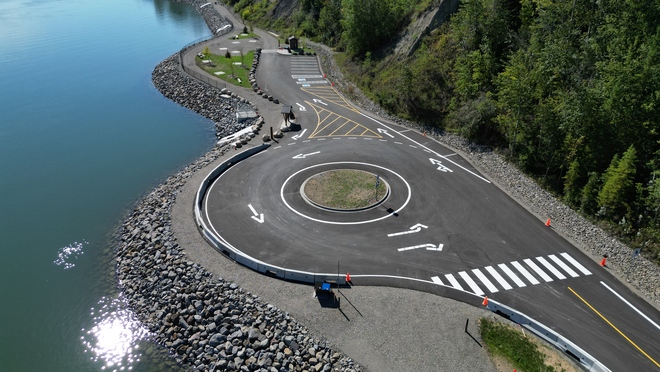 DA Thomas recreation site on the Site C reservoir just outside Hudson’s Hope opens this month with a picnic area, access to a waterside walking trail and, later on, a dock where locals can launch cartop boats including kayaks and canoes.
10. You can float down the Puntledge River, but use caution
No disrespect to the wildly popular float channel that connects one lake to another at Penticton, but floating the Puntledge River near Courtenay on Vancouver Island is a more adventurous and scenic upgrade. They key is to use caution. Do your homework, know when it’s safe to go, and follow these three go-tos to have a floating good time on the river.
- Obey posted signage, and always check the dam release and water level before getting in: Check our flow updates and local tubing guides. Always obey high-flow advisories and posted signage. Avoid tubing when water is too high in spring or after rain. And if the river looks fast and choppy, skip tubing that day.
- Wear a life jacket, shoes and expect rocks. The Puntledge riverbed is full of smooth but slippery rocks, and many exits from tubing runs involve scrambling onto rocky banks. Wear water shoes or old running shoes.
- Consider also putting a life jacket over the mesh in a tube. If you’re worried about your bum bouncing off rocks, raise it up in shallower sections or protect it by inserting a life jacket over the bottom of a mesh-bottom float tube.
- Pack out everything, and don’t leave tubes behind. Pack out cans, food wrappers, broken tubes, anything you bring in. The river is important salmon habitat and a source of pride among locals.
Located on the east coast of Vancouver Island, our Puntledge River recreation area sits about nine kilometres southwest of Courtenay and six kilometres north of Cumberland. The Comox Lake Dam picnic area, which also features a beach, viewpoint and a pit toilet, is on the Puntledge River at the outlet of the Comox Lake Reservoir. Note that we’re doing construction in the recreation area through the fall and using the Comox Dam picnic area as a laydown site that will be inaccessible through May 31. Trail users can expect trail detours along the river’s recreation system as crews work to replace aging boardwalks and bridges.
Tip: Go online to get river tubing tips on the Puntledge, including the best routes for different ages and abilities. Puntledge Park to Condensory Bridge takes about 30 to 45 minutes and is considered the safest, easiest route – ideal for first-timers or families with young children. Tubers Trail to Condensory Bridge lasts 45 to 60 minutes and includes some gentle rapids and forest scenery. A popular put-in point is at the fish hatchery on Powerhouse Road. From the parking area near the fish hatchery, walk past the gate and, part way down the access road, spot the Tubers Trail sign and take that trail – careful, it’s steep in parts – to the put-in point.