

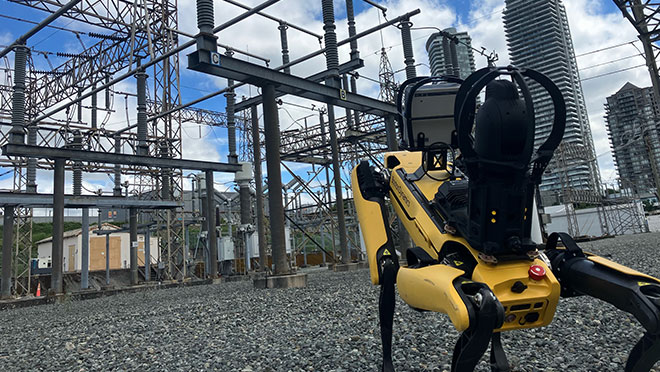
VANCOUVER: BC Hydro is advancing safety and innovation by deploying Spot, Spark and Bolt – four-legged robots now supporting crews with inspections, substation patrols and accessing hard-to-reach areas. A next-generation bipedal humanoid robot is also in development for indoor substation work and potential security support. The goal is to use these robots to support parts of higher-risk tasks, reducing workers’ exposure to potential hazards while strengthening the reliability of BC Hydro’s electrical infrastructure.
The robots may look like props from a movie set, but the trio are some of the most advanced tools in BC Hydro’s safety toolkit. Spot and Spark can climb stairs, open doors, enter confined spaces, read gauges and detect hotspots using cameras and thermal sensors.
Built to handle tough conditions, the robotic dogs can stay upright when pushed, roll over and carry up to 30 pounds over rough terrain – navigating around debris, machinery, vehicles and humans. Bolt, a smaller and more agile unit, is being used in underground distribution environments where maneuverability is critical.
“I’m excited to see how innovative technologies like robotics can strengthen safety for our teams,” said Matt Wilson, BC Hydro’s Senior Vice President of Safety. “By using robots to support our teams as they work in potentially hazardous environments, we are taking advantage of new technology to reduce risk and avoid potential injuries, while still gathering the critical information we need to keep the system reliable for British Columbians.”
Spot’s journey to BC Hydro began in 2022, with an early protype leading to extensive testing and development. Today, the technology can navigate BC Hydro’s complex electrical system – conducting automated patrols, detecting fence and equipment damage, and helping crews spot issues early.
Last year in Victoria, Spot was lowered into an underground vault to complete a full scan and create a detailed 3D model. Engineers used that data to plan repairs without requiring anyone to enter the confined space as an exploratory exercise. Although BC Hydro has robust safety programs and procedures for performing high risk work, any opportunity to eliminate the need for a worker to be exposed to a hazard is ideal.
Spot’s success has accelerated BC Hydro’s investment in robotics, expanding the fleet in 2025 to four. Spark supports field operations across Metro Vancouver; Bolt is designed for tight underground distribution spaces; and the bipedal humanoid robot is in development for indoor and underground substation operations. What started as a single pilot has grown into one of the most advanced utility robotics programs in Canada.
BC Hydro is also integrating an artificial intelligence system into its robots to enable automated acoustic and visual inspections – an emerging capability that could detect equipment issues long before they cause outages.
To help inspire the next generation of safety minded innovators, and teach kids about electrical safety, the robots visited schools in Metro Vancouver this past week for BC Hydro’s annual Electrical Safety Week campaign, which runs from May 11 to 15 this year. As part of this initiative, BC Hydro employees visit kindergarten to Grade 7 classrooms across the province to deliver safety presentations focused on helping children develop safe habits around electricity. Since its launch in 2015, the program has educated nearly 65,000 students, growing each year to reach more families. For more information on Electrical Safety Week, visit schools.bchydro.com. For more information on electrical safety, visit bchydro.com/besafe.
Contact:
BC Hydro Media Relations
e. media@bchydro.com
p. 604 928 6468