

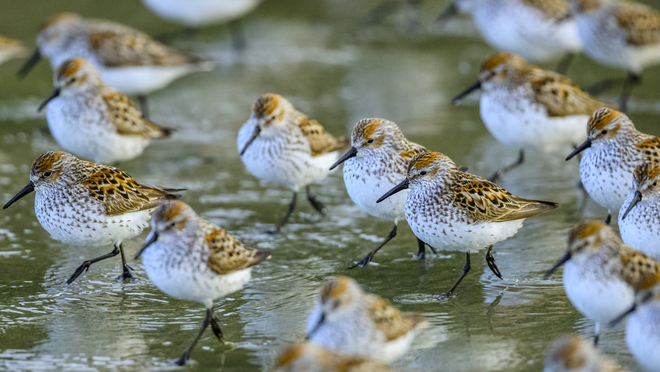
 Western Sandpipers migrate more than 10,000 km from South/Central America to Alaska, stopping to refuel in the Fraser River Delta in late April.
Lights can mess with many birds who migrate after sunset
A few weeks ago, Janet McIntosh contacted us with a modest proposal. Could BC Hydro use its Peak Saver program to encourage customers to turn off or adjust lights at times in the spring when birds are migrating, mostly after the sun goes down?
We would've loved to help, but our Peak Saver program — which rewards participating customers who use less power during specified periods of peak electricity demand — focuses on the winter months when electricity use is highest, and wraps up by April. But we embraced the idea of spreading the word to British Columbians that changing the way we use exterior lights can really help migrating birds.
So we sat down with McIntosh, a member of the White Rock and Surrey Naturalists Society, to learn a few things about bird migration and bright lights at night.
Geese and other big birds, including pelicans, fly during the day as they have little fear of predators and can handle stronger daytime air currents. But about 80% of other migrating birds — mostly smaller ones — fly at night. And lights for our homes and businesses can interfere with their ability to navigate the skies.
Through April and early May (and then on their return trip September through October) smaller flyers rise high into the sky after sunset. They use the moon, stars and geographical landmarks to navigate. And they navigate in huge numbers — as many as 15 million birds flying what's known as the Pacific Flyway migratory route each spring and fall.
"It's easy to find security lighting in our communities that shines out and sometimes even up into the night sky," says McIntosh. "We may see these around businesses and around semi-rural properties. Sometimes the lights are so bright, they create a glare problem for passing drivers or pedestrians, as well as for migrating birds."
Residential homes may also incorporate bright exterior lighting, way beyond what's needed for safety or security. Outside home lighting used to be a single porch light, left on only when someone was expected. Many new homes are now larger and closer to their neighbours and use lights to illuminate roof lines, facades, garage doors, driveways, and fence pillars — sometimes on all sides of the house, and sometimes left on through the entire night.
Here's how you can help:
- Shield lights, and direct them downward where needed for safety and security.
- Use motion sensors if possible.
- Turn off any solely decorative lighting overnight during bird migration season.
"Besides private homes, there are also larger buildings with decorative façade or rooftop lighting, not really needed for safety or security," says McIntosh. "Any individual who lives or works in one of these buildings might ask whether the lights could be toned down or turned off during bird migration season. Same goes for some businesses, parking lots, sports fields, car lots, and industrial sites."
Bright lights may cause birds to circle, call to each other, descend to a lower level, or fly off course toward the lights. They lose energy and reduce their chances of successfully completing their migrations.
For a fascinating exploration of birds, their migration routes, and behaviour, try the Audubon Society's Bird Migration Explorer tool.
More ideas and resources to help keep birds safe
There are a variety of online resources that often combine advice on using energy-efficient lighting with strategies to help keep the sky darker and aid migrating birds.
The City of Vancouver's Outdoor Lighting Design Tips includes helpful illustrations of how cutoff and semi-cutoff lighting limits or eliminates light projecting into the sky.
Another thing to consider is how to reduce the chances of birds hitting the windows of your home. The advocacy organization Fatal Light Awareness Program (FLAP) Canada estimates that about 25 million birds are killed each year in collisions with buildings across Canada. The FLAP Canada website includes guidelines for bird-safe window markers and what to do when you find an injured bird.
Cats also kill millions of birds in Canada. A University of Guelph study in 2025 estimated that about 60 million birds each year are killed by cats in Canada, as almost 40% of households in this country own at least one cat. The Stewardship Centre for British Columbia offers tips and information on protecting birds from cats.
Where to watch birds in B.C.
B.C. is a great place to watch migrating birds as millions travel each year between Alaska and Central and South America. Early morning and late afternoon are generally the best time for bird watching, and these locations are among the best places to spot them:
- George C. Reifel Migratory Bird Sanctuary (Delta)
- Boundary Bay Regional Park (Delta/Surrey)
- Maplewood Flats (North Vancouver)
- Vancouver Island
- Columbia Valley Bird Trail (Invermere/Creston)
Look for a bird watching area near you at bcbirdtrail.ca.