

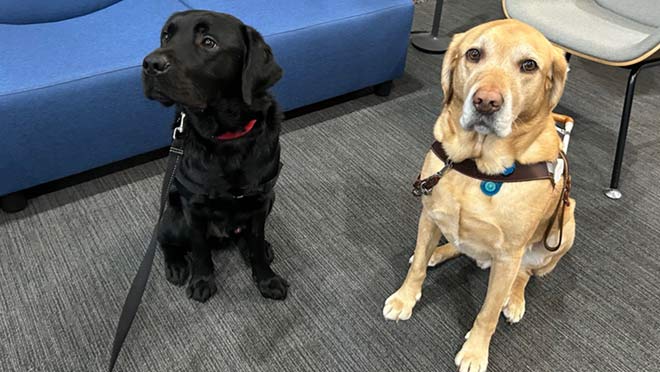
 Mickey (left) is a service puppy-in-training and Hobson is a guide dog. Both are regulars in BC Hydro workplaces alongside their handlers.
Guide dog Hobson and a service puppy-in-training in the office
Steven Woo started losing his sight as a kid, and as his condition progressed, he eventually realized that a guide dog could make his navigation of the everyday safer, from avoiding walking texters on sidewalks to finding his way around the office.
For the past year, both as the handler of a guide dog named Hobson and as a human resources advisor, Woo has been helping our team members better understand the role of guide dogs and how to interact with them in the workplace and beyond.
That includes resisting the urge to offer doggie treats to Hobson.
"Most people don't see the harm in it," says Woo, who joined us a year ago as an HR advisor on our Inclusion, Diversity, Equity, Accessibility (IDEA) team. "I have to explain to them that they can't feed Hobson, because he'll start seeking food from other people, and that's going to be disruptive to the work he does. He needs certain boundaries and consistencies."
Woo has deep experience as the handler of a guide dog. He got his first guide dog, Horatio, in 2016 and was his handler until 2019, when Horatio became too old to provide adequate safety. A yellow Labrador retriever, Hobson now "works" alongside Hobson in our downtown office and offers Woo a fantastic educational opportunity. He's working on a guide to guide dog etiquette he hopes to circulate around BC Hydro.
He also has an enthusiastic advocate in volunteer puppy raiser Tanya Fish, a marketing manager who recently got the green light to bring her service puppy-in-training, to work with her.
"After my border collie of 15 years passed away in March 2024, I wasn't ready to commit to another 'forever' dog, but I deeply missed the companionship," says Fish. "Becoming a puppy raiser felt like the perfect way to combine my passion for dog training and behaviour with giving back to my community."
Guide and service dogs have similar training in socialization obedience and task performance, to get them used to the real-world environment. But the type of work that each dog does varies.
Service dogs are trained to perform tasks for people with disabilities other than low vision or blindness, such as hearing impairments and epilepsy. Like guide dogs, service dogs are trained by certified organizations, like the Pacific Assistance Dogs Society (PADS). Fish is a volunteer puppy raiser with PADS, and she's currently raising Mickey, an 18-month-old service dog-in-training, using some of her previous experience as a certified pet dog trainer to educate him.
The B.C. Guide and Service Dog Act allows certified guide and service dog teams, as well as service dogs in training with accredited schools access to any public place, including restaurants, hotels, stores, and transit, including planes. They have the same rights as the public, and businesses can't charge extra fees or deny entry, provided the dog behaves appropriately.
Guide and service dogs are allowed in workplaces through formal accommodations, while the allowance of service dogs in training is discretionary. There's such high demand for these dogs that individuals in B.C. are often waiting years to be matched with one. Allowing pups in training from PADS and other accredited schools helps support volunteers who are raising these dogs, while at the same time helping create a more inclusive and diverse workplace.
We're actively encouraging and supporting guide dogs and service dogs-in-training in BC Hydro offices because it supports our goal of normalizing disability in the workplace. And it can help us identify gaps in current processes.
Woo recalled that a few months after joining BC Hydro, a security employee noticed that it was taking Woo a bit longer than usual to walk through an office security gate with Hobson.
"He asked whether we could extend the time the gate remains open for someone who needs a bit more time to pass through," says Woo. "It turns out that adjustment could be made, and is now something everyone can have upon request."
Woo says the presence of guide and service dogs in the workplace aligns with a BC Hydro core value – We work together – and links to a core cultural commitment of valuing diverse capabilities and ways of thinking.
It's not all work for guide and service dogs
As Hobson's handler, Woo says he shares responsibility with the dog in assessing situations for safety.
"If I'm crossing a street, I'm listening for traffic sounds or a car that is near us," says Woo. "Hobson was trained in what's known as intelligent disobedience, so if it's not safe to cross, he'll decide not to."
Woo says that out in public, just having a guide dog beside him signals to passersby that he has a disability. But he often finds himself educating members of the public that they shouldn't be engaging with a guide or service dog, as the dogs are trained to remain focused and behave discreetly. They don't interact with others unless given permission.
Occasionally, Woo encounters people who question the ethics of making a dog "work" He lets people know that being a guide dog doesn't mean Hobson never gets to play.
"Hobson still gets to be a dog and have fun," says Woo. "He loves to swim – he's a big swimmer. We spend a lot of time by the lake or on a beach, and he loves to chase a ball."
How a puppy-in-training fits in at work
Before Fish brought Mickey to work, the first step was to reach out and identify any concerns from colleagues, including allergies or phobias. And the response was overwhelmingly positive.
"My colleagues were excited about the idea of having a pup in the office and supportive of BC Hydro undertaking this inclusion and diversity initiative," says Fish, who worked with Woo to do pre-emptive communication to provide guidance and answer questions from their teams about their dogs.
Fish says Mickey adapted quickly to commuting on transit and settled into the office routine right away. He's also a great conversation starter with colleagues and provides the opportunity to share information about service dogs.
"His only 'flaw' is he tends to let out loud sighs when he's relaxed, but this often provides some welcomed comedic relief during long meetings,"says Fish. "He's also incredibly in tune with my emotions – if I show signs of frustration or stress, he'll pick up on this and look up at me or rest his head on my lap as if to remind me to relax and stay present. This isn't a trained behaviour, it's just who he is."