

Williston Reservoir
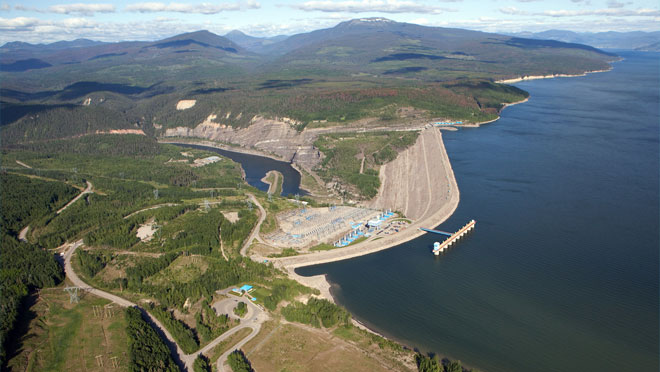
Largest reservoir in B.C., popular all year
Williston Reservoir, near Hudson's Hope and Mackenzie in northeast British Columbia’s Peace region, is the world’s seventh-largest reservoir by volume. The Peace hydroelectric system starts in the headwaters of the Peace River and includes three major dams: W.A.C. Bennett, Peace Canyon and Site C.
The waters of the Williston Reservoir are behind the W.A.C. Bennett Dam, the largest dam in the province. This reservoir is the primary storage reservoir for the Peace system. Water from Williston Reservoir drives the turbines at the generating station before continuing downstream to the Peace Canyon Dam and Generating Station, located about 6 km southwest of Hudson's Hope, and then to the Site C dam and generating station, located about 7 km southwest of Fort St. John.
Williston Reservoir has multiple boat launches and is an excellent body of water for fishing, with bull and rainbow trout, rocky mountain and lake whitefish most prevalent. Williston is also well used during the winter months, when the surface is frozen.
The Williston Reservoir is located on the traditional territories of Tsay Keh Dene, Kwadacha and Treaty 8 First Nations.
Where it is
Williston Reservoir is near the towns of Mackenzie and Hudson's Hope. The W.A.C Bennett Dam Visitor Centre is at the east end of Williston Reservoir, a stone's throw from the dam.
Need directions? Use this Google Map link.
There are multiple recreation sites along the Williston Reservoir. Some of these facilities and their reservoir access are not maintained by BC Hydro.
| Williston Reservoir | ||||||||
|---|---|---|---|---|---|---|---|---|
| Alexander Mackenzie's Landing boat launch |  |  |  |  |  |  |  |  |
| Dunlevy Inlet boat launch | | | | | | |||
| Kwadacha boat launch (Finlay River at Fort Ware) | | | | |||||
| Elizabeth Creek boat launch | | | | | | |||
| Cut Thumb Bay* | | | | | | |||
| Six Mile Bay* | | | | | | |||
| * Facilities and reservoir access not maintained by BC Hydro. | ||||||||
Visitor information
Alexander Mackenzie's Landing is accessible via road as well as the water from any of the multiple boat launches along the Williston Reservoir. It features a campground, picnic area, a sandy beach, a boat launch and access to hiking, boating, fishing and swimming.
Open from May 15 to October 15, the facilities at Alexander Mackenzie's Landing include:
- 22-unit campground: Maximum of 14 nights camping per calendar year, and no reservation of sites is permitted. Campers failing to occupy sites overnight may have their equipment removed at their expense so that others may use the site.
- Sandy beach
- Single-wide boat launch
- Event seating area
- Four pit toilets
- Grassed open space
- Display signs and shelters
- Designated wheelchair-accessible sites and pit toilets
- No drinking water
- Picnicking
- Hiking
- Motor boating
- Fishing
- Paddling
- Swimming
Trail and area use
- Use of ATVs and dirt bikes is prohibited within the recreation area.
- Trails are closed to motorized vehicles.
- The use of firearms in the recreation area is prohibited.
- Remember to please be respectful of fellow campers and obey instruction from the facility operator or campground host.
- Please keep this area clean and ensure that all food materials, garbage, and fish entrails are bagged securely and placed in the appropriate containers.
Directions
Alexander Mackenzie's Landing is located 8 km by road from Mackenzie, B.C. Use this Google Map link for directions.
A boat launch is located on the Parsnip Reach near BC Hydro's Alexander Mackenzie Campground. The minimum usable Williston Reservoir elevation of the Alexander Mackenzie Landing boat ramp is 660.4 m (2,167 ft) above sea level.
Access at Cut Thumb Bay, Six Mile Bay is provided for car‑top boats only; these sites are not maintained by BC Hydro.
Boat ramps are available on the Peace Reach, located at Elizabeth Creek and Dunlevy Inlet. The minimum usable elevation of the Elizabeth Creek boat ramp is 656.8 m (2,155 ft), and the minimum usable elevation of the Dunlevy Inlet boat ramp is 662.1 m (2,172 ft) above sea level.
The Kwadacha boat launch on the Finlay River at Fort Ware is located approximately 70 km north of Williston Reservoir.
In general, boat launches are unusable at very low water levels, which typically occur shortly after ice breakup.
The current Williston Reservoir elevation may be found here.
Some locations on the reservoir provide excellent angling for bull trout, rainbow trout, rocky mountain whitefish and lake whitefish. Fishing licences are required; these may be purchased at local merchants or government agents. Be sure to check the Freshwater Fishing Regulations Synopsis for provincial angling restrictions.
Williston Reservoir begins to freeze over during November and continues until mid-January when total freeze-up usually occurs.
Snowmobiling and other winter activities are common on Williston Reservoir. When using the frozen surface of the reservoir extreme caution must be exercised as winter hazards include pressure ridges, gas holes, open water, and broken shoreline ice. Rapid temperature changes that may cause ice melt and extreme cold and wind are also hazards to wintertime users.
During the winter season an ice-breaking barge may be in service on Williston Reservoir which results in open water and thin ice. Use of the water channels is not recommended during the winter season and snowmobilers must exercise extreme caution.
The area in the vicinity of the W.A.C. Bennett Dam water intakes is extremely dangerous during the winter freeze-up. Reservoir users must stay well back from the structures and obey all posted signs.
Since 1968, BC Hydro has implemented a surface debris clearing program on the reservoir. BC Hydro remains committed to the goals of the program – to create a safe, accessible waterway available to the public for recreational use.
BC Hydro's clearing program is ongoing, therefore, debris may be encountered at any time in all areas of the reservoir.
Boating and other safety information
All persons intending to operate a boat on Williston Reservoir should always:
- Obey all boater safety laws, which include carrying emergency equipment and wearing lifejackets.
- Carry extra shear pins and a spare propeller.
- Inform others of your destination and when you are to return.
- Observe all warning signs and stay well away from BC Hydro's dams and structures.
Extreme caution and an awareness and appreciation of hazards are essential for safe boating on Williston Reservoir.
Williston Reservoir is a very large and potentially hazardous reservoir for the unwary. Boaters are cautioned that when the reservoir is not at its maximum level, snags and stumps may lie just below the water surface. Floating and submerged debris may be encountered in all areas of the reservoir. Boaters should also be aware of strong winds that occur suddenly, causing high waves (over 2 m) and strong currents.
The banks of the reservoir are easily eroded and subject to sloughing from reservoir actions. If wave action is severe and you need to reach shore, it may be difficult to make a safe landing due to cliffs, unstable banks and/ or floating or submerged debris along the shoreline.
Boaters who are not experienced with large cold lakes, natural and man-made hazards of reservoirs, and isolation from other users, should remain in sheltered areas.
Generally, the reservoir level is lower during winter, reaching its minimum elevation for the year in April or May. The reservoir reaches maximum levels by August after runoff from yearly snowmelt. A normal yearly reservoir elevation change could be as much as 18 m.
Dam intakes cause strong surface and underwater currents. For your own safety and the safety of others please remain well away from dams, intake and spillway and structures.
BC Hydro offers a safety radio service [PDF, 1.6 MB] as a courtesy to people working or enjoying recreational opportunities in and around Williston Reservoir.
The radio service is intended to be used for safety check-ins, reporting hazards and emergency use. The system is intermittently monitored for safety and emergency use, but service outages may occur.
Please note that the radio service is not a replacement for following proper safety policies or procedures. Prior to your trip departure, it is good practice to let others know when and where you are going and when you are expected back.
BC Hydro is not liable for any personal loss, injury or death due to system failure or fault.
When camping at Alexander Mackenzie's Landing be sure to follow these safety precautions when it comes to wildlife and fires:
- Camping can bring you into contact with many species of wildlife, including deer, bears, and cougars. Never feed wildlife, and keep your pets under control. Dogs must be on a leash at all times.
- Follow the campfire rules and keep fires confined to the fire pits provided. Be sure to completely extinguish fires before leaving.
- Observe fire restrictions imposed by the Ministry of Forests. To report a forest fire, phone 1 800 663 5555.