

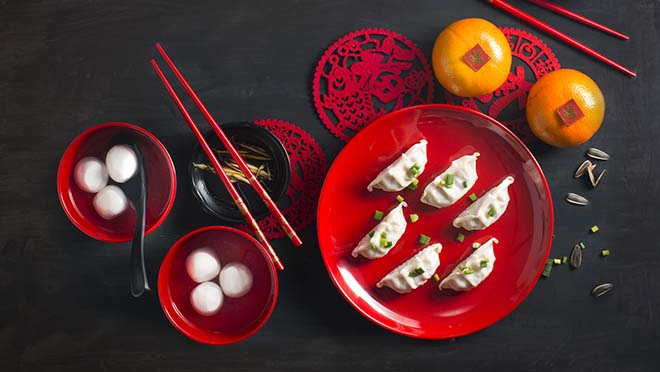
 Food chosen for during Lunar New Year has ties to luck and prosperity, including dumplings and oranges.
Fire Horse energy, plus a bonus eclipse March 3
Festivities around Lunar New Year in Vancouver’s Chinatown are always a major celebration, but it’s worth pausing to appreciate the sheer scale of the Spring Festival in China.
Last year, an estimated 2.3 billion interregional trips were made during Chunyun, often described as the world’s largest annual human migration. This included 2.2 billion road trips and 96 million rail journeys. Travel was so intense, and electric vehicle use so widespread, that one region even deployed mobile EV-charging robots at highway service areas to handle the surge in demand.
Here in B.C., there are plenty of ways to mark the arrival of the Year of the Fire Horse, which begins on February 17, 2026, and runs until February 5, 2027. In the Chinese Zodiac, it’s a distinctive combination that blends the bold, independent spirit of the Horse with the dynamic energy of Yang Fire, associated with warmth, creativity, passion, and movement. For those who follow Zodiac traditions, this pairing is seen as symbolizing a year of powerful momentum, new possibilities, and meaningful change.
How much do you know about Lunar New Year and the moon? Here’s a list of 10 things you might not know:
1. Lunar New Year lasts 15 days, not just one
Lunar New Year begins on the new moon and culminates with the Lantern Festival on the 15th day. Across the many cultures that celebrate it, the holiday is a time for families to gather, share meaningful meals, and take part in community traditions such as parades, lion and dragon dances, and fireworks.
2. If the skies clear on March 3, you’re in for a treat
The next lunar eclipse is in the early hours of March 3, 2026, and it will be viewable by the naked eye — no protection needed for this eclipse — in B.C.
According to H.R. MacMillan Space Centre astronomer Rosanna Tilbrook, a partial eclipse will start around 2 a.m. and peak around 3 a.m., with the moon likely to glow an eerie red (known as the blood moon).
"The March lunar eclipse will indeed be visible from Vancouver, although due to the timing, we won't have any observing opportunities at the Space Centre," Tilbrook recently said in an interview with Vancouver Is Awesome.
3. Lunar New Year isn’t just Chinese, and includes First Nations
Lunar New Year is observed across many Asian cultures, each with its own traditions, foods, and greetings. These include Korean Seollal, Vietnamese Tết, as well as Tibetan and Mongolian New Year celebrations.
Some Indigenous communities in British Columbia also mark an important seasonal celebration around this time of year. Hobiyee—celebrated by the Nisga’a and other Coast Salish and Northwest Coast Nation—aligns with the waxing crescent moon and signals the start of a new season.
Depending on the position of the moon, the new year will be read by the Nisga'a in different ways:
- If the crescent moon's edges point upward, it foretells an abundant year of salmon, oolichan, berries and other foods. It's based on the timing of the end of winter and the emergence of oolichan (eulachon), an oily fish — known as Saak — central to Nisga'a culture. It has been harvested and processed since before recorded time, mainly on the banks of Ḵ'alii-Aksim Lisims (Nass River) at Fishery Bay in northwestern B.C.
- If a star is sitting in the centre of the crescent moon ("ii luu-t'aahl bil̓ist ahl ts'im hoobix"), it's also a sign of abundance for the Nisga'a.
- A sideways Hobiyee moon without a star sitting in it can be seen as a harbinger of a poor year for resources.
The Nisga’a Nation will celebrate Hobiyee on February 20–21 in the Nass River Valley. And while 2026 details are still to come, the Nisga’a Ts’amiks Vancouver Society typically hosts a community celebration featuring dancing, drumming, singing, a market, and food at the PNE Forum in late February or early March.
4. The date for Lunar New Year changes each year
Lunar New Year always falls between January 21 and February 20, but its timing isn’t based on the Gregorian calendar. In many Asian cultures, the holiday follows a lunisolar calendar, which tracks the phases of the moon while also using occasional leap months to ensure the celebration stays aligned with the same season each year. In 2026, Lunar New Year arrives on February 17.
5. For Lunar New Year, food names matter
Across many East Asian cultures, certain Lunar New Year dishes are enjoyed not just for their flavour, but for the symbolic meanings tied to their names, shapes, and colours. These foods are associated with wishes for prosperity, longevity, and good fortune in the year ahead:
- Fish: symbolizes abundance or surplus, as the Mandarin word for fish (yú) sounds like the word for “surplus.”
- Dumplings: represent wealth, as their traditional shape resembles ancient Chinese gold ingots.
- Long noodles: signify long life, and are often eaten without cutting to preserve the symbolism.
- Oranges and tangerines: associated with luck and prosperity, as their names sound like the words for “luck” and “wealth” in several Chinese dialects, and their bright golden colour symbolizes good fortune.
6. The moon always shows us the same face
The Moon is in synchronous rotation with Earth, meaning it rotates on its axis in the same amount of time it takes to orbit our planet—about 27.3 days for each. Because these periods match, we always see the same lunar face from Earth. That familiar side is marked by large dark plains of ancient volcanic rock—called maria—contrasting with bright ancient crustal highlands and the impact craters.
The so‑called “dark side of the Moon” isn’t actually dark. A more accurate term is the “far side of the Moon,” simply the hemisphere we can’t see from Earth. It receives just as much sunlight as the near side; we just never get the right vantage point to view it directly.
Curious to see the far side? Short of boarding a spacecraft, you can explore it through immersive experiences in Vancouver. The H.R. MacMillan Space Centre is presenting a Dome show celebrating the 50th anniversary of Pink Floyd’s The Dark Side of the Moon, featuring music and full-dome projections inspired by lunar exploration.
7. Cleaning before New Year is great, but not on New Year’s Day
Many households clean thoroughly before Lunar New Year as a way to symbolically sweep out the old and make space for good luck to enter. But on New Year’s Day itself, cleaning is often avoided. The belief is that sweeping, washing, or taking out the trash on the first day of the year could unintentionally sweep away the good fortune that has just arrived.
8. Time is (slightly) different on the moon
Time on the moon runs slightly faster than on Earth because the gravity is weaker there. The difference is small, about 58 microseconds per day, but over extended periods, it adds up.
“The same clock that we have on Earth would move at a different rate on the moon,” Kevin Coggins, NASA’s space communications and navigation chief, said in an interview with Reuters.
So while you’d need to be very, very patient to see a difference, if you set two watches at the same time and put one on the moon, over a number of years the moon watch time would be ahead of the Earth watch time.
9. Communities across B.C. celebrate Lunar New Year all month long
Lunar New Year events take place across B.C., but Vancouver’s Chinatown hosts one of the province’s most vibrant and enduring celebrations. The February 22 parade will be a highlight for many, but the festivities extend well beyond a single day. Throughout the Spring Festival period, the Chinatown Storytelling Centre, local businesses, and restaurants offer special programs, exhibits, and seasonal menus that honour the holiday’s traditions and community spirit.
Here’s a sampling of Lunar New Year events happening around B.C. this month:
Vancouver: The Lantern City (Downtown Vancouver), February 2 to March 9; LunarFest Vancouver, February 14-28; UNA Lunar New Year, (UBC), February 22; Chinatown Parade
Richmond: Asian Lunar New Year Market (Yaohan Centre), February 7-8, 14-15.
Surrey: Museum of Surrey Lunar New Year, February 21; Surrey Libraries Lunar New Year Celebration (City Centre Branch), February 12; Chinese New Year Gala Celebration (Bell Performing Arts Centre), February 8.
Burnaby: Lunar New Year on the Heights (Burnaby Heights lion dance route), February 28
Vancouver Island: Lunar New Year Parade & Blessing of Merchants (Victoria Chinatown) , February 22
10. You could fit every planet between Earth and the moon
And you could do it with room to spare. The average distance between the Earth and the moon is 384,400 km, and that’s more than enough to line up all the planets in our solar system side by side.
Did you know? The frequent flyer Fred Finn of the UK holds the Guinness World Record as the world’s most travelled human. By 2003, Finn (now a motivational speaker) had racked up 22.3 million km via air travel. That’s equivalent to 29 trips to the moon and back.