

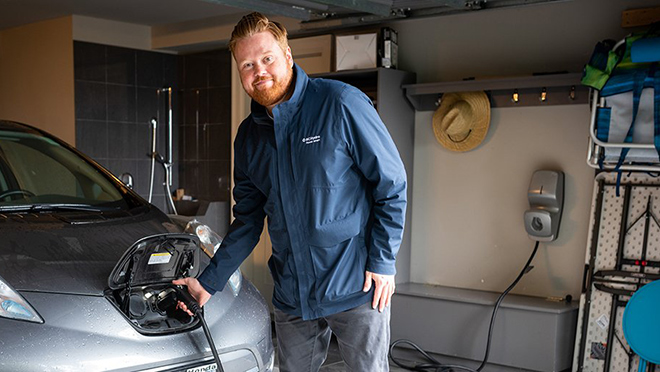
 The combination of rebates for Level 2 home chargers and EV power management devices, and an optional time-of-day electricity rate, has helped make home charging the norm in B.C. That includes more drivers plugging into chargers in strata parkades.
The basics and beyond for the new EV owner
For many B.C. drivers, 2026 is shaping up to be a strong year to go electric. With gas prices remaining unpredictable, more affordable EV and plug-in hybrid options available both new and used, and charging becoming faster and easier, switching to an EV is increasingly straightforward. Lower fuel and maintenance costs, quieter driving and the convenience of charging at home are also drawing more people to electric vehicles.
Here are a few simple things to know about choosing and operating an EV in B.C. in 2026:
1. Choose the best type of EV for your needs and budget
If a brand-new EV is out of reach, there are still plenty of great options to consider. Seven new EVs retail for less than $50,000, and after 15 years of strong sales in B.C., the used market is full of choice, with models at a wide range of price points. As the most active EV market per capita in North America, B.C. offers one of the best selections of used electric vehicles in the country.
Cargurus.ca currently lists more than 400 EVs from 2020 or newer priced under $40,000, including about 120 vehicles priced below $30,000 with fewer than 100,000 kilometres on the odometer.
Looking for a new EV? Check out the handy new CAA buyers’ guide.
There’s also been a surge in interest in plug-in hybrids, especially among drivers who don’t have access to home charging or who prefer the flexibility of gas-powered backup and longer range for extended commutes or road trips. In B.C., there are at least 10 mainstream plug-in hybrid models available from manufacturers such as Hyundai, Toyota, Ford, Kia and Honda.
Did you know? Based on current BC Hydro rates, a Nissan Leaf can travel 100 km for just $2 in electricity costs. That’s a tiny fraction of what it would cost to drive an equivalent gas-powered car the same distance.
2. Consider how much range you’ll need
Three things are conspiring to all-but-eliminate range anxiety in driving an EV:
- EV manufacturers are adding more range, and the ability to charge at fasters speeds, to models each year.
- As home charging becomes the norm, drivers leave home with plenty of charge.
- Fast-charging networks, including our own, are offering more public EV charging sites and much faster charging.
For the urban commuter, even a modest range will get it done. If you enjoy longer trips and need at least 400 km of range, Canada offers plenty of options, including around a dozen five-seat SUVs, more than a dozen sporty 2- and 4-door cars, six pickup trucks, and about a dozen minivans or other “people mover” vehicles. For road trippers who want extended range without spending big on a 500 km-plus EV, a plug-in hybrid can offer a combined electric and gas range of 900 km or more.
Did you know? A battery EV is fully electric and charges by plugging in. A plug-in hybrid combines a rechargeable battery with a gas engine. A hybrid EV has both electric and gas power but cannot be plugged in. And a fuel cell EV generates electricity on board using hydrogen to power its motor.
3. Use rebates to save on a home charger
For many EV owners, the ability to plug into a charger at home, is a game-changer. With access to rebates of up to $350 for the purchase and installation of a Level 2 home charger, 80% or more of EV charging in B.C. is done at home. It’s relatively easy to get a home charger installed in a single-family home, and more apartments and townhomes are adding EV charging in parking areas thanks to EV Ready rebates of up to $137,000 specifically for stratas.
If you live in a multi-unit residential building run by a strata, you’ll need permission to install a charger and also to apply for rebate pre-approval. If you don’t own your home, consider asking your landlord, building management company, or employer to add EV charging. They’ll all be able to access rebates, and adding EV charging can help attract tenants or employees.
Our EV power management device rebates are also set up to help drivers in single-family homes avoid a costly electrical service upgrade when installing a Level 2 home charger. If your current system doesn't have enough capacity for the EV charger, an EV power management device – which controls electrical loads – could help you avoid an upgrade.
Also look for municipal and Indigenous community top-up rebates for installing home chargers, including for apartments, condos, and townhomes.
Here are the steps to follow in charging your EV at home:
- Choose a rebate-eligible EV home charger
- Hire an electrician to check to see if your electrical service is ready for a Level 2 charger
- Apply for EV charger rebates
- Consider signing up for our optional time-of-day pricing
- Enrol your charger (if eligible) in our Peak Saver program.
Did you know? You get an additional $250 bonus if you purchase an eligible EV charger and enrol it in our Peak Saver program.
4. Set yourself up for public fast-charging
It seems like only yesterday that if you stopped to use a fast charger in B.C., it was a 50 kW charger. There are now hundreds of public chargers ranging from 100 kW to 350 kW, which can deliver up to 100 kilometres of range in just five minutes. Our EV network now features more than 700 ports across B.C. in towns, cities and along highways, with charging up to 350 kW and 100 kW-plus at 20 charging sites north of Prince George.
Here’s how to get started with public fast-charging:
- Create a BC Hydro EV account and download our BC Hydro EV app to access our network, see your charging history and manage payments.
- Use the app to find available EV chargers and activate charging sessions.
- Add a payment card to your account and set up auto-reload
- Order your RFID card
- Check which charger connector you need on our network. Our sites support fast charging with CCS and CHAdeMO connectors, with NACS connectors supported at newer locations. Some of our sites also offer Level 2 charging, which all vehicles can use EVs with NACS ports will need an adapter.
Learn more about our charging network – one of the most reliable in North America.
5. Check to see if our time-of-day pricing is for you
Our optional time-of-day pricing is designed to help us decrease loads on the electricity grid at peak times. And with savings of 5 cents per kWh, it can be a great fit for those who plug in their EVs overnight.