

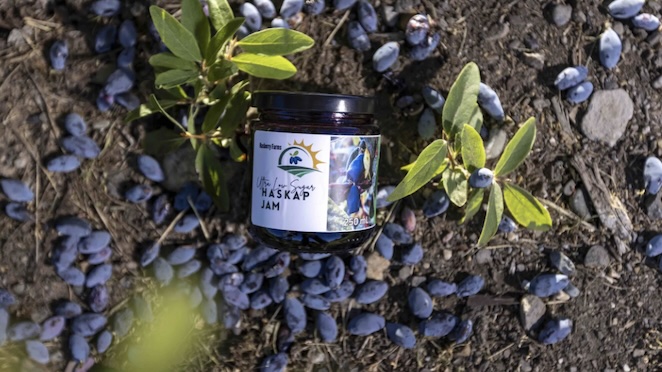
 Haskap berries travel best to more distant markets as jam or juice, but Haspberry Farms in Chetwynd, B.C. use a large specialty freezer – purchased via a BC Hydro Peace Agricultural Compensation Fund grant – to store popular frozen berries for sale months after harvest in July and August.
Our agricultural fund helps B.C. grower reach new markets
Found in the wild in every Canadian province except B.C. and the Yukon, the haskap has always featured juicy berries shaped like elongated purple balloons. But while the native variety's berries looked edible, they were so bitter they were unfit for human consumption.
The haskap still had a lot going for it, however, most notably its ability to withstand Canadian winters and provide nutrition. And in 1998, it experienced a sweet resurrection in the hands of an agricultural researcher at the University of Saskatchewan.
Dr. Bob Bors launched a breeding program that experimented with haskap varieties from Japan and Russia in search of hardier, better-tasting fruit. The university's collection of haskap – the world's largest – has since given birth to commercial haskap businesses across Canada, including Haspberry Farms on the outskirts of Chetwynd, B.C.
Today, the haskap experiments continue, even at the farm level.
"These are Beauty, Beast, and Blizzard, the three Bs," says Kristin Atherton of family-owned, family-run Haspberry Farms, pointing to alternating rows of haskap varieties. "They pollinate each other, and we love them because they taste so good: they're not bitter. Some varieties are here just for pollination, and we don't pick them. We're kind of snobbish about our haskap."
It also turns out there's an art to introducing a customer to the taste of this berry.
"You have to warn people that it's going to be a bit tart," says Atherton, who handles the paperwork for the family business while her job as a Chetwynd high school principal pays the bills. "Tell them that, and they'll love it. It pops in their mouths and their taste buds go ‘wow'. But if you don't warn them, they might be expecting something sweeter, like a blueberry. And most people don't like to be surprised."
If you live in the Peace region of B.C., you're probably familiar with the haskap. You can consider yourself lucky if you've had them fresh or frozen. They even turn up in a craft beer at Mighty Peace Brewing in Fort St. John and at other brewers around B.C., or as jam as far south as Stong's Market on Vancouver's west side.
But the founders of Haspberry Farms – Atherton's parents Norm and Linda Bunker – have a dream to expand the processing of haskap products and potentially their market reach beyond the Peace region. Toward that goal, they've twice been successful in getting funding from our Peace Agricultural Compensation Fund.
In 2020, the fund helped with a $14,727 contribution to maximizing plant growth and production, including the trialing of two types of bird control. And in 2023, they got $50,000 from the fund towards building a commercial processing centre, which helped them build a kitchen and purchase a dedicated freezer for frozen berries that replaced the makeshift use of a refrigerated reefer van.
The $20 million BC Hydro Peace Agricultural Compensation Fund was established as part of our Site C Agricultural Mitigation and Compensation Plan, and it's designed to support agricultural production and related economic activity in the Peace region. A 10-member board oversees the fund and is comprised of six appointees of regional agriculture associations and the Peace River Regional District, plus three at-large members made up of agriculture producers in the region.
Administered by Northern Development Initiative Trust on our behalf, the fund has two intakes per year, with funds being distributed on a bi-annual basis. This past September, the fund contributed $1 million, including $770,000 to the North Pine Farmers Institute's terminal bin storage expansion project, and
$230,000 to seed cleaning plant Optimum Grains for upgrades and an expansion of their fertilizer facility.
By comparison, the scope of operations at Haspberry Farms and the funding they've received is a drop in the bucket. But it means plenty to a family-run farm where two key employees, Norm Bunker and his daughter Kristin, are unpaid workers rewarded not by money, but by the idea that they can spread their love of a healthy, nutritious, and delicious fruit.
"Dad's recovering from hip surgery so can't bend over – but he's still getting around and was making jam earlier today," says Kristin, pausing to think about why the family believes so much in haskap. "It's a super fruit and we really want to produce something that's healthy. I put the frozen berries in my smoothie every morning."
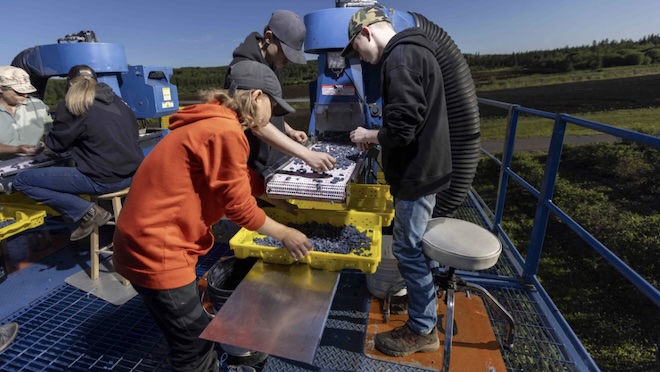 Haspberry Farms is a family-run operation that also offers seasonal jobs to locals, including sales associates paid between $22 to $28 an hour to sell the farm’s products at local markets.
'I think we all just want to see it succeed'
After years of working in the oil and gas industry, in forestry and driving trucks, Norm Bunker figured he'd have a go with haskap farming. A friend suggested it could be the next big thing, and starting in 2018, it became a really big thing to the family.
"Dad got the family involved from the beginning, and I think we all just want to see it succeed," says Kristin. "My dad and my brother are the farmers – I don't like picking them, but I love eating them. My nephews help out and my boys, 8 and 10, want to work on the farm. My mom goes to the Chetwynd farmers' market every week, we have our berries in several stores, and we're happy with that. But look how long it has taken us."
To expand their market, they need to ensure they have full food-safe certification and that their production is set up to send a reliable supply to markets beyond the Peace region. There are signs that may happen – there will be haskap jam in sandwiches served in the Mission School District, jams will be in at least one Vancouver store, and Kristin left bags of frozen berries with the owner of a Vancouver-area chain of stores that sell nutritional supplies and ready-made smoothies.
Haskap farming is not easy, in part because so few people are even aware of what a haskap is. Last year, Vernon-area haskap farmer Amber Stamm'ler of Indigo Family Farm told a local reporter that anyone thinking of farming haskap "should think 100 times before you actually do this". That sentiment isn't lost on Kristin Atherton and her family as they collectively tackle the myriad of challenges in bringing the berries from their farm to your table, but they're proud that what was once a horse pasture is now a source for a bold berry made for Canada.