

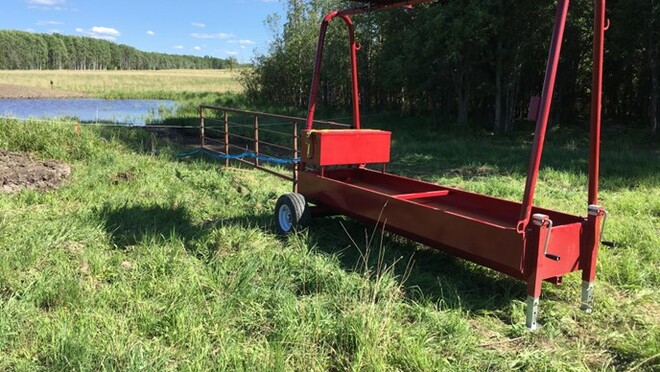
 Rather than risk cattle injuring their legs or infecting their hooves while wading into muddy water ponds at Dead Horse Creek Ranch, the Hedges family recently introduced water buggies that use solar-powered pumps to draw water from ponds known as "dugouts".
Paralympian works with BC Hydro to add innovative cattle-watering system
A four time Paralympian on Canada's wheelchair basketball team, Bo Hedges is part of a family that runs Dead Horse Creek Ranch north of Fort St. John. With funding from our Agricultural Compensation Fund, the ranch has recently added solar-powered water buggies as a safer, more effective way of providing water for grazing cattle on the ranch.
The timing couldn't be better, as recent drought in the Peace Region has made it more difficult for cattle to access drinking water.
The Hedges allow their 300 cattle to roam freely on 2,500 acres of pasture, much of it Crown grazing land they lease from the B.C. government. Human-made watering ponds, known as dugouts, serve as the main supply of drinking water, but as summer rolls on, water levels recede and the animals start to walk further and further into the dugouts in search of water.
And that's where the trouble begins.
"One thing is the water gets dirty — the cows poop and pee in the water, and also drag mud in," says Bo Hedges, who handles a lot of the paperwork for the family ranch. "Cows can get infections that lead to foot rot, and they can twist an ankle as they try to get in and out of this deep mud."
These are not isolated issues. Toss in additional challenges, such as cows on some ranches wading into lakes and streams and damaging riparian areas with their manure and saliva, and the industry long ago realized a pump-and-trough water option could help solve numerous issues. But only recently did someone come up with the idea of powering pumps with solar energy, ideal for watering in areas far away from grid power access.
At Dead Horse Creek Ranch, the Hedges also place solar-powered electric fences around the dugouts to keep the cows out of the mud until they discover the cleaner water in the solar-powered water buggies. After a few years with the buggies — which are built by an increasing number of Canadian companies including nearby ClearFab in Cleardale, Alberta — Hedges says there’s new vegetation thriving around the dugouts, and the water inside them is much cleaner than before.
Instead of having to take 10 or more head of cattle to the vet for various injuries and infections each year, Hedges says that number has been reduced to two or three per year. The ranch produces beef and also sells breeding stock to other ranches, so they need their cattle as healthy as possible.
"When you're doctoring fewer cattle, you're also saving on medicine," says Hedges. "And you're exposing fewer animals to antibiotics. It saves time, money, and the animals are healthier."
The $20 million BC Hydro Peace Agricultural Compensation Fund was established as part of our Site C Agricultural Mitigation and Compensation Plan, and it's designed to support agricultural production and related economic activity in the Peace region.
Dead Horse Creek has purchased the solar water buggies under a matching 50-50 funding arrangement through the Ag Fund, and Hedges recently applied for further funding to add more buggies to the mix. Hedges recently got good news as Dead Horse Creek was named one of three ranches to get funding for solar water buggies — along with Alpoh Farms and Cecil Lake Livestock Association — through the Ag Fund.
In all, 20 projects were approved for a combined $531,315 in funding through the BC Hydro Peace Agricultural Compensation Fund for 2026. Among this year's recipients are:
Franklin & Co. Flower Farm, which received $46,940 for an infrastructure upgrade to expand cut-flower production capacity and improve climate resilience.
Peace Country Stock Dog Association, which will use $5,000 to deliver four practice sessions and one stock dog clinic. Stock dogs are an effective tool for managing livestock.
Whiskey Creek Ranch Ltd., which is getting $20,190 to help funding a project that will equip the farm with a commercial-grade egg washer and dedicated housing unit to improve productivity and reliability. This funding follows an earlier agricultural fund project that allowed the company to increase egg volumes by expanding to 399 laying hens.
See the full release on 2026 Ag Fund recipients.
Related: